What You Can Legally Run Out of a Bay Area Home
Six of the nine Bay Area counties already let you sell meals out of your own kitchen. San Francisco does not, yet. Here is what the caps actually are, county by county, and how home kitchens compare to an ADU or a home office.
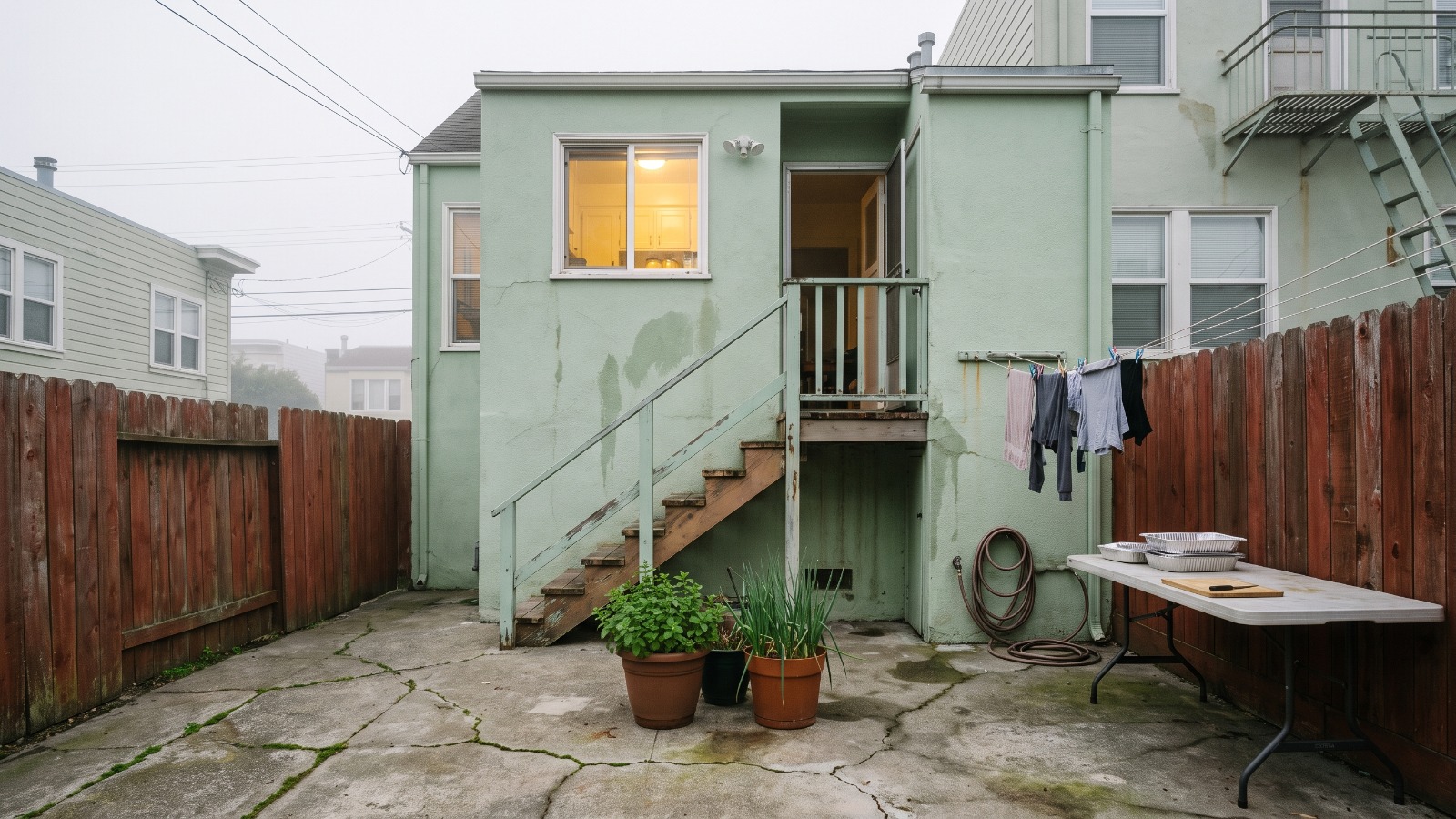
Back stairs and small concrete yard behind a stucco row house in San Francisco's Outer Sunset, the kind of home kitchen a MEHKO permit would cover. Photo: Houseberry
There is a house in the Outer Sunset, the grid of stucco row houses between Golden Gate Park and Sloat Boulevard, with a card table at the bottom of the back stairs. Three foil trays on it, a pickup window written on an index card and taped to the gate. Saturdays, four to seven.
That setup is legal in Hayward, in San Mateo, in Concord and in Petaluma. It is not legal in San Francisco.
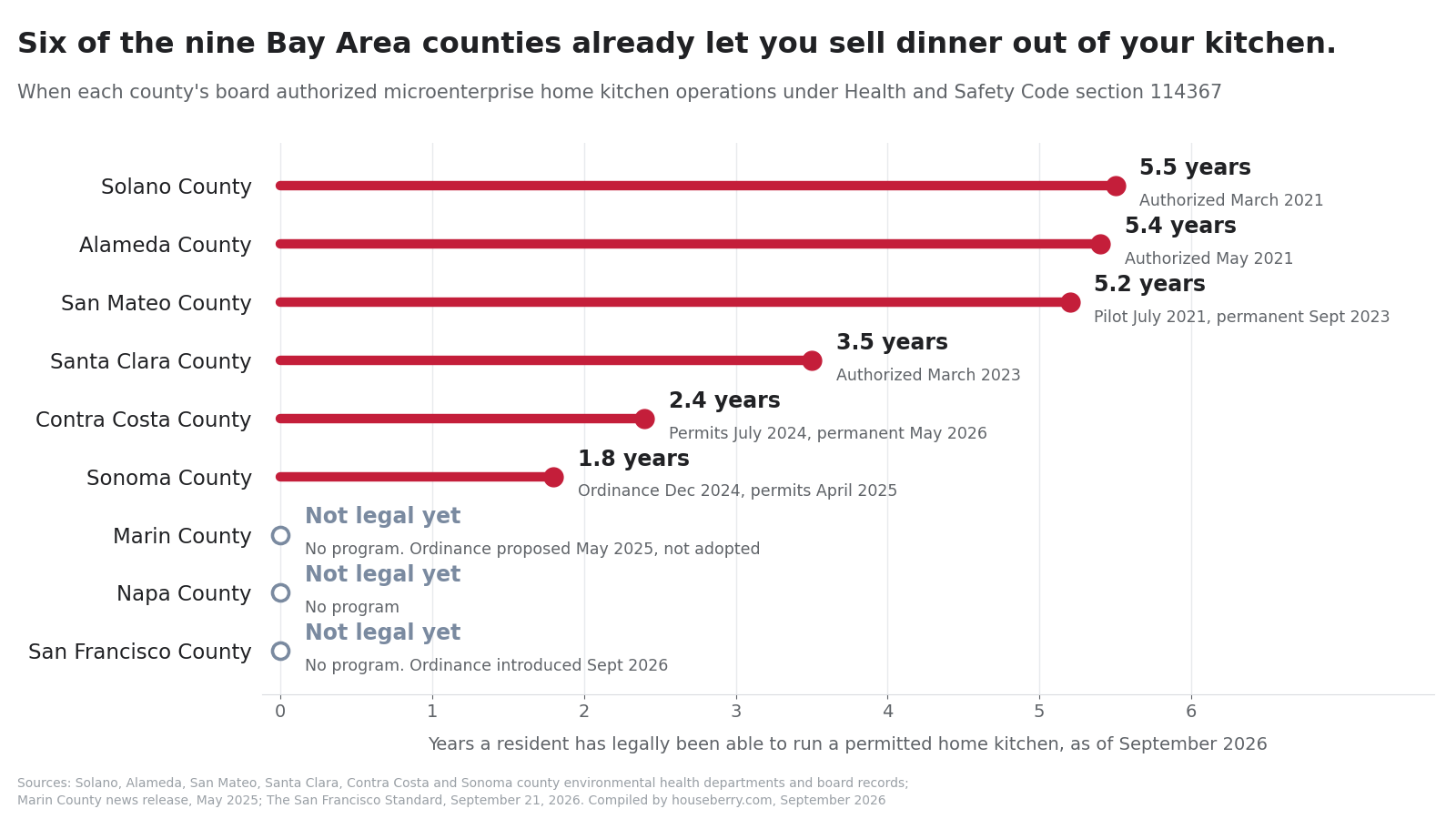
Six of the nine Bay Area counties already permit microenterprise home kitchen operations, the state's term for a permitted food business run out of a private home kitchen. San Francisco is one of the three that do not. Supervisor Jackie Fielder, who represents District 9, introduces an ordinance on Tuesday that would move the city across that line. An ordinance introduced is not an ordinance passed.
Six counties said yes. San Francisco is the hole in the map.
A home kitchen permit exists in state law and nowhere in practice until a county board votes. Health and Safety Code section 114367 lets a county, or a city running its own health department, authorize the permits by ordinance. Until that vote, the permit does not exist where you live.
The Bay Area voted in no particular order. Solano went first in March 2021, Alameda in May. San Mateo County piloted from July 2021 and made it permanent in September 2023. Santa Clara County approved a pilot in March 2023. Contra Costa began issuing permits in July 2024 and made the program permanent on May 12, 2026. Sonoma County adopted its ordinance in December 2024 and began permitting the following April.
That leaves three. Napa never opted in. Marin put an ordinance on its board calendar in May 2025 and then pulled it to a later date, where it has stayed. And San Francisco has never had a program at all.
Fielder's ordinance would close the gap. The San Francisco Standard reported that it comes with the usual machinery attached: a health department inspection, food handler certification, and written landlord approval for anyone renting. The Standard puts the statewide count at roughly 1,200 permitted operations, 97 percent of which drew no complaint between 2019 and 2024.
The caps are the whole design
These programs pass because the ceiling is low on purpose. Health and Safety Code section 113825 limits a home kitchen to 30 individual meals a day and 90 a week, and to one full-time-equivalent employee who is not a household member. Food goes directly to the person eating it, never to a wholesaler or retailer.
The money cap is the one people get wrong. The statute says $100,000 in gross annual sales, adjusted yearly for inflation, and the California Department of Public Health set the adjusted figure at $107,121 effective January 1, 2025. That is gross, not profit, and it is why 90 meals a week binds before the dollar limit does. Sell 90 meals at $18 and you gross about $84,000 a year before you buy a single onion.
Renting does not disqualify you, but your landlord gets a vote, because the programs require written permission. The permit is not free either. Alameda charges $696 a year, San Mateo $1,108.
The ADU is the bigger number, and the harder one
A second unit beats a kitchen by an order of magnitude, and costs an order of magnitude more to start.
We have been through the current rules in detail, so here is the short version. California's 2026 ADU laws cut fees on small units, put a 15-business-day clock on permit completeness reviews, and dropped owner-occupancy for junior ADUs with their own bathroom. AB 956 would push cities to ministerially approve two detached units on a single-family lot instead of one. It was on the Governor's desk as of early September.
The catch is the same one we ran into in Mill Valley: a detached ADU runs about $450 a square foot in Marin, roughly $360,000 for 800 square feet. At $3,000 a month that is a ten-year payback before maintenance, vacancy or the loan. A home kitchen costs a permit fee and a weekend. An ADU is a construction project with a mortgage attached.
The Bay Area home business rule almost nobody reads
Underneath both sits an older layer, and it is the one that trips people up: the home occupation rules in your city's planning code.
San Francisco's version is typical. Its guide to home-based businesses says you cannot have clients coming to the home, cannot have employees who do not live there, cannot advertise on the building, and cannot use more than one third of the floor area commercially. Piedmont is stricter still. Its home occupation permit costs $100, allows exactly one room and not the garage, and bans outside employees and customer visits outright.
Read those lists against a home kitchen and the tension is obvious. A permitted home kitchen is, by design, a business where a stranger comes to your door to collect dinner. Any city adding one has to square that with its own planning code, a separate question from the health permit.
| Route | What it lets you sell | The cap or limit | Where it applies |
|---|---|---|---|
| Permitted home kitchen (MEHKO) | Hot meals cooked and sold the same day, direct to the person eating them | 30 meals a day, 90 a week, and $107,121 in gross annual sales as of January 1, 2025. One non-household employee | Alameda, Contra Costa, San Mateo, Santa Clara, Solano and Sonoma counties. Not Marin, Napa or San Francisco |
| ADU rent | A separate legal dwelling, leased to a tenant | No state cap on the rent. Cities may still require leases of 30 days or longer. Build cost of roughly $250,000 to $500,000 for a detached unit | Any residential lot in California, under state ADU law plus local development standards |
| Home occupation permit | An office, a trade or a service run from inside the house | No customers at the door and no non-resident employees in most cities. San Francisco caps commercial use at one third of the unit's floor area | Set city by city. Piedmont charges $100 and allows one room, not the garage |
Three routes, three very different ceilings. Only one is a construction project.
How to think about this if you actually own the house
Start with what the house physically allows, then with what your county and city allow. A kitchen with a back entrance and somewhere for a car to pull over is a candidate for one thing. A flat rear yard is a candidate for another.
Where this shows up in a purchase decision is smaller than the headlines suggest. A permitted home kitchen will not move an appraisal. What it changes is how many ways a block can work for the person living on it, which is part of how we look at neighborhoods at Houseberry. The Outer Sunset is a fair example. Median sale price about $1.73 million in August 2026 against a citywide median near $2.2 million, and a 4.2 out of 5 overall score that ties for the top of the 92 San Francisco neighborhoods we rank. It is also block after block of single-family stock with real kitchens and real back stairs, the precondition for any of this.
Here is the caveat I would want a friend to hear first. A home business is not a mortgage strategy. Ninety meals a week at a realistic margin is grocery money, not a second income that changes what a lender will hand you. Underwriters generally want a two-year track record before self-employment income counts toward a loan at all. Buy the house you can afford on the income you already have, and treat the kitchen as an option it happens to come with.
And if you live in San Francisco, Marin or Napa, the honest answer today is that you cannot do it legally at all. Fielder's ordinance gets introduced Tuesday, then goes to committee, then to the full board. Watch the committee calendar, not the press release.
Sources
The San Francisco Standard, “Selling tacos from your backyard could soon be legal in San Francisco,” September 21, 2026
California Health and Safety Code section 113825, definition and limits for microenterprise home kitchen operations
California Health and Safety Code section 114367, local authorization of microenterprise home kitchen operations
California Department of Public Health, Microenterprise Home Kitchen Operation Adjusted Gross Annual Sales Limit, effective January 1, 2025
County of Santa Clara Department of Environmental Health, microenterprise home kitchen operations permit page
San Mateo County Health, Microenterprise Home Kitchen Operations program page
Sonoma County Department of Health Services, Environmental Health, MEHKO program page
Alameda County Health, Environmental Health Department, MEHKO program page
Local News Matters, “Contra Costa County expands opportunities for home-based cooks, food entrepreneurs,” May 12, 2026
County of Marin news release, “Microenterprise Home Kitchen Ordinance Proposed to Assist Individual Entrepreneurs,” May 1, 2025
Solano-Napa Small Business Development Center, MEHKO Solano program page
SF.gov, “Guide to opening a home-based business”
City of Piedmont, home occupation permit page
Houseberry, San Francisco neighborhood rankings, city guide and Outer Sunset neighborhood page, retrieved September 21, 2026
Map of San Francisco Neighborhoods
Loading map...
View Full Map
Top Neighborhoods in San Francisco, CA


All information provided on this website including but not limited to - school ratings, safety, amenities, user opinions, and property data - is for general informational purposes only. We do not guarantee its reliability, accuracy, or completeness. Users should independently verify information and consult appropriate professionals as needed. By using this website, you agree Houseberry is not responsible for actions, decisions, or consequences arising from reliance on the information provided
houseberry.com - CA DRE# 01847391
 Bay East ©2025. CCAR ©2025. bridgeMLS ©2025. Information Deemed Reliable But Not Guaranteed. This information is being provided by the Bay East MLS, or CCAR MLS, or bridgeMLS. The listings presented here may or may not be listed by the Broker/Agent operating this website. This information is intended for the personal use of consumers and may not be used for any purpose other than to identify prospective properties consumers may be interested in purchasing. Data last updated at September 21, 2026 12:00 AM