Oakland has $532 million in voter bonds it hasn't sold yet
Oakland wants to sell up to $300 million of its unsold Measure U, KK and DD bonds in March. Where the money goes, what housing gets, and what the bond tax costs on a typical Oakland home.

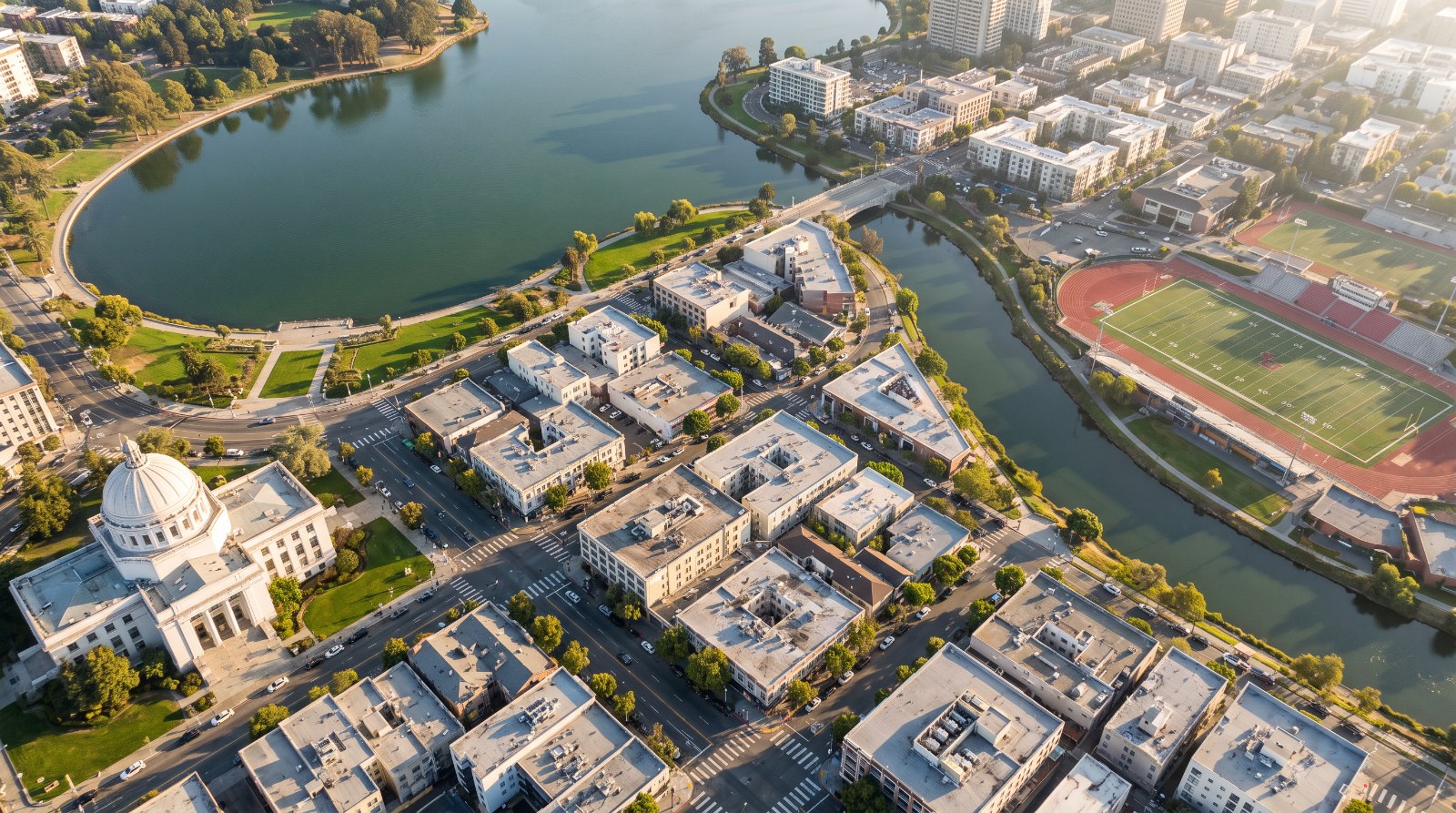
AI-rendered oblique aerial view of the south end of Lake Merritt in Oakland, with the 12th Street shoreline, the Lake Merritt Channel, Laney College and the Alameda County Courthouse Photo: Houseberry
Oakland voters said yes to $1.65 billion in city bonds across three elections, in 2002, 2016 and 2022. The city has borrowed $1.12 billion of it. The rest, exactly $532,020,000, is still unsold, and a new ordinance headed to the City Council would let Oakland sell all of it, starting with up to $300 million in March.
You are already paying for the part that was sold. On a home bought at Oakland's typical price, which Houseberry data puts at about $927,000 in September 2026, the city's bond tax worked out to roughly $405 a year at the latest audited rate, less than many owners guess.
This is a story about Measure U, the $850 million housing and infrastructure bond that 75 percent of voters passed in November 2022. Four years later it is 45 percent sold. The March sale would push it to about 76 percent, and the split shows what City Hall wants first: streets get $125.3 million, housing gets $50 million.
Where the March money goes
Finance Director Bradley Johnson laid out the plan in an Oct. 5 agenda report for the Finance and Management Committee, which takes it up Oct. 27. The ordinance does not sell a single bond by itself. It authorizes the city to sell the remaining bonds over several years, and each sale still needs its own Council resolution naming the projects.
The first of those sales has a project list already penciled into the budget the Council adopted June 12:
| Measure | What it pays for | Planned amount |
|---|---|---|
| U | Streets, sidewalks and related infrastructure | $125,315,000 |
| U | City facilities | $81,460,084 |
| U | Affordable housing | $50,000,000 |
| KK | City facilities | $12,720,500 |
| DD | Waterfront trails at Estuary Park | $6,000,000 |
Streets win by a wide margin. The report ties the money to Oakland's 2022 Five-Year Paving Plan and to the 25-year federal consent decree that requires the city to fix inaccessible sidewalks, curb ramps and crosswalks. That last one is not optional.
The $6 million from Measure DD is a reminder of how long this takes. DD was the 2002 bond that rebuilt the edges of Lake Merritt and the 12th Street crossing. Twenty-four years later, $35.8 million of it has never been sold. Only $2 million of the Estuary Park money is in the current budget, and staff will ask for the other $4 million when the project resolution comes back.
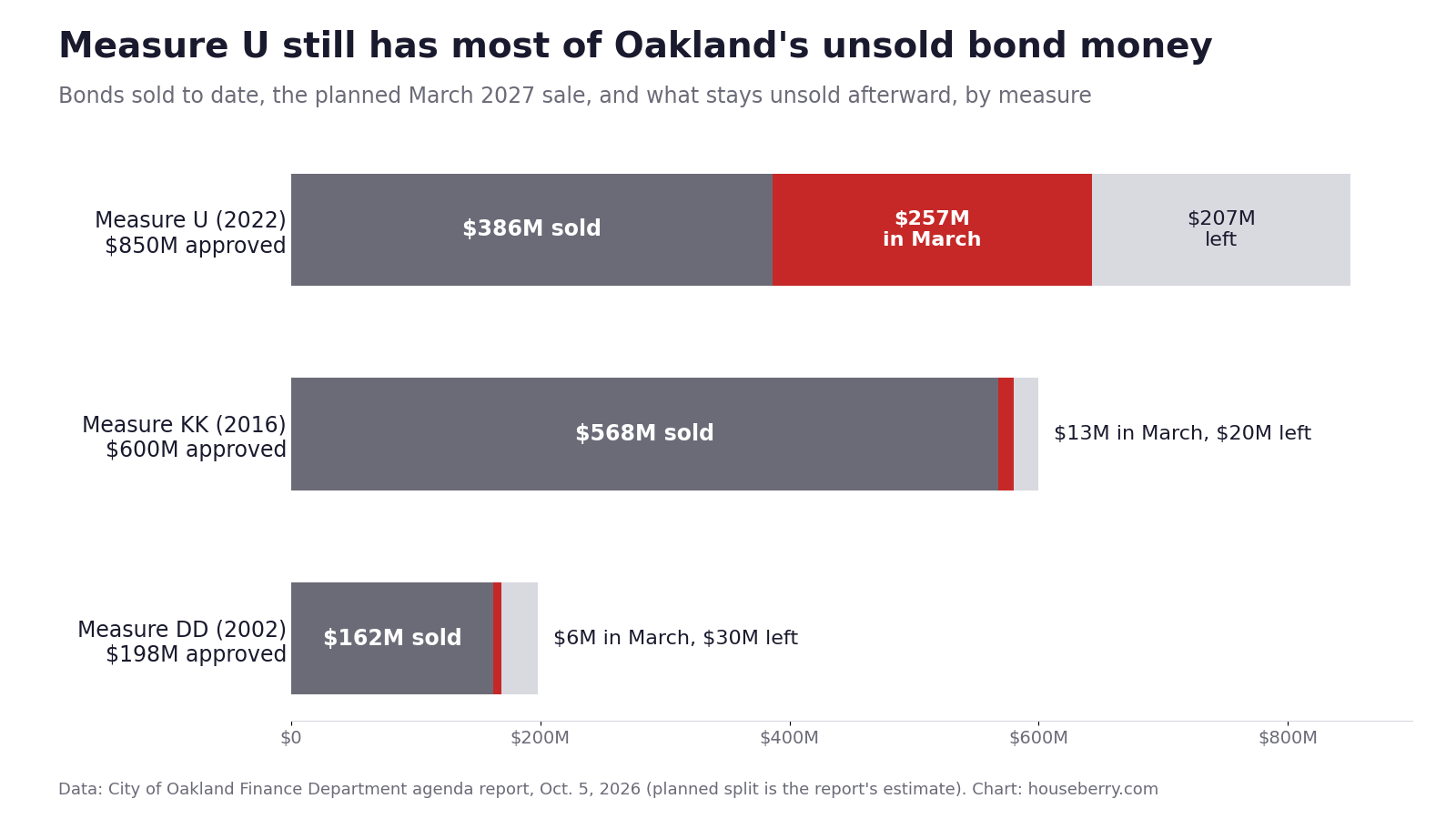
What Measure U has already paid for
The housing money has moved in two batches. The 2023 sale carried $68.4 million labeled for housing. The December 2025 sale, which the city said drew $638 million in orders from 26 firms, included about $181 million for housing according to the San Francisco Chronicle. That list named $30 million to buy and preserve existing affordable buildings and $33 million for the Mandela transit village at West Oakland BART.
The same December sale put $50.5 million into street resurfacing, $28 million into Liberation Park in East Oakland and $10 million into the Oakland Ice Center.
Output is showing up. The city's housing department reported in its 2025 impact report that 603 affordable homes were finished in 2025, 110 of them for formerly unhoused residents, and that more than 1,600 more are expected to start construction in 2026. In December 2025 it awarded $63.5 million, largely Measure U money, to five developments with 325 homes. Its preservation program kept 48 units affordable in 2025, including a cooperative at 1432 12th Avenue and a building at 1534 29th Avenue.
Some of that pace was slow by choice. In 2022 the city told voters it would time new bond sales so the tax rate would not climb, waiting for old bonds to be paid down or property values to rise. Credit downgrades and budget trouble slowed things further. By April 2025 the group Empower Oakland was publicly accusing the city of holding Measure U bonds hostage.
What the next $50 million can build
Use the December awards as the yardstick. $63.5 million for 325 homes works out to about $195,000 of city money per home, with state and federal sources covering the rest. At that rate, $50 million is about 256 more affordable homes.
Now add up the housing slice. Roughly $68 million in 2023, about $181 million in 2025 and $50 million in March comes to about $299 million of the $350 million voters set aside. That would leave about $51 million for every future housing round.
We would sell the bonds, and we would put more of them into housing. The city expects 1,600 affordable homes to start construction in 2026, the next projects in line will need city money to close their financing, and $50 million is the smallest housing slice of any Measure U sale so far. Streets have a federal court order behind them. Housing should not have to wait for one.
What the bonds cost on your tax bill
Bond debt shows up on an Alameda County tax bill inside the line labeled "City of Oakland 1," which also carries the old 1981 police and fire pension tax. Oakland's audited financial report splits the two. The bond part was 0.0076 percent in 2015-16, rose to 0.0552 percent in 2023-24 and fell back to 0.0440 percent in 2024-25.
That 0.0440 percent covers every outstanding city bond, DD, KK and U together. It is about 62 percent of what Measure U alone was estimated to cost when it went on the ballot.
The tax is charged on assessed value, not market value. Under Proposition 13 a recent buyer's assessed value is close to the purchase price, while a longtime owner's is often far lower. So the table below fits someone who bought at today's prices. It uses Houseberry's September 2026 neighborhood medians, subtracts the $7,000 homeowner's exemption and applies the 2024-25 rate. Rockridge, the priciest on the list, comes out near $990 a year. Havenscourt, in the East Oakland flats, comes out near $244.
| Place | Typical price, Sept. 2026 | City bond tax per year | At the 2022 Measure U estimate |
|---|---|---|---|
| Rockridge | $2,257,682 | $990 | $1,598 |
| Crocker Highlands | $2,059,665 | $903 | $1,457 |
| Temescal | $1,099,963 | $481 | $776 |
| Oakland citywide | $927,424 | $405 | $654 |
| Grand Lake | $722,227 | $315 | $508 |
| Havenscourt | $562,363 | $244 | $394 |
| Fruitvale Station | $537,233 | $233 | $376 |
Two forces will move that number. New sales add debt service, and the city's borrowing costs are not cheap: the taxable bonds that fund housing priced at 5.55 percent in December, against 3.99 percent for tax-exempt ones. Pulling the other way, the 1981 pension tax is nearly paid off. It was cut to 0.0705 percent in 2024-25, and an explainer posted on the Alameda County treasurer's site cites a city estimate of 0.0044 percent for 2026-27. On a $920,000 assessment that drop alone is worth about $600 a year, more than the whole bond line.
What to check before March
The committee vote is Oct. 27. The Council holds first and second readings Dec. 1 and Dec. 15. The real fight is Feb. 2, 2027, the tentative date for the resolution that names each project, because that is the last point where the $50 million housing figure can grow. Bonds would be priced the week of March 1 and close the week of March 15.
If you own in Oakland, find your assessed value on your county tax bill and multiply it by 0.00044 to see your current bond cost. Then look up your neighborhood on Houseberry's Oakland rankings, or find your street on the Houseberry map, before Feb. 2 decides which streets and buildings get this round of money.
Sources
- City of Oakland Finance Department, General Obligation Bond Measures DD, KK, and U Remaining Authorization, Oct. 5, 2026.
- City of Oakland, Annual Comprehensive Financial Report, fiscal year 2024-25, Schedule 7.
- City of Oakland, Oakland Successfully Issues $334M in Bonds, Dec. 9, 2025.
- Oakland Housing and Community Development, 2025 Annual Impact Report.
- City of Oakland, Measure U frequently asked questions.
- The Oaklandside, Housing on the Oakland ballot, Oct. 24, 2022.
The Houseberry Research Team is Houseberry's reporting team: Bay Area real estate analysts, data specialists and longtime local market watchers. Every day we check the public record: building permits, city council and planning agendas, county recorder filings, state housing bills, police incident data and school results. Then we tie each story to what it means for specific neighborhoods, using Houseberry's own neighborhood data on prices, appreciation, safety, schools and amenities. Questions or corrections: Contact us.
Map of Oakland Neighborhoods
Loading map...
View Full Map
Top Neighborhoods in Oakland, CA




All information provided on this website including but not limited to - school ratings, safety, amenities, user opinions, and property data - is for general informational purposes only. We do not guarantee its reliability, accuracy, or completeness. Users should independently verify information and consult appropriate professionals as needed. By using this website, you agree Houseberry is not responsible for actions, decisions, or consequences arising from reliance on the information provided
houseberry.com - CA DRE# 01847391
 Bay East ©2025. CCAR ©2025. bridgeMLS ©2025. Information Deemed Reliable But Not Guaranteed. This information is being provided by the Bay East MLS, or CCAR MLS, or bridgeMLS. The listings presented here may or may not be listed by the Broker/Agent operating this website. This information is intended for the personal use of consumers and may not be used for any purpose other than to identify prospective properties consumers may be interested in purchasing. Data last updated at October 21, 2026 12:00 AM