Menlo Park risks a $6.65 million fine over the old Sunset campus
A developer is suing Menlo Park to force approval of 665 homes at the former Sunset Magazine campus. What by right approval means, and why the Marina Safeway and Woodland Hills fights turn on the same fine print.

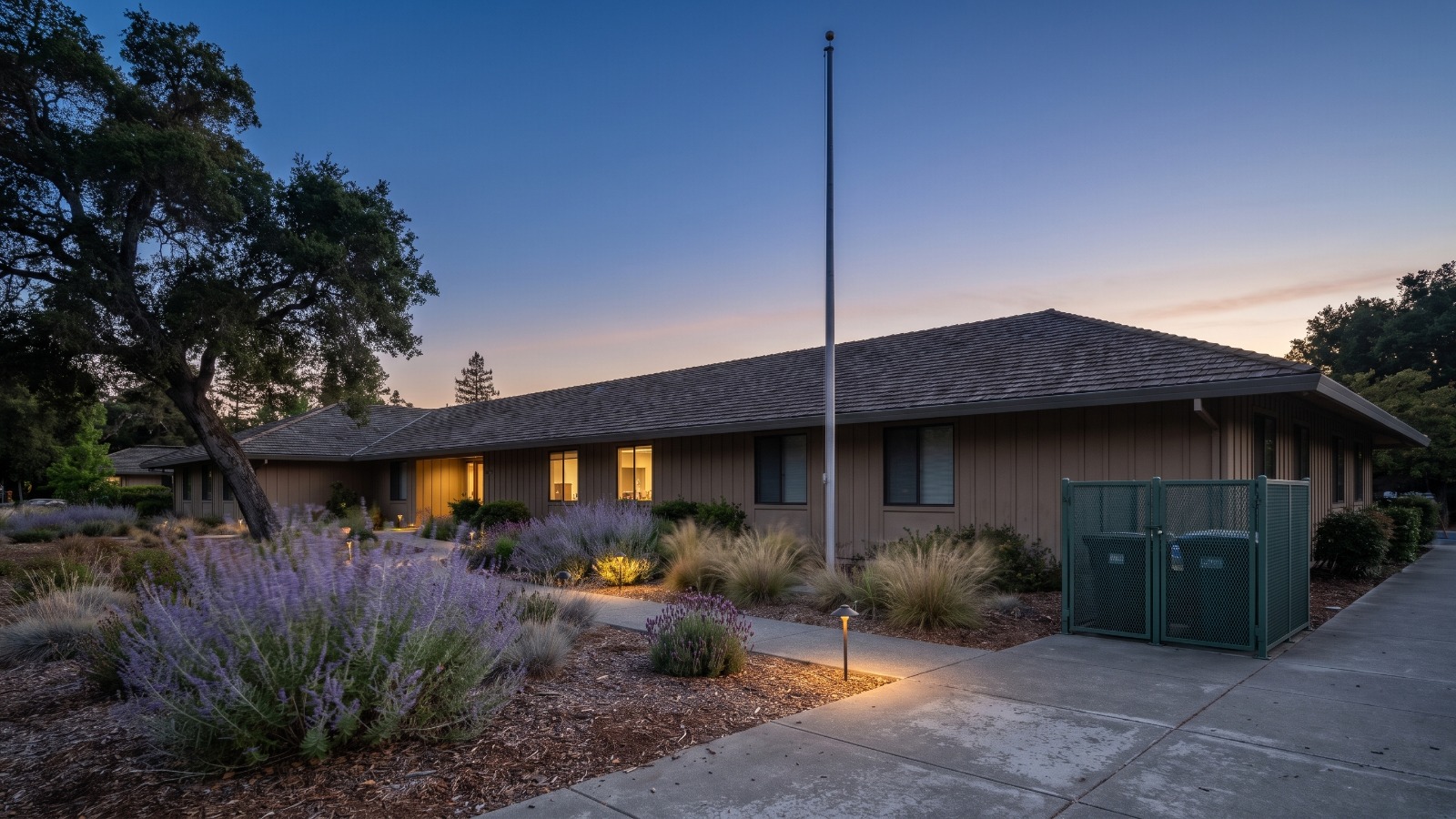
AI-rendered view of the former Sunset Magazine campus at 80 Willow Road in Menlo Park at blue hour, the site of the proposed Willow Park towers Photo: Houseberry
The old Sunset Magazine campus at Willow Road and Middlefield is still what it was in 1951. Low ranch buildings, deep eaves, a garden of lavender and grasses, San Francisquito Creek running along the back. A developer wants to put 665 homes there, in buildings 301 to 458 feet tall.
The fight over 80 Willow Road is no longer about whether California can make a city approve housing. The argument is over a creek bank, a hotel, and which of the city's objections arrived on time. The answer could cost Menlo Park at least $6.65 million.
This is a story about the fine print in California's fast-track housing laws, and why the biggest housing fights in the Bay Area now turn on it. The San Francisco Standard put it plainly on October 20: opponents lost the big arguments, so they are fighting over definitions. The campus sits in Linfield Oaks, where the typical home sold for about $2.98 million in September 2026, according to Houseberry's Linfield Oaks data. For anyone who owns near a strip mall, a parking lot or an office park, the same rules apply to your block.
What "by right" approval actually means
AB 2011, a 2022 state law in effect since July 2023, lets apartments go on land zoned for offices, shops or parking. If a project meets the city's objective standards and the law's conditions, approval is ministerial, as Nossaman's summary of the law explains. That word carries the whole story. A planner checks the plans against written rules, the way a building inspector checks a wiring diagram. There is no public hearing, no council vote and no environmental review that neighbors can appeal.
The conditions are where every fight now lives. At least 75 percent of the site's edge has to touch "urban uses," meaning developed land. The site cannot be wetlands or protected habitat. Mixed-income projects must set aside a share of homes for lower-income households, 15 percent in the common rental version, and pay construction workers prevailing wages. For a project over 150 homes, the city has 90 days to list every rule the plans break. A rule it fails to flag in time is treated as met.
AB 712, which took effect in January, put money behind those deadlines. If the Attorney General or the state housing department warns a city in writing and the city does not fix the problem within 60 days, a developer who later wins in court collects attorney's fees and the court must fine the city $10,000 per home, according to Holland & Knight's review of the 2026 housing laws.
So for a neighbor, the leverage moved. Before 2023 it was the microphone at a planning commission hearing. Under AB 2011 it is the city's rulebook, written before any application arrives, and the 60 or 90 days the city gets to use it.
Willow Park: five lists in 15 months
The city's own timeline, posted on its 80 Willow Road project page, tells most of the story. N17 Development filed a preliminary application on December 7, 2023, and the full one on May 24, 2024. The city deemed it complete on November 14, 2024. Then it sent findings of inconsistency on January 13, 2025, May 6, 2025, November 7, 2025, February 12, 2026 and April 13, 2026. On May 6, 2026, it reaffirmed that the project does not qualify for AB 2011 at all.
That is five lists of problems in 15 months on a law that gives a city 90 days.
On July 29, Attorney General Rob Bonta's office sent the city a 10-page notice. We read it, in the copy the Palo Alto Daily Post published with the developer's demand letter. Its central line is that the city "cannot change its rationale" for finding the project ineligible. It also says Palo Alto's Creekside Park next door counts as an urban use, that the hotel does not disqualify the project because the developer locked in the older rules, and that the city cannot bill the developer for its lawyers. The developer says that bill came to $302,938.
Menlo Park answered on October 1 in a letter from City Manager Justin Murphy. Its case is specific.
About 61 percent of the site's edge borders San Francisquito Creek, which is not developed land. Creekside Park is conservation land. A hotel cannot ride on housing protections. Offices and parking are not principally permitted uses in the site's C-1 zone. The city also says the Attorney General's office met with staff for one hour on July 28, the day before the notice, and asked nothing about the project itself.
The next day N17 sued. We read the complaint the city posted. It asks a judge to order approval, refund the legal fees and impose fines of at least $6,650,000. Paragraph 4 says the city "is not permitted to say no to the Project." From the first filing to that lawsuit took 1,030 days.
We think the city is on the wrong side of the timing argument.
The creek question is a real one, and a judge could accept the city's 61 percent figure. But AB 2011 gives a city 90 days to list a large project's problems so a builder hears every objection once, early. A city still finding new reasons in April 2026, 17 months after it called the application complete, is doing what the law was written to stop, whatever one thinks of a 458-foot tower beside San Francisquito Creek.
The honest trade-off in Linfield Oaks
The objections deserve a fair hearing. Linfield Oaks is a neighborhood of 1950s ranch houses and big yards, scored 4.1 out of 5 overall and eighth of 15 Menlo Park neighborhoods on Houseberry's Menlo Park ranking. Its typical price rose about 4.6 percent in a year, from about $2.85 million in October 2025 to about $2.98 million in September 2026, by Houseberry's price history. Across Middlefield Road, The Willows ran about $3.08 million in September. The tallest building, at 458 feet, would rise over streets of mostly one- and two-story houses.
There are doubts about whether the project can be built at all. A Keyser Marston memo attached to the city's letter calls it financially infeasible with or without city fees. Rep. Sam Liccardo has raised questions about the property's owner. The former magazine headquarters is listed on the California Register, and demolishing it is part of the plan.
And the fine is paid by residents. At $6.65 million and about 32,000 people, it works out to roughly $208 a person.
The other side of the ledger is a city that has reached about 40 percent of its 2023 to 2031 housing target, and under 20 percent for very low-income homes, according to KQED. One approval at 80 Willow Road would cover about a fifth of the whole eight-year target.
The Marina and Woodland Hills are the same fight
Menlo Park is one of three big sites where the argument has narrowed to definitions.
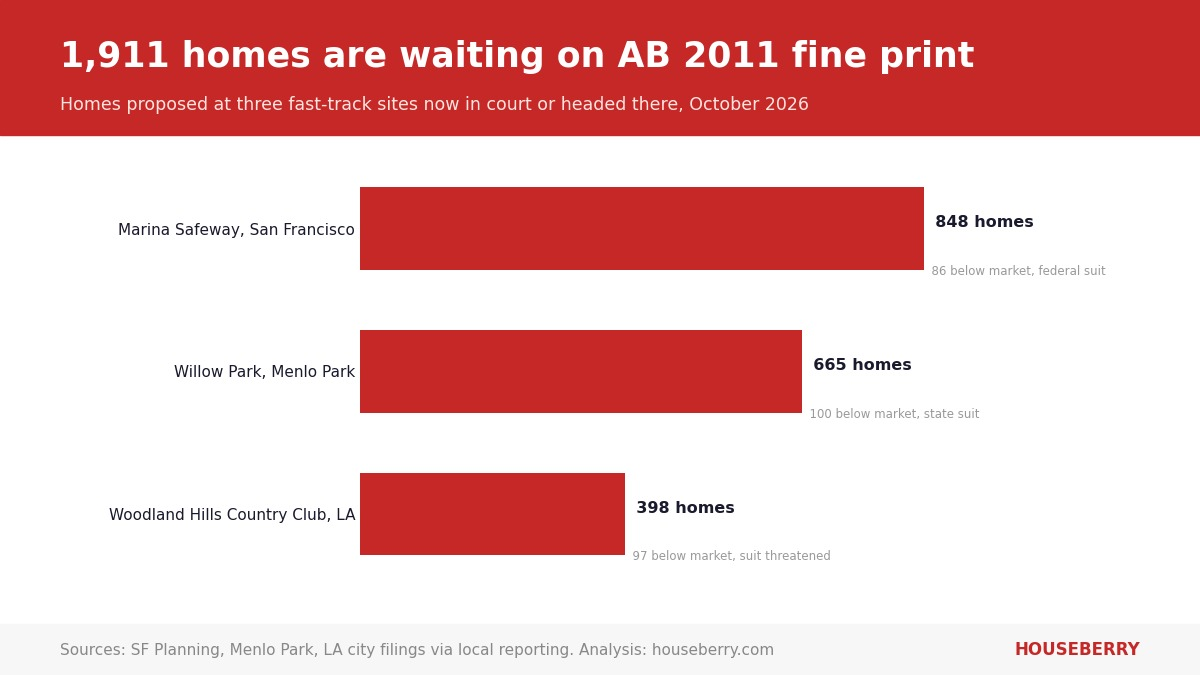
At the Marina Safeway, 15 Marina Boulevard in San Francisco, Align Real Estate plans 848 apartments in towers of 22 and 18 stories, 86 of them below market. In September the YesAND Foundation, Neighborhoods United SF and Marina residents filed a federal suit against the city, PG&E and the developer, as KQED reported. They argue Fort Mason and other neighbors do not count as urban uses, and that the city skipped a contamination assessment on the site of an old gas works. Their lawyer, Stu Gross, told the Standard the laws should be applied "as written."
We have covered the contamination question and the fake car-free park flyers separately. The Marina's typical home sold for about $2.57 million in September 2026, according to Houseberry's Marina data.
At the Woodland Hills Country Club in Los Angeles, the owner wants 398 homes on about 20 of the club's 93 acres at 21150 Dumetz Road. Los Angeles planners found the golf course is mountain lion habitat, which keeps the project off the AB 2011 fast track, the Westside Current reported. The City Council then voted unanimously to rezone the land. The developer's representative has said a lawsuit is likely.
| Site | Homes | Below market | The fine-print question | Where it stands |
|---|---|---|---|---|
| Willow Park, Menlo Park | 665 | about 100 | Does a creek edge count as developed land, and did the city raise objections in time? | State suit filed October 2, decision expected December 19 |
| Marina Safeway, San Francisco | 848 | 86 | Do Fort Mason and the harbor count as urban uses, and was contamination assessed? | Federal suit filed in September |
| Woodland Hills Country Club, Los Angeles | 398 | 97 | Is a golf course protected mountain lion habitat? | Fast track blocked, suit threatened |
Read across the rows and the pattern is plain. Two of the three turn on what borders the site: a creek in Menlo Park, Fort Mason in the Marina. Two turn on habitat or wetlands. None of the 1,911 homes is being fought on whether the region needs them.
What to check before December 19
If you own near a commercial lot, find out whether your city's design and height rules are written as objective standards. Under AB 2011 those written rules are the only thing a planner can apply, and they cannot be added after an application arrives. If your city has a project like this in the pipeline, the dates that matter are the city's 60 or 90 day deadline to list problems and any state warning letter, which starts AB 712's 60-day clock.
In Menlo Park, Sonja Trauss of YIMBY Law said in the Standard's story that when developers sue now, it is "hugely expensive for the city." The court is scheduled to hear the case in mid-November and rule on December 19, and the ruling will tell every Bay Area city how much a late objection costs. Before then, see how Linfield Oaks and the other 14 neighborhoods compare on our Menlo Park neighborhood ranking.
Sources
- San Francisco Standard: NIMBYs lost the big arguments. Now they're fighting over fine print, October 20, 2026
- KQED: Menlo Park could face millions in fines in housing fight, October 6, 2026
- City of Menlo Park: 80 Willow Road project page, timeline and documents
- Attorney General's July 29, 2026 notice and the developer's August 3 demand, via the Palo Alto Daily Post
- Willow Project LLC v. City of Menlo Park, petition dated October 2, 2026
- The Almanac: State backs controversial skyscraper proposal at old Sunset Magazine campus, August 4, 2026
- KQED: San Francisco housing group files lawsuit opposing Marina Safeway project, September 2026
- Westside Current: Wildlife ruling stalls 398 homes planned at Woodland Hills Country Club, September 7, 2026
- Holland & Knight: California's 2026 housing laws
- Houseberry neighborhood data for Linfield Oaks, The Willows and the Marina, October 2026
The Houseberry Research Team is Houseberry's reporting team: Bay Area real estate analysts, data specialists and longtime local market watchers. Every day we check the public record: building permits, city council and planning agendas, county recorder filings, state housing bills, police incident data and school results. Then we tie each story to what it means for specific neighborhoods, using Houseberry's own neighborhood data on prices, appreciation, safety, schools and amenities. Questions or corrections: Contact us.
Map of Menlo Park Neighborhoods
Loading map...
View Full Map
Top Neighborhoods in Menlo Park, CA


All information provided on this website including but not limited to - school ratings, safety, amenities, user opinions, and property data - is for general informational purposes only. We do not guarantee its reliability, accuracy, or completeness. Users should independently verify information and consult appropriate professionals as needed. By using this website, you agree Houseberry is not responsible for actions, decisions, or consequences arising from reliance on the information provided
houseberry.com - CA DRE# 01847391
 Bay East ©2025. CCAR ©2025. bridgeMLS ©2025. Information Deemed Reliable But Not Guaranteed. This information is being provided by the Bay East MLS, or CCAR MLS, or bridgeMLS. The listings presented here may or may not be listed by the Broker/Agent operating this website. This information is intended for the personal use of consumers and may not be used for any purpose other than to identify prospective properties consumers may be interested in purchasing. Data last updated at October 21, 2026 12:00 AM