A fenced Mountain View industrial lot could become 36 rowhomes
Prometheus wants to replace a parking lot and light-industrial building on San Rafael Avenue with 36 for-sale rowhomes, nine below market. Here is what would go up, who the cheaper homes are for and what neighbors lose.

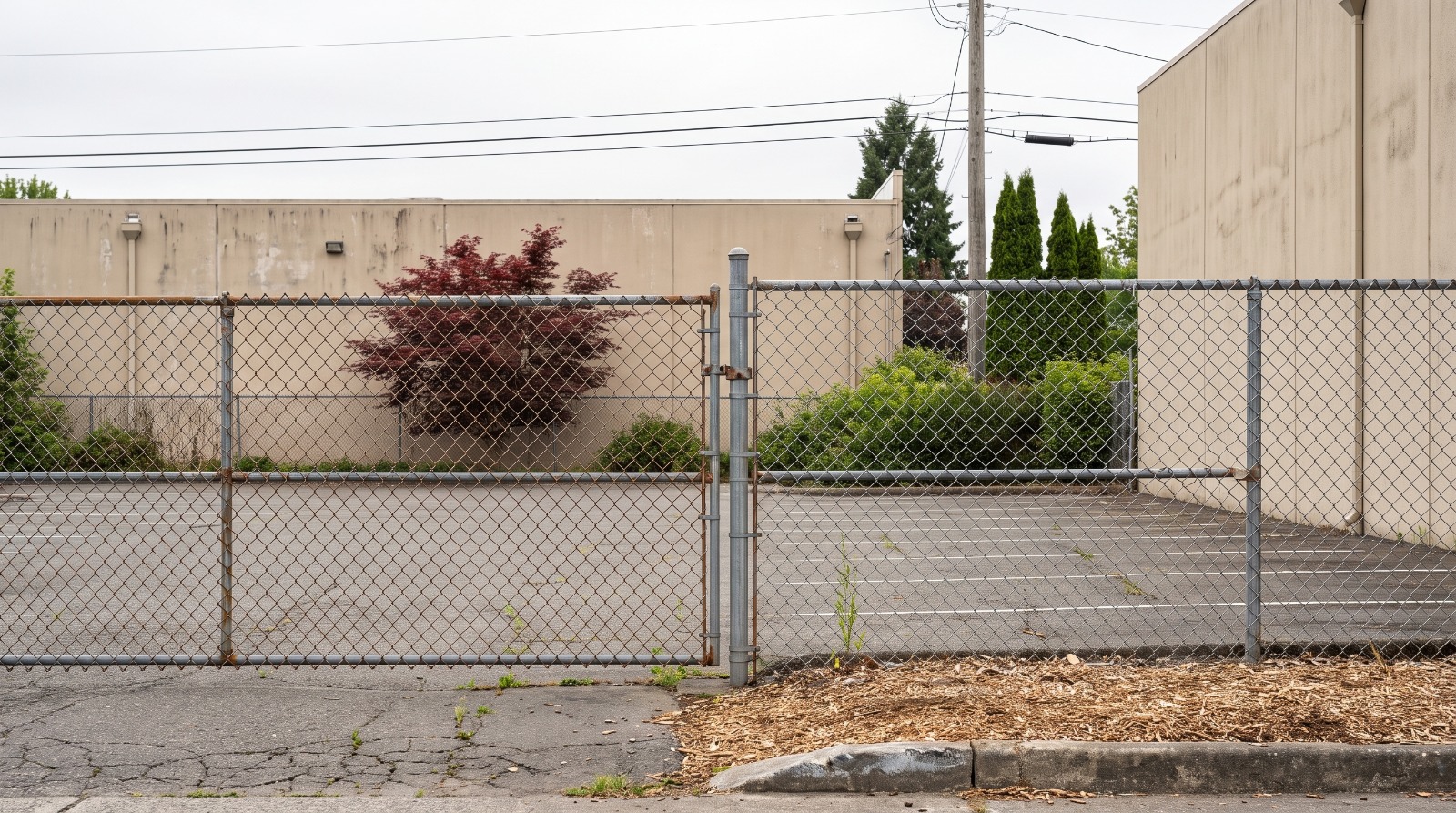
AI-rendered view of the fenced, empty parking lot at 940 San Rafael Avenue in Mountain View, with the light-industrial building behind it, as it looks today Photo: Houseberry
Halfway down San Rafael Avenue, between Terra Bella Avenue and San Pablo Drive, a chain-link gate closes off an empty parking lot. Behind it sits a low beige light-industrial building. Prometheus Real Estate Group wants to replace both with 36 three-story rowhomes, and on Wednesday, October 21, Mountain View's Environmental Planning Commission will be asked to send the plan to the City Council with a yes.
These would be for-sale homes from a company better known in Mountain View for big apartment buildings, and nine of the 36 would sell below market. The site sits in Moffett-Whisman, where the typical home was worth about $1.45 million in September 2026, according to Houseberry's price history, down from $1.52 million in October 2025.
We think the commission should approve it.
A 1.80-acre industrial lot backed up against four one-story homes on San Pablo Drive is a poor place for a warehouse and a good place for townhouses, and this plan does most of what the city asks of a project like it.
What is there now, and what would go up
The site is two lots. The one at 924 San Rafael holds two light-industrial buildings. The one at 940 is the vacant, fenced parking lot. The city's land-use map calls the whole thing General Industrial, which does not allow homes at all, so the project needs a general plan change and a rezoning before anything else happens.
What would replace it is modest by Mountain View standards. Five buildings of six to eight homes each, craftsman-style gables, board-and-batten siding and stucco. Eleven homes would be three-bedroom units of 1,384 square feet. The other 25 would be four-bedrooms of 1,840 to 1,894 square feet. Every home gets a two-car garage, 11 of them tandem. Seven homes would face San Rafael Avenue directly, with front porches and low fences.
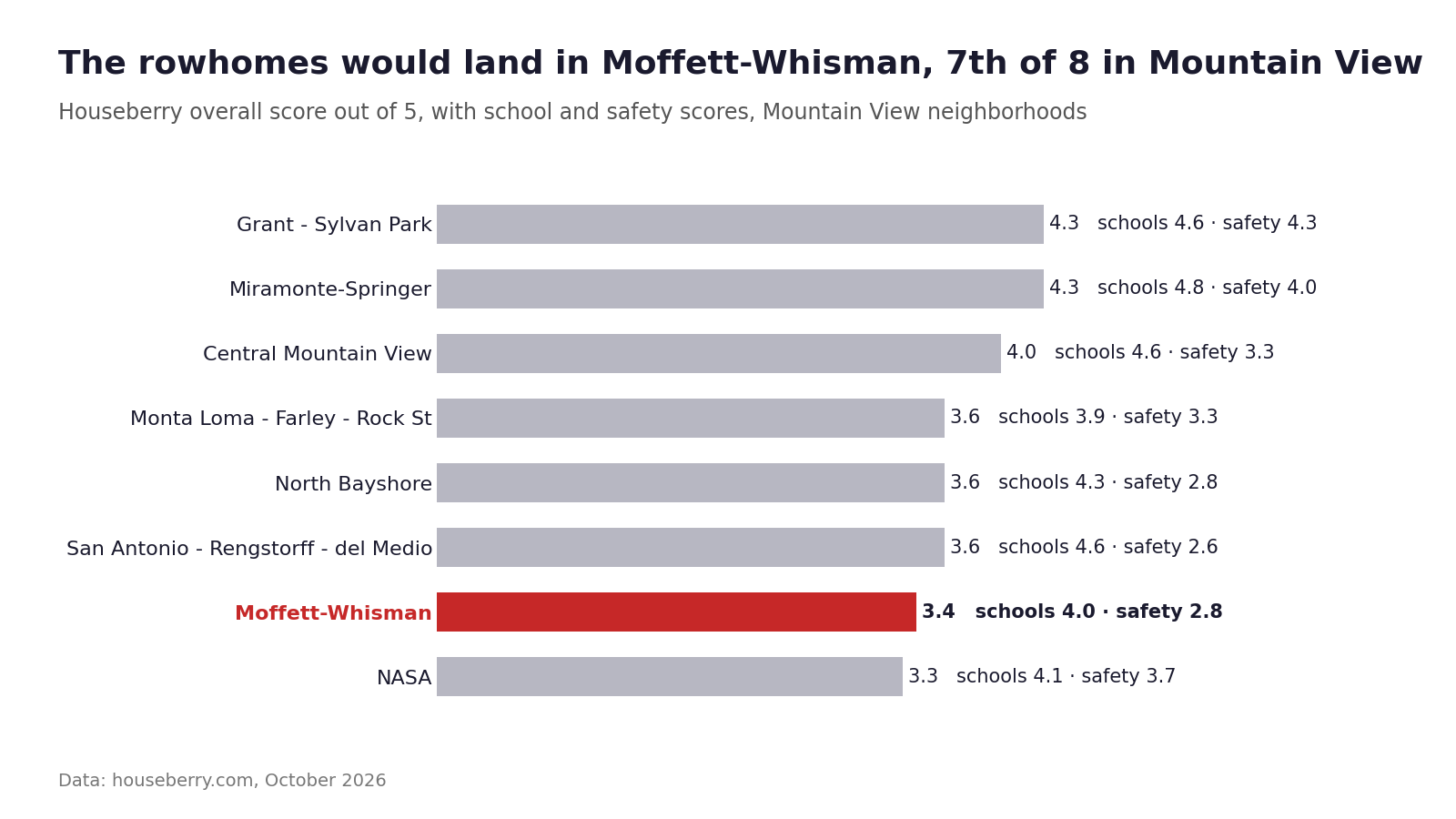
The neighborhood the homes would join is one of the city's cheaper ones. Houseberry ranks Moffett-Whisman 7th of 8 Mountain View neighborhoods at 3.4 out of 5 overall, with a 4.0 school score and a 2.8 safety score. Its September 2026 typical price of $1.45 million is a bit more than half the $2.76 million typical home price Houseberry shows for Mountain View as a whole. By our count, that is a 4.6 percent drop in 11 months.
Who gets the nine below-market homes
Mountain View requires rowhouse projects to sell 25 percent of their homes below market, and Prometheus hit the number exactly. The mix leans toward middle incomes.
| Income tier | Share of area median income | Homes |
|---|---|---|
| Low income | 80 percent | 2 |
| Moderate | 100 percent | 1 |
| Moderate | 120 percent | 4 |
| Above moderate | 150 percent | 2 |
Three of the 9 are three-bedroom homes and six are four-bedrooms, in the same proportion as the market-rate plans. Staff checked that the affordable units are spread across all three floor plans, which the city's ordinance requires.
Those five homes at 120 percent of median and below also qualify the project under the state density bonus law. That would have entitled Prometheus to 8 percent more homes and one concession. It asked for neither. It asked only for six waivers, all small: 38 percent site coverage against a 35 percent cap, a floor-area ratio of 1.09 against 1.05, 31.4 percent landscaping against 35, and shorter setbacks, including a 2-foot rear setback for accessory structures where the code wants 15.
The trade-offs neighbors raised
Ten people came to the developer's neighborhood meeting on August 25. The worry they raised most was on-street parking. That fear runs into the numbers. The city's own code asks for 83 spaces, and Prometheus is providing all 83: 72 in garages, nine for guests and two "temporary" spaces so residents with tandem garages can shuffle cars. State law would have let the developer stop at 79.
The trees are the harder loss. All 18 on the site come out, including two Deodar cedars the city lists as heritage trees, which stand where the driveway would go. The replacement plan is 48 new trees, about two-thirds California natives, and the arborist report projects the site's canopy rising from 10.1 percent today to 40.2 percent at maturity. That takes decades, and the first ten years look thinner.
Parks are the third trade-off. The project pays a $992,337 park fee instead of setting aside land. That works out to about $34,200 for each of the 29 homes the fee applies to, by our math. Even so, the city's park shortfall in its Stierlin planning area grows from 13.46 acres to 13.63.
Across the street, a park is coming
The best thing about this site is what is happening on the other side of the road. The city has spent about $24.8 million buying 909, 917 and 939 San Rafael Avenue for a 2.4-acre park, the Mountain View Voice reported in April, with construction expected to start in fall 2028. The Terra Bella area has less than 1.5 acres of parkland per 1,000 residents, half the city's goal.
Prometheus is adding a raised mid-block crosswalk on San Rafael that lands at the project's common open space, which has a playground, seating and specimen trees. Seven porches would look straight at the park. City staff call that "eyes" on the park, and for once the planning phrase fits.
The block is filling in.
At the Terra Bella corner, Alta Housing broke ground on La Bella in early October, 108 affordable apartments. Put the two projects together and this short stretch of San Rafael goes from storage yards and parking to 144 homes and a park in about three years.
Why 36 and not 45
Here is the part we would push on. The site's proposed designation allows up to 45 homes. Prometheus is building 80 percent of that. The rezoning it asked for, called R3-2, caps this lot at exactly 36, and the city's pending R3 zoning update, which the council takes up November 17, would move the site into a new district a week after this project's own hearing.
Nine more homes is not a scandal on a two-acre lot. It is, though, the difference between a project and a slightly better one, and Mountain View had permitted 16.8 percent of the 11,135 homes the state expects of it by 2031, the Mountain View Voice reported in March. Rowhomes are the format where the city tends to accept the low end of what is allowed.
Land math makes the point plainer. Mountain View's park-fee code values land here at $10.4 million an acre. At that price the 1.80 acres are worth about $18.7 million, or roughly $520,000 of dirt under each of the 36 homes. Spread over 45 homes, it would be about $416,000. That gap shows up in sale prices.
Still, this plan turns a fenced lot into 36 homes people can own, nine of them priced for households near the area median income, with a park across the street. If the commission says yes Wednesday and the council follows on November 10, compare Moffett-Whisman against the rest of the city on our Mountain View neighborhood ranking before the first model home opens.
Sources
- City of Mountain View, Environmental Planning Commission staff report, Rowhouse Gatekeeper Project at 924-940 San Rafael Avenue, October 21, 2026
- CEQAnet, 924-940 San Rafael Avenue Rowhouse Project, SCH 2026060894
- Mountain View Voice, Mountain View moves forward with plans for Terra Bella park, April 22, 2026
- Houseberry, Moffett-Whisman neighborhood page
The Houseberry Research Team is Houseberry's reporting team: Bay Area real estate analysts, data specialists and longtime local market watchers. Every day we check the public record: building permits, city council and planning agendas, county recorder filings, state housing bills, police incident data and school results. Then we tie each story to what it means for specific neighborhoods, using Houseberry's own neighborhood data on prices, appreciation, safety, schools and amenities. Questions or corrections: Contact us.
Map of Mountain View Neighborhoods
Loading map...
View Full Map
Top Neighborhoods in Mountain View, CA



All information provided on this website including but not limited to - school ratings, safety, amenities, user opinions, and property data - is for general informational purposes only. We do not guarantee its reliability, accuracy, or completeness. Users should independently verify information and consult appropriate professionals as needed. By using this website, you agree Houseberry is not responsible for actions, decisions, or consequences arising from reliance on the information provided
houseberry.com - CA DRE# 01847391
 Bay East ©2025. CCAR ©2025. bridgeMLS ©2025. Information Deemed Reliable But Not Guaranteed. This information is being provided by the Bay East MLS, or CCAR MLS, or bridgeMLS. The listings presented here may or may not be listed by the Broker/Agent operating this website. This information is intended for the personal use of consumers and may not be used for any purpose other than to identify prospective properties consumers may be interested in purchasing. Data last updated at October 21, 2026 12:00 AM