A Lavender Heights historic district would protect 12 buildings
Sacramento's draft district around 20th and K protects 12 LGBTQ landmarks. We read the rules to show what the other 29 owners would gain and lose.

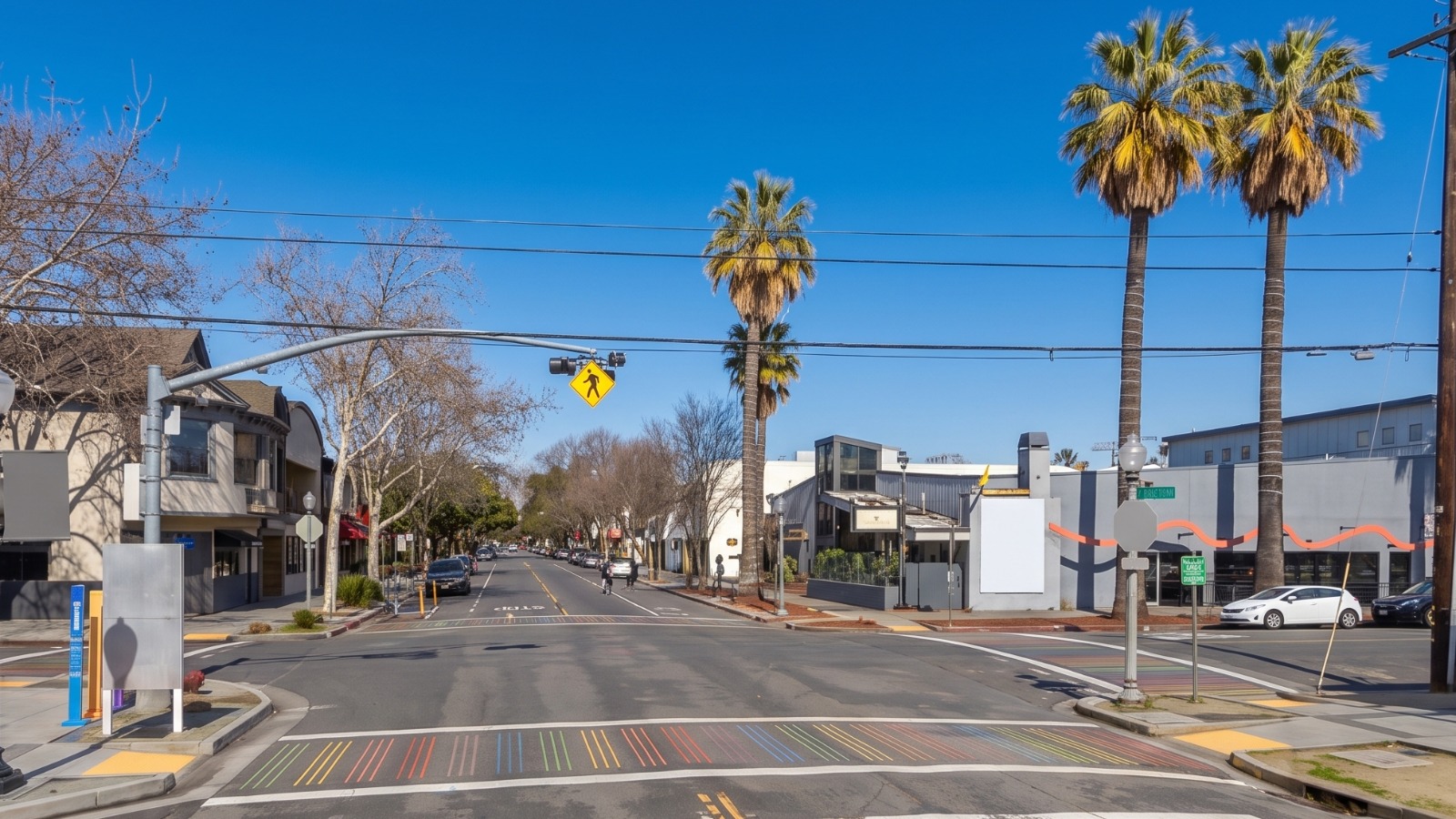
AI-rendered view of 20th and K Streets in Sacramento's Lavender Heights under midday sun, with the rainbow crosswalk and palm trees on K Street Photo: Houseberry
Stand at 20th and K Streets in Midtown Sacramento and two of the buildings the city wants to protect sit right at the intersection. Faces, the gay bar at 2000 K Street, is one. The Depot, across K at 2001, is the other. A rainbow crosswalk runs between them.
Sacramento's draft Lavender Heights historic district would draw a line around these blocks, roughly I Street to the north, 23rd Street to the east, Liestal Alley to the south and 19th Street to the west. The city's 2024 survey record counts 41 properties inside that line. Only 12 are contributing buildings, the ones tied to the neighborhood's LGBTQ history from 1967 to 2000. The other 29 are not. That split decides what each owner here could build, and we have not seen it quoted anywhere else.
It also lands in one of the busiest parts of the city. Houseberry scores Midtown / Winn Park / Capitol Avenue, the neighborhood that holds Lavender Heights, 4.4 out of 5 for amenities. On Houseberry's Sacramento amenities ranking, only East Sacramento and Land Park score higher among 185 neighborhoods.
Twelve buildings carry the history
This district is about what happened inside the buildings, not how they look. The survey record, written for the city by the firm Page & Turnbull in September 2024, finds the district eligible for its events and the people tied to it. It rejects the architecture case outright, because the buildings "do not conform to any cohesive style or period of construction."
So the list reads like a map of a community. The Mercantile Saloon opened in a converted Victorian at 1928 L Street in 1976 and is still pouring. Rev. Jerry Sloan opened the Lambda Community Center at 1931 L Street with the money he won in a lawsuit against Jerry Falwell, according to the draft plan. Dr. Harvey Thompson opened a clinic at 910 to 912 21st Street in 1978, and he and Dr. Sandy Pomerantz built the early framework of what became the Sacramento AIDS Foundation. Lioness Books and the First Sacramento Women's Building shared 2224 J Street.
Four of the 12 still do what made them historic: the church at 2100 J, Faces, The Depot and the Merc. The other eight now house something else.
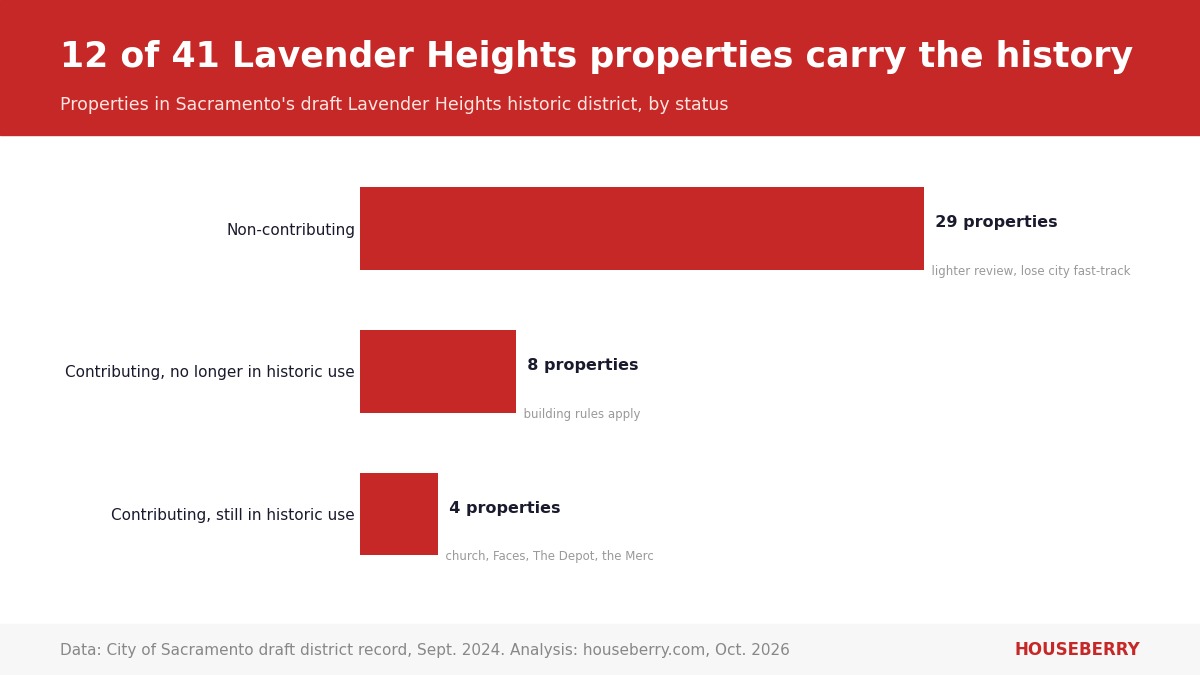
Every rule in the draft plan is about the outside of a building. Additions to a contributing building can't cover more than half its existing footprint. Fences on the sidewalk side stop at 4 feet and can't be chain link. New meters and conduit go on the side or the back. Then each building gets its own sheet, and the sheets differ a lot.
| Address | What it was | What the draft plan allows on top |
|---|---|---|
| 1215 19th St. | New Helvetia Roaster | Rooftop addition, set back |
| 910 to 912 21st St. | Thompson and Pomerantz offices, The Open Book | Rooftop addition, set back 20 feet |
| 919 20th St. | Lambda Community Center | Rooftop addition, set back 20 feet |
| 2115 J St. | Sacramento AIDS Foundation | Rooftop addition, set back |
| 1900 K St. | Sacramento AIDS Foundation | Rooftop addition, set back |
| 2000 K St. | K Street Station, now Faces | Rooftop addition, set back |
| 2001 K St. | The Western, now The Depot | No rooftop addition |
| 2220 J St. | Sacramento Women's Center, Gifted Gardener | No rooftop addition |
| 2224 J St. | Lioness Books | Rear addition only |
| 1928 L St. | Mercantile Saloon | Rear addition only |
| 1931 L St. | Lambda Community Center | Rear addition only |
| 2100 J St. | First United Methodist Church | No additions at all |
Half can grow up, half can't. The church can't even fill in its courtyard.
The other 29 lots get lighter rules and lose a shortcut
Non-contributing means built after 2000, altered too much, or simply without a documented role in the history. Twenty-three of the 29 have street addresses on J, K, L, 19th, 20th, 21st and 22nd. Six appear in the record only as parcel numbers on K and L Streets.
The draft plan calls review for these properties "less restrictive." It still has teeth for anything new. A building taller than its contributing neighbor, say a new one beside the one-story Merc on L Street, has to step its upper floors back so the street wall matches. Corner lots can go taller, under Section 3.2 of the plan. The ground floor needs windows, active storefronts and doors that face the sidewalk.
The bigger change is one the plan doesn't mention. Since 2020 Sacramento has offered its own ministerial path for infill housing under City Code 17.860.030. A project of 2 to 200 homes that meets the city's written design standards gets approved by planning staff, with no hearing, no environmental review and no parking minimum. The city's application, dated Sept. 1, 2026, lists a site within a historic district on the Sacramento Register as ineligible.
That rule doesn't care whether a lot is one of the 12. List the district, and all 41 properties lose the city path.
The state's SB 35 path would still exist. It bars demolishing a historic structure, so the 29 could try it. But the city's own comparison chart shows what comes with it: projects of 11 or more homes must make 10 percent of them affordable to lower-income households and pay prevailing wages. The city path asks for neither.
Timing matters too. Under City Code 17.604.240, a nominated district is treated as a district for development review for 180 days while the council decides, and the council can extend that once.
What the plan leaves alone
Nothing in the draft plan changes the zoning, which the survey records as C-2-SPD, a general commercial zone. The standards cover building exteriors, not the businesses inside them. The plan even protects the rainbow crosswalks and allows Pride decorations and flags.
Demolition review is not new here either. Any building in the city 50 years or older already gets sent to the preservation director before a demolition permit, district or not, under City Code 17.604.600.
The 12 contributing owners get real incentives. A Mills Act contract can lower property taxes in exchange for a 10-year upkeep plan. The city charges $4,603 to apply for a building of 2,500 square feet or less and $8,416 for larger ones, and applications are due July 1. Listed buildings also get the more flexible California Historical Building Code, and a nonresidential one converted to housing can hold one home per 750 square feet of its original space instead of following the zone's density limit.
List the 12. Keep the shortcut for the 29
We think the city should adopt the district and fix the shortcut before it does.
The history is real and documented to the street number. The Merc, the Lambda Center sites, the AIDS Foundation offices and the women's center buildings are worth protecting, and protecting them costs Midtown very little housing. Twelve buildings is a small share of a 41-property district, and the rules still allow rooftop additions on half of them.
The cost sits on the 29 properties that hold none of the history. Houseberry's Midtown review calls this grid the one part of Sacramento that never really asks you to drive. Those are exactly the lots where a no-hearing apartment project should be easiest, and listing would make them harder. The fix is small. The adoption ordinance or Section 17.860.030 could keep the city path open for non-contributing sites that meet the district's own written design standards, which the city's application already has a checklist for.
Not everyone in Lavender Heights wants detailed rules. At the Midtown Association's Oct. 9 meeting, Abridged reported, Sacramento LGBT Community Center executive director David Heitstuman said he would rather see markers that tell the story than detailed building rules, and Midtown Association director Emily Baime Michaels worried the rules could stall housing. All five community members who spoke backed the district.
What owners can check before the hearings
The Preservation Commission holds a public hearing on any district plan and sends its recommendation to the City Council, which has the final vote under City Code 17.604.300. The commission has an Oct. 21 meeting on the city calendar, but its agenda was not posted when we checked, so we can't say Lavender Heights is on it.
If you own in these blocks, start with the city's draft district plan and find your address. One of the 12 means a page of rules written for your building and a shot at a Mills Act contract. One of the 29 means lighter rules and a lost shortcut, which is the part worth raising with preservation staff now. The 2024 survey counts could still change before adoption, so confirm your parcel's status with the city.
Midtown / Winn Park / Capitol Avenue ranks 72nd of 185 overall in Houseberry data, pulled down by a 1.6 safety score and carried by that 4.4 for amenities. Boulevard Park sits just north and Marshall School to the east. Before the commission takes this up, see how every one of them stacks up on Houseberry's Sacramento neighborhood ranking.
Sources
- City of Sacramento, Lavender Heights Historic District draft survey record (DPR), Sept. 25, 2024
- City of Sacramento, Draft Lavender Heights Historic District Plan
- City of Sacramento, Ministerial Approval of Infill Housing application, form CDD-0428, Sept. 1, 2026
- Sacramento City Code, Chapter 17.604, Historic Preservation
- City of Sacramento, Mills Act Program
- Abridged, Should Sacramento preserve Lavender Heights?, Oct. 9, 2026
- Bay Area Reporter, Report finds potential historic LGBTQ district in Sacramento, Dec. 4, 2024
The Houseberry Research Team is Houseberry's reporting team: Bay Area real estate analysts, data specialists and longtime local market watchers. Every day we check the public record: building permits, city council and planning agendas, county recorder filings, state housing bills, police incident data and school results. Then we tie each story to what it means for specific neighborhoods, using Houseberry's own neighborhood data on prices, appreciation, safety, schools and amenities. Questions or corrections: Contact us.
Map of Sacramento Neighborhoods
Loading map...
View Full Map
Top Neighborhoods in Sacramento, CA




All information provided on this website including but not limited to - school ratings, safety, amenities, user opinions, and property data - is for general informational purposes only. We do not guarantee its reliability, accuracy, or completeness. Users should independently verify information and consult appropriate professionals as needed. By using this website, you agree Houseberry is not responsible for actions, decisions, or consequences arising from reliance on the information provided
houseberry.com - CA DRE# 01847391
 Bay East ©2025. CCAR ©2025. bridgeMLS ©2025. Information Deemed Reliable But Not Guaranteed. This information is being provided by the Bay East MLS, or CCAR MLS, or bridgeMLS. The listings presented here may or may not be listed by the Broker/Agent operating this website. This information is intended for the personal use of consumers and may not be used for any purpose other than to identify prospective properties consumers may be interested in purchasing. Data last updated at October 13, 2026 12:00 AM