An heiress built SF's $15M Lake Street house for her brother
2 Sixth Avenue went viral for selling at nearly double its asking price. The house has changed hands twice in 112 years, and the woman who built it was one of the richest on the West Coast.

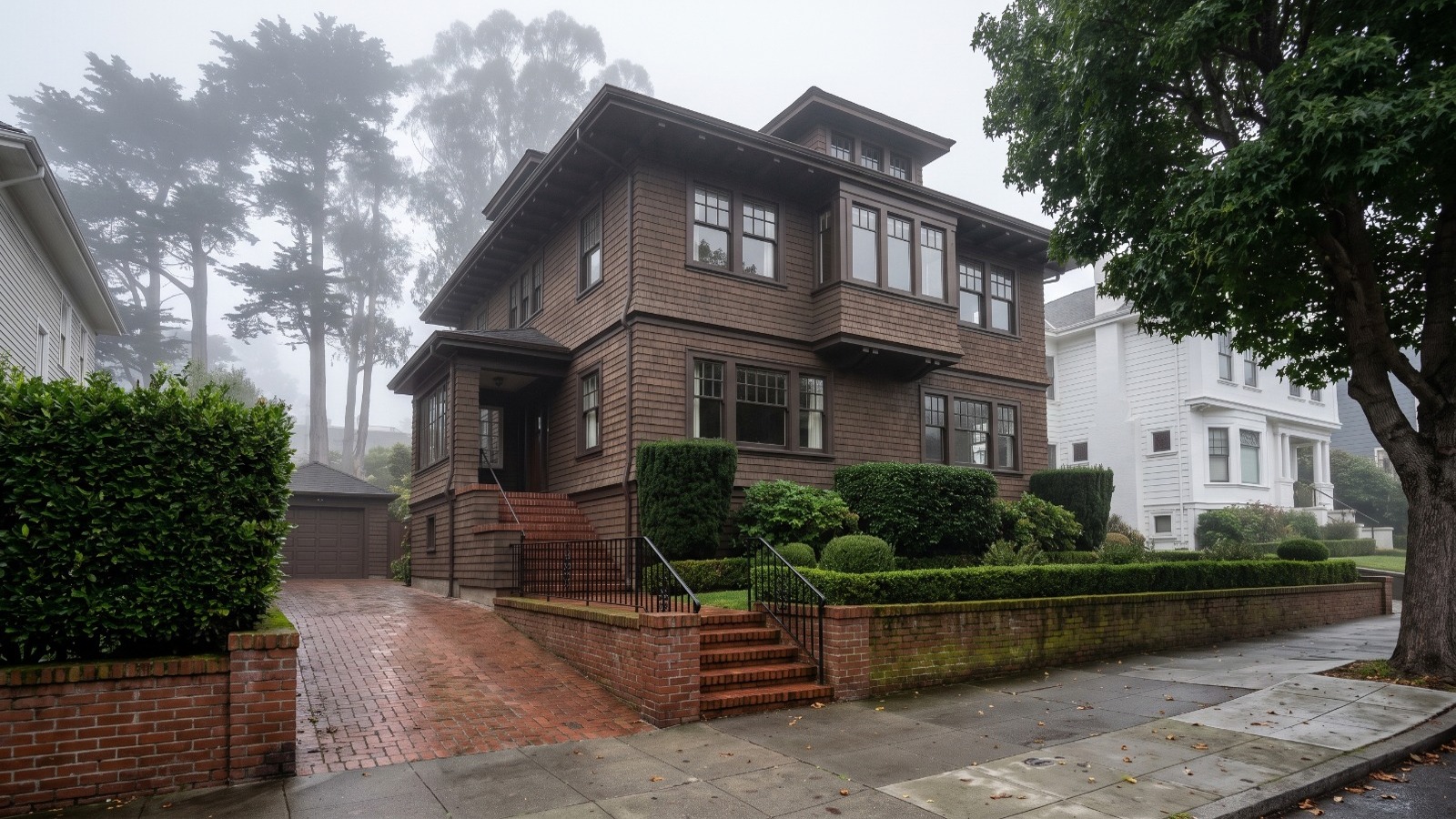
AI-rendered photo of the 1914 shingle house at 2 Sixth Avenue on the Presidio edge of San Francisco's Lake Street neighborhood, in marine-layer fog Photo: Houseberry
Walk north on 6th Avenue from Lake Street and the block runs out fast. The pavement ends at the Presidio's edge, and the last house before the trees is a shingled two-story with deep eaves, a brick driveway and a garden that goes back farther than most San Francisco lots go at all.
That house, 2 Sixth Avenue, listed on September 17 for $7,999,000. It closed on October 7 for $15,000,000. The typical home in the Lake Street neighborhood ran about $2.76 million in September 2026, according to Houseberry's price history, so this one went for roughly five and a half times that.
The overbid is why the sale went viral. The better story is how rarely this house has been for sale at all. It has changed hands twice in 112 years. It was built in 1914 by one of the richest women on the West Coast, for her younger brother and his eight children, and that family kept it for 70 years.
Twenty days and $7 million over
Listing agent Maureen Terris of Compass called it "a once-in-a-generation property" and told SFGATE that the house is not a renovated "white box." Asked about the bidding, she kept it short. "People wanted it. That's all I can say." The buyer has not been named.
It was not a record. In May, a Cow Hollow house at 2512 Union Street also closed at $15 million on a $7.95 million ask, 88.7 percent over, which the SF Standard reported was the biggest overbid in 26 years for a San Francisco home listed above $5 million. 2 Sixth Avenue landed 1.2 points short of that.
Our read is that nobody mispriced this house by half. An ask under $8 million in this market is a starting gun, and the buyer was paying for something the comps cannot measure: more than three standard city lots of land with a national park for a back fence.
The numbers back that up. Lake Street homes sold for a median of 10.9 percent over asking across the past 12 months, according to Houseberry's Lake Street sales records. This one went eight times further. The largest Lake Street house sale of the spring, 2206 Lake Street, brought $11 million in May for 5,080 square feet, or about $2,165 a foot. 2 Sixth Avenue is smaller and brought 54 percent more per foot.
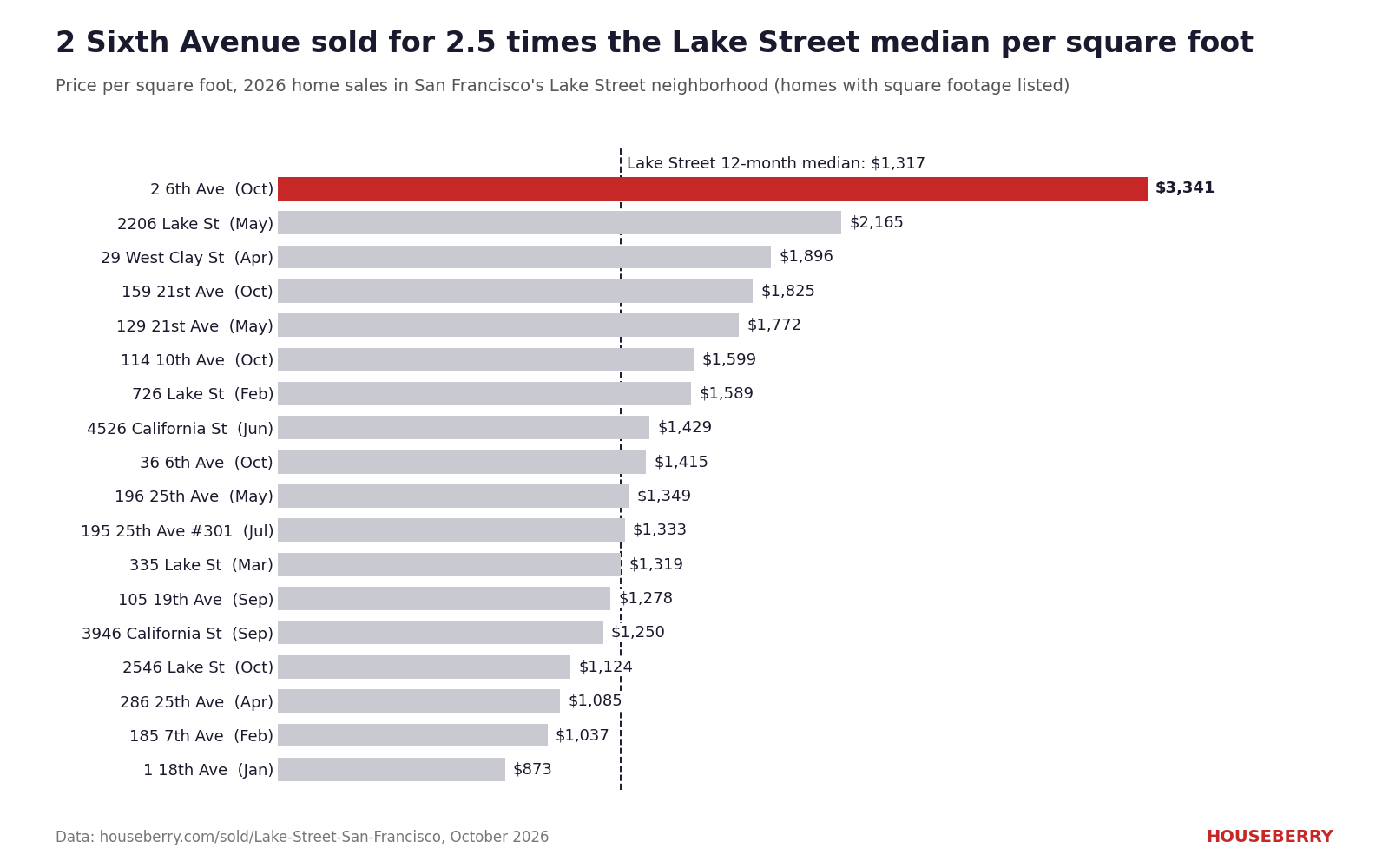
Then there is the math on the same street. 36 6th Avenue, a two-bedroom of 1,025 square feet, sold on October 5 for $1.45 million. Two sales on 6th Avenue, two days apart, and one is ten times the other.
| Address | Sold | Price | Square feet | Price per sq ft |
|---|---|---|---|---|
| 2 6th Ave | Oct 2026 | $15,000,000 | 4,490 | $3,341 |
| 2206 Lake St | May 2026 | $11,000,000 | 5,080 | $2,165 |
| 29 West Clay St | Apr 2026 | $7,200,000 | 3,797 | $1,896 |
| 129 21st Ave | May 2026 | $6,300,000 | 3,555 | $1,772 |
| 36 6th Ave | Oct 2026 | $1,450,000 | 1,025 | $1,415 |
The woman who built it sued to sell her own buildings
Elise Kelley was born in Mendocino in 1866, the second daughter of William and Eliza Kelley, whose home is now the town's Kelley House Museum. She went to Mills College in Oakland and traveled to Europe, the Middle East and Japan. At 27 she married Louis P. Drexler, a San Francisco millionaire close to twice her age. Six years later she was a widow and one of the richest women on the West Coast.
When he died in 1899, his will let her manage his properties and collect the rent. It did not let her sell the best of them. She sued over that restriction and won.
What she did with the money is still standing downtown. In 1913, with the lawsuit underway, she commissioned the Colombo Building at 1 to 21 Columbus Avenue, on the site where A.P. Giannini had opened the Bank of Italy in 1904, the bank that became Bank of America. It is now San Francisco Landmark No. 237.
She was a loyal member of the Women's Christian Temperance Union and would not let tenants sell alcohol in her buildings. She traded a seven-story building at New Montgomery and Minna for 3,200 acres of asparagus land in the Delta. She hired Julia Morgan to design her retirement home in Woodside, and she founded a convalescent hospital and school for disabled children in Palo Alto.
And on 6th Avenue, the year before the Panama-Pacific Exposition opened, she built a house for her little brother.
Eight children and a shingled house
Otis Kelley was the youngest of the Mendocino Kelleys. He and Annie McGuire married in 1897 and raised six sons and two daughters: Lloyd, Richard, Margaret, Carroll, James, Mervyn, Katherine and Gordon, the last born in 1918. According to the Kelley House Museum's family history, several of the children lived at 2 Sixth Avenue for most of their lives, and Margaret came back after her divorce with her son, Blair.
The architect was Frederick D. Boese, who lived from 1877 to 1922 and did much of his work in this corner of the city. The house's own history page lists his 23 Seventh Avenue from 1903, one block over, plus houses on Cherry Street, Locust Street and Pacific Avenue in Presidio Heights, and the pair at 123 and 125 19th Avenue he designed for himself in 1912. Every one of them is within about a mile and a half of 6th Avenue.
The style is what architectural historians call the First Bay Tradition, the brown-shingle school of Bernard Maybeck and Ernest Coxhead: redwood inside, shingles outside, windows in pairs and threes, rooms laid out for living instead of for show. Boese drew it in 1914 with deep eaves and a wide brick entry. That is the original redwood trim the listing photos lingered on, and the coffered dining room ceiling, and the wood-burning fireplaces in both front rooms.
The Kelleys stayed until the last of the children who lived there died in the 1980s. In 1984, the house sold for the first time.
What was at the end of the street in 1914
When the Kelleys moved in, the view out back was already a golf course. In 1895 the Presidio's commander let the San Francisco Golf and Country Club lay out nine holes on the Army post for 50 cents a round. The course became an earthquake refugee camp in 1906, went to 18 holes in 1910, and has been a public course since 1999, when the Presidio became a national park site.
A few blocks west, Mountain Lake gives the street its name. Juan Bautista de Anza camped at the lake for two days in March 1776 and picked out the site for the Spanish presidio from there.
The neighborhood around it was dunes and a few roads until the 1906 earthquake pushed San Francisco west, which is why so many Lake Street houses date from the years just after it. In 1917, three years after this house went up, the city officially renamed the Richmond the Park-Presidio District to avoid confusion with the city of Richmond across the bay. Residents kept saying the Richmond anyway, and the city made the old name official again in 2009.
Lake Street itself has a newer chapter. In December 2022, the SFMTA board voted to make Lake Street from 28th Avenue to Arguello Boulevard a permanent Slow Street, with through traffic discouraged along the Presidio's southern edge.
Forty-two years with the McGraths
Joan and Bob McGrath bought the house in 1984. Bob McGrath founded Mobile Modular in 1979, and in 1984, the same year as the house, it became McGrath RentCorp, the Livermore company that rents portable classrooms and offices to schools and businesses. The McGraths are now in their 90s, and Terris told SFGATE they were ready to pass the house on.
Forty-two years of ownership leaves a mark on the tax bill. Under Proposition 13, the 2025 property tax on the house was $20,147, according to public records shown on the listing. A sale resets the assessment to the price paid. At San Francisco's 2025 to 2026 rate of about 1.183 percent, the base tax on $15 million comes to roughly $177,000 a year, close to nine times what the McGraths paid.
What $15 million buys on this block
Strip away the history and the buyer still got things that do not come back on the market. The lot is 9,233 square feet, more than three times a standard 25-by-120 San Francisco parcel. It is detached on all sides. It has a two-car garage and room on the brick drive for five more. And nothing will ever be built on the Presidio side of the fence.
The neighborhood holds up on the numbers too. Houseberry scores Lake Street 4.1 out of 5 overall, ninth of 92 San Francisco neighborhoods, with a 4.5 for safety and a 4.2 for schools. Sea Cliff, the other Presidio-edge neighborhood buyers weigh it against, scores 4.2 with a typical price near $5.57 million in September 2026. The trade-off is weather. Lake Street ranks 82nd of 92 city neighborhoods for sunshine in Houseberry's 30-year climate data, so the garden that sold this house spends a lot of summer mornings in fog.
The last time anyone could buy this house, it had been off the market for 70 years. The McGraths kept it 42 more. If you are shopping the north side of the Richmond now, see how Lake Street and the other 91 neighborhoods rank on schools and price, and line up the safety scores side by side, because on 6th Avenue the next chance may be a generation away.
Sources
- SFGATE via Yahoo Finance: SF home sells for $7M over asking, nearly double the list price (October 7, 2026)
- The Independent via Yahoo Finance: San Francisco house sells for double its list price as AI money floods the city (October 8, 2026)
- The SF Standard: Cow Hollow home sets San Francisco's 21st-century overbidding record (May 14, 2026)
- 2 Sixth Avenue property history page, Compass
- Kelley House Museum: Elise Kelley Drexler
- Kelley House Museum: Otis and Annie
- Colombo Building, Wikipedia
- Presidio Golf Course history
- Richmond District, San Francisco, Wikipedia
- SF Examiner: SFMTA makes Lake Street a permanent Slow Street
- Mobile Modular: About us
- San Francisco Board of Supervisors: FY 2025-2026 property tax rate resolution
The Houseberry Research Team is Houseberry's reporting team: Bay Area real estate analysts, data specialists and longtime local market watchers. Every day we check the public record: building permits, city council and planning agendas, county recorder filings, state housing bills, police incident data and school results. Then we tie each story to what it means for specific neighborhoods, using Houseberry's own neighborhood data on prices, appreciation, safety, schools and amenities. Questions or corrections: Contact us.
Map of San Francisco Neighborhoods
Loading map...
View Full Map
Top Neighborhoods in San Francisco, CA


All information provided on this website including but not limited to - school ratings, safety, amenities, user opinions, and property data - is for general informational purposes only. We do not guarantee its reliability, accuracy, or completeness. Users should independently verify information and consult appropriate professionals as needed. By using this website, you agree Houseberry is not responsible for actions, decisions, or consequences arising from reliance on the information provided
houseberry.com - CA DRE# 01847391
 Bay East ©2025. CCAR ©2025. bridgeMLS ©2025. Information Deemed Reliable But Not Guaranteed. This information is being provided by the Bay East MLS, or CCAR MLS, or bridgeMLS. The listings presented here may or may not be listed by the Broker/Agent operating this website. This information is intended for the personal use of consumers and may not be used for any purpose other than to identify prospective properties consumers may be interested in purchasing. Data last updated at October 11, 2026 12:00 AM