Alameda ADU Condos: Can You Sell Your ADU Separately?
Alameda is about to let owners sell a backyard ADU as its own condo. Here is what the new rules require, what the paperwork costs, and what a unit might sell for against local medians.
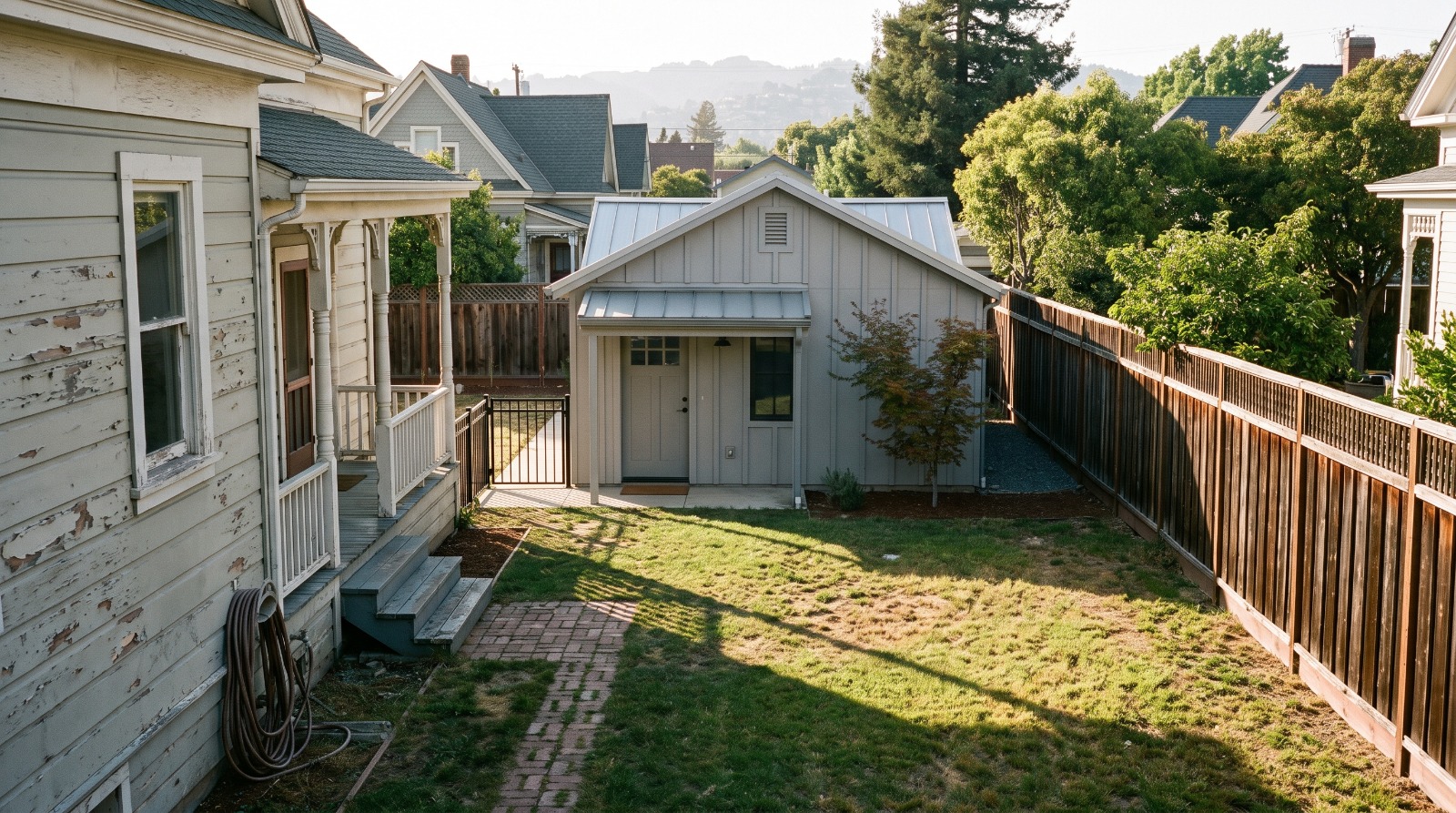
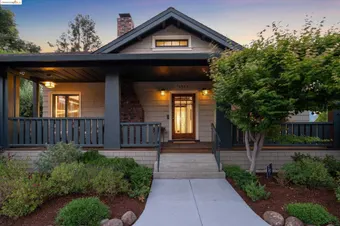
A detached backyard ADU behind a Victorian on a deep East End lot, the kind of unit Alameda's ADU condo rules would let owners sell separately. Photo: Houseberry
A 750-square-foot backyard unit in Alameda would likely sell for somewhere around $580,000 as a condo. The house in front of it sits in a city where Houseberry's typical home price hit $1.42 million in August 2026.
That gap is the whole story. Alameda is one council vote away from letting homeowners sell an ADU separately from the main house, and for the first time a backyard cottage on the island could become its own deed, its own mortgage and its own entry-level home.
Yes, you will be able to sell an ADU separately in Alameda, once the new rules take effect. The City Council gave the ordinance a 4-0 first vote on September 15 and is set to adopt it on the October 6, 2026 consent calendar. It takes effect 30 days later, which puts the first applications in early November.
What Alameda actually approved
The ordinance does two jobs. It rewrites Alameda's ADU code (Section 30-5.18) and adds a new condo section (30-5.19) that uses the state law written for exactly this, AB 1033, which let cities opt in to separate ADU sales starting in 2024.
The building rules first, because they decide what can be sold later. Per the council file (2026-6314):
- ADUs top out at 1,200 square feet. Junior ADUs, which sit inside the main house, top out at 500.
- A single-family lot can carry one attached ADU, one JADU and one detached new-construction ADU of up to 800 square feet.
- A lot with an existing multifamily building can add up to eight detached ADUs, capped at the number of existing units. A proposed multifamily project gets up to two.
- Detached ADUs can rise 18 feet, or 20 if the roof pitch matches the main house, with 4-foot side and rear setbacks. No off-street parking is required.
- ADU permits get ministerial review within 60 days of a complete application.
The condo section is written for ADUs. A junior unit carved out of the main house is not a candidate in the text we read, which makes sense. You cannot really sell a bedroom suite with a shared wall and a shared furnace.
The Alameda Post's account of the September 15 meeting had Mayor Marilyn Ezzy Ashcraft framing it as a first-time-buyer foothold, while staff planner Tristan Suire called it "one tool in the toolbox." That is the honest description.
The six steps, and the two you do not control
Selling an ADU as a condo in Alameda takes six steps, and two of them depend on someone else saying yes. Here is the order the ordinance sets up.
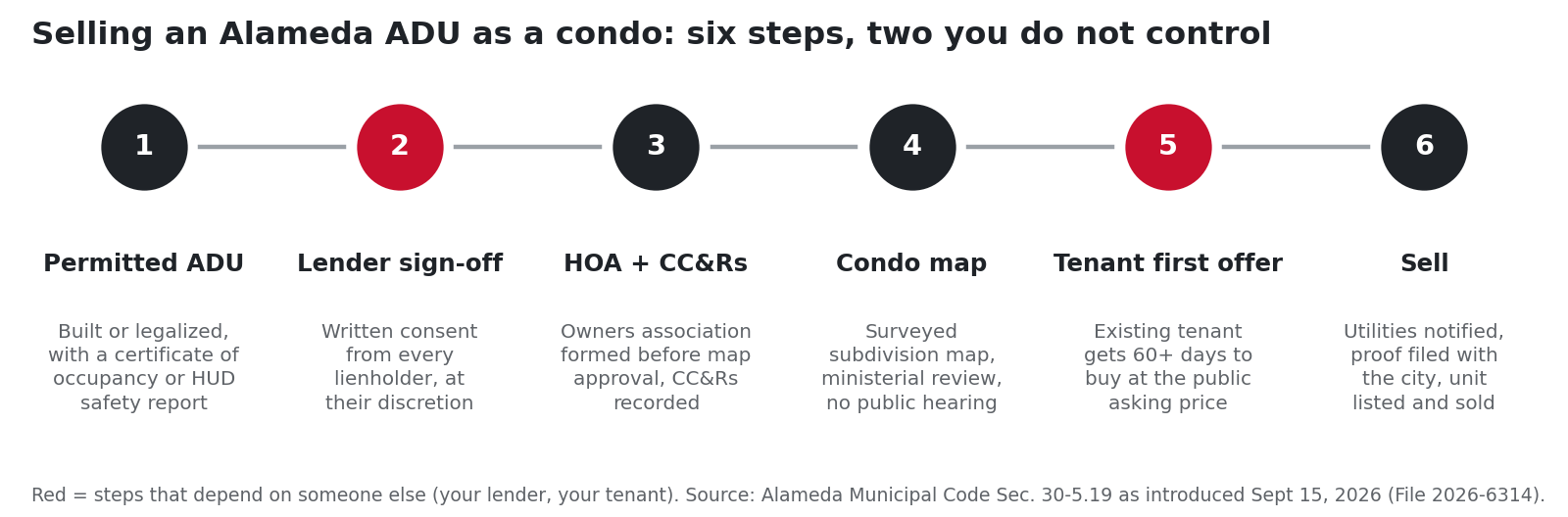
The lender step is the one that will quietly kill the most deals. Every lienholder has to sign a consent to the condo plan, and the ordinance language gives them "sole and absolute discretion." If you have a big first mortgage on the property, your bank is being asked to let part of its collateral walk out the door. San Jose's planning staff flagged the same problem to KQED in 2025. Owners with little or no debt have a much easier path.
The tenant step is slower but predictable. If someone already rents the ADU, they get the first chance to buy it at the same price you would offer the public, for at least 60 days after they receive the state Department of Real Estate subdivision report.
Before the map is approved, the ADU also needs a safety inspection (a certificate of occupancy or a HUD housing quality standards report), and the two owners need a homeowners association with recorded CC&Rs. Yes, a two-member HOA. It will handle shared landscaping, exterior upkeep and utilities, and it will need rules both sides can live with for decades.
What the paperwork is likely to cost
Expect roughly $10,000 to $50,000 in soft costs to turn an existing, permitted ADU into a sellable condo, before any construction or utility work. Alameda has not published a dollar figure, so that range comes from other places doing the same thing.
In Sebastopol, a councilmember estimated $10,000 to $20,000 for a typical conversion, including $2,000 to $5,000 for a surveyor, $3,000 to $8,000 for an attorney to draft CC&Rs, and $1,000 to $3,000 in title and recording fees. Industry guides put the wider range at $15,000 to $50,000 once utility separation enters the picture.
Utilities are the wild card. A 1920s Alameda lot with one gas meter and one sewer lateral serving both buildings is a very different project than a new ADU built with its own meters. The ordinance only requires that you notify the utilities and prove it to the city, but a buyer's lender will want to know who pays which bill.
Against a sale in the high $400,000s to $600,000s, even $50,000 is not fatal. It just means this is a project for owners who are sure they want to sell, not a casual option to keep in the drawer.
What would an ADU condo sell for in Alameda?
A 500 to 750 square foot ADU condo in Alameda would plausibly land around $390,000 to $580,000, or roughly a quarter to 40 percent of what a typical Alameda house costs. That estimate multiplies Alameda's Redfin median of $773 per square foot in August 2026 by typical ADU sizes, and it lines up with San Jose's real sale.
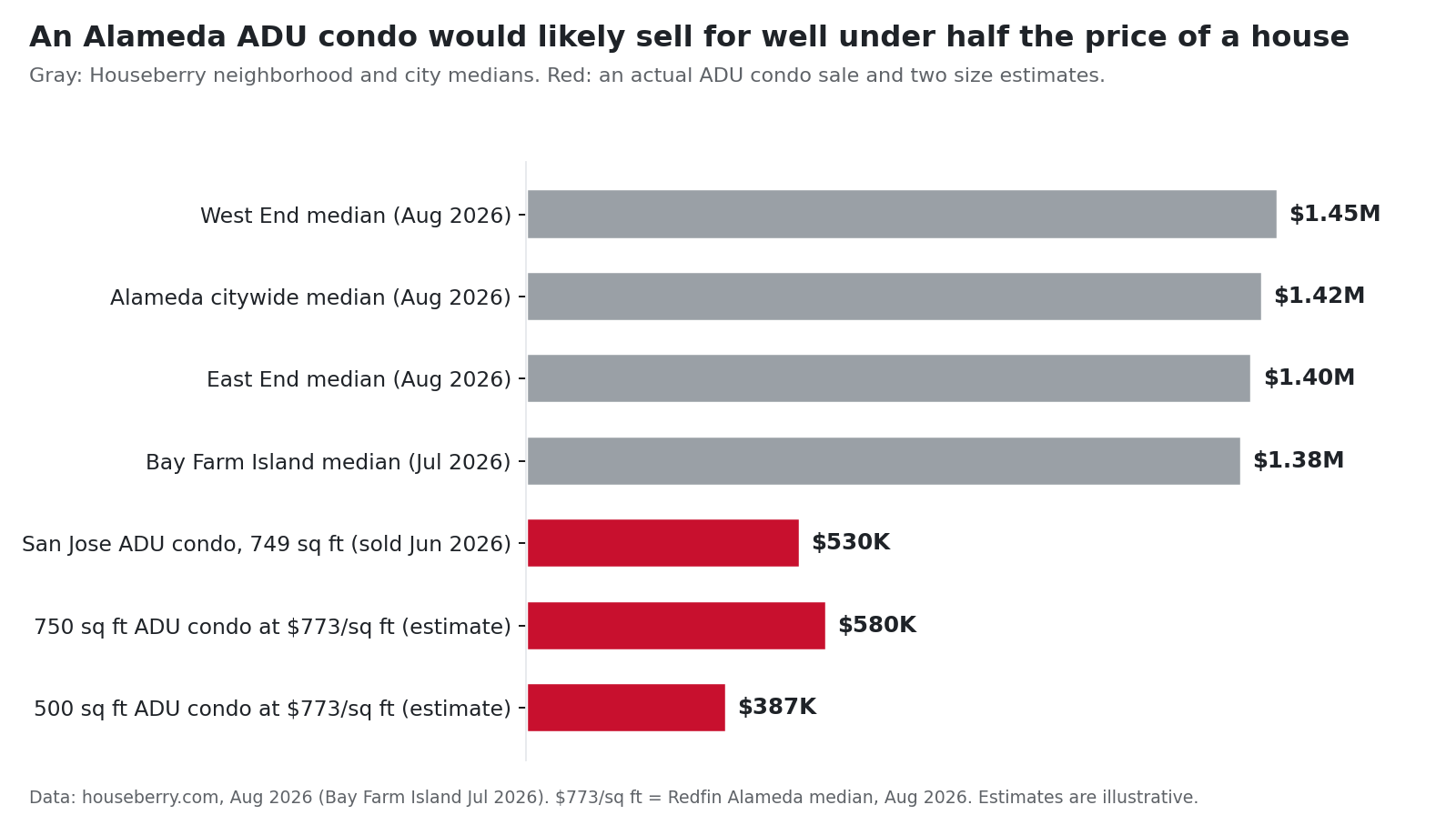
On our own numbers, the West End median was about $1.45 million in August 2026, the East End about $1.40 million, and Bay Farm Island about $1.38 million in July 2026. Very few houses on the island trade anywhere near the ADU condo price band.
Two cautions on that math. Per-square-foot prices are an average across big houses and small condos, and small units sometimes command more per foot, sometimes less. And a condo with a two-member HOA and a shared driveway is a new product with no local sales history yet. Appraisers will be guessing for a while, which is why we label these as estimates and not comps.
Where the lots make this pencil
The East End and the older blocks of the West End are where Alameda ADU condos are most likely to show up first, because that is where the long, narrow lots are. Bay Farm Island is a harder case.
The East End, the part of the island between Park Street and the Fruitvale and High Street bridges, scores 4.1 overall and 4.4 for amenities on Houseberry. Its pre-war housing stock sits on deep lots with space behind the house and, often, a side path. That side path matters more than people think. A condo buyer needs a way in that does not run through someone else's kitchen door. Alameda's historic building study list counted about 4,000 buildings, a little under half of them Victorians, per SFGate.
The West End, the western half of the main island out toward Alameda Point, scores 3.4 overall and 3.0 on safety, with a 4.5 on public spaces. Its mix of older cottages and postwar homes on standard lots gives it plenty of candidates, and it is also where Alameda's bigger housing pipeline sits, as we covered in our piece on the 2,300 homes stalled at Alameda Point.
Bay Farm Island, the largely postwar planned community across San Leandro Bay next to Oakland Airport, ranks first in Alameda at 4.6 overall. But many of its homes sit inside the Community of Harbor Bay Isle association structure, on smaller, regular lots. Adding a second HOA layer on top of an existing one is the kind of thing lawyers enjoy and buyers do not.
How Alameda compares with Berkeley, San Jose and Oakland
Alameda joins San Jose and Berkeley among Bay Area cities with a working ADU condo route. Oakland, as far as we could find in late September 2026, has not adopted one.
| City | Status (Sept 2026) | Tenant first-offer window | Notable detail |
|---|---|---|---|
| Alameda | Final vote Oct 6, 2026, effective 30 days later | At least 60 days | No impact fees under 750 sq ft, ministerial map |
| Berkeley | Council approved Jan 2026 | Three months for tenants in rent-controlled ADUs | Exempt from the city's condo conversion fee |
| San Jose | In effect since 2024 | Follows state AB 1033 rules | First sale closed June 2026 at $530K |
| Oakland | No adopted ordinance found | Not applicable | Code bars separate sale except as state law allows |
Berkeley's version, per city staff's presentation and The Real Deal, is built around its rent-control system, which is why the tenant window is longer. Alameda's 60-day floor is simpler. San Jose went first, and our look at that first sale covers how a developer ran it as a proof of concept.
Oakland is the notable holdout. Its median of about $974,000 in August 2026 is the lowest of the four, so the price gap between an ADU condo and a house is narrower there. Maybe that makes the policy less urgent in Oakland. Or maybe it means Oakland ADU condos would be the only ones a lot of buyers could actually reach.
What this does and does not mean
It does mean an Alameda owner with a permitted ADU and a cooperative lender can, starting in November, turn that unit into cash without selling the house. It does not mean every backyard unit becomes a condo. At about 50 ADUs a year, this will be a trickle. The Planning Board discussion in May noted that converting every existing ADU would touch less than 3 percent of Alameda's rental stock.
Can my tenant stop the sale? No. They get the first offer at the public price for at least 60 days, not a veto.
Do I have to live on the property? The condo section does not add an owner-occupancy rule, and the broader update drops the owner-occupancy requirement for JADUs, per the Alameda Post's June report.
What if I have not built the ADU yet? Then the smarter move is to design it as a future condo from day one: its own meters, its own entrance path, under 750 square feet if you want to skip impact fees. Our rundown of California's 2026 ADU laws covers the state-level rules that apply alongside Alameda's.
I am for this. Alameda has spent decades being an island where the cheapest way into a house was a $1 million-plus mortgage. A $500,000 cottage with its own deed, a few blocks from Park Street, is exactly the kind of starter home the Bay Area stopped building. It will not fix affordability. It adds a rung to a ladder that has been missing a few.
If you are weighing whether a particular block has the lot depth and the neighborhood numbers to make it work, start with how Alameda's neighborhoods rank and work backward to the parcel. That is the order we would do it in.
Sources
- City of Alameda, Ordinance text amending Sections 30-5.18 and adding 30-5.19 (Legistar)
- City of Alameda, Council File 2026-6314, October 6, 2026 consent calendar (Legistar)
- Alameda Post, Council Advances Housing Rules, AC Transit Warns of Route Cuts
- Alameda Post, Planning Board Supports ADU-to-Condo Conversions
- Alameda Post, Planning Board Endorses New ADU-to-Condo Conversions
- California Legislature, AB 1033 bill status
- City of Berkeley, ADU Separate Sale Implementation presentation, January 2026
- The Real Deal, Berkeley approves ADU sales, January 22, 2026
- KQED, San Jose developers pioneer new California law selling ADUs as condos
- Sebastopol Times, Sebastopol City Council approves ADU condo conversions
- Redfin, Alameda housing market, August 2026
- SFGate, Step back in history with Alameda's Victorians
- Houseberry, Alameda city data and 12-month price history
Map of Alameda Neighborhoods
Loading map...
View Full Map
Top Neighborhoods in Alameda, CA




All information provided on this website including but not limited to - school ratings, safety, amenities, user opinions, and property data - is for general informational purposes only. We do not guarantee its reliability, accuracy, or completeness. Users should independently verify information and consult appropriate professionals as needed. By using this website, you agree Houseberry is not responsible for actions, decisions, or consequences arising from reliance on the information provided
houseberry.com - CA DRE# 01847391
 Bay East ©2025. CCAR ©2025. bridgeMLS ©2025. Information Deemed Reliable But Not Guaranteed. This information is being provided by the Bay East MLS, or CCAR MLS, or bridgeMLS. The listings presented here may or may not be listed by the Broker/Agent operating this website. This information is intended for the personal use of consumers and may not be used for any purpose other than to identify prospective properties consumers may be interested in purchasing. Data last updated at October 1, 2026 12:00 AM