Why AI Robotics Firms Are Leasing Sunnyvale, Not SF
Bay Area robotics occupancy went from under 500,000 square feet in 2020 to 7.6 million in 2026, and San Francisco holds only 11 percent of it. What Apptronik's Sunnyvale lease says about where the next wave of AI jobs lands.

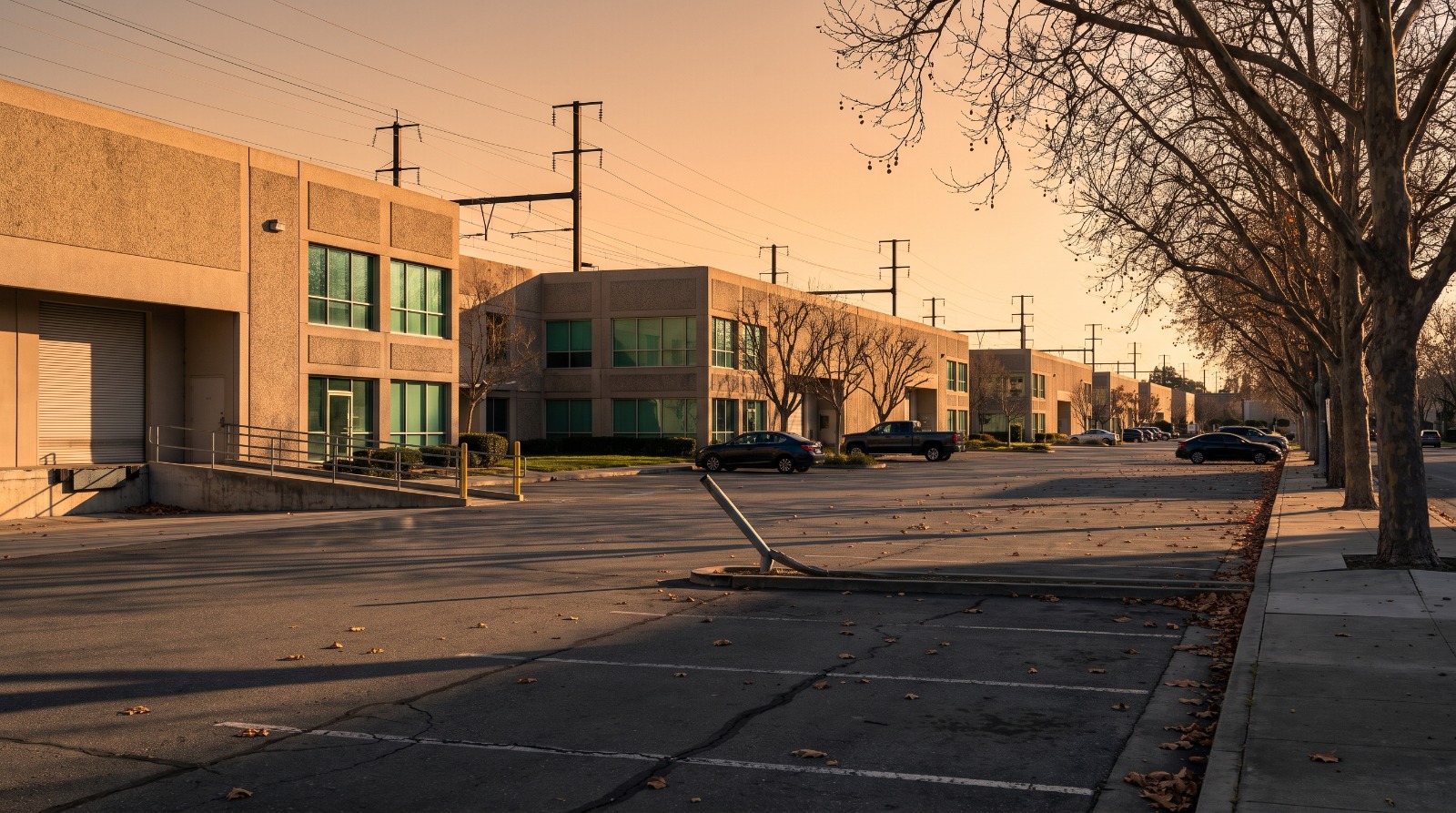
Low-rise research and development buildings along West California Avenue in Sunnyvale's Peery Park, the kind of space AI robotics companies are leasing in 2026. Photo: Houseberry
Bay Area robotics companies occupied under 500,000 square feet of real estate in 2020. In 2026 they occupy 7.6 million, according to JLL. San Francisco has 11 percent of it.
That gap is the story behind a small lease that ran in the trade press this week. Apptronik, the Austin humanoid robot maker, took roughly 27,000 square feet at 640 West California Avenue in Sunnyvale's Peery Park. It is not a big deal by square footage. It is a very good illustration of where physical AI actually goes when it needs a building.
Three numbers to hold onto: robotics occupancy is up more than fifteenfold in six years, Sunnyvale's research and development vacancy rate was 8.2 percent in the second quarter of 2026 against 11.7 percent for Silicon Valley overall, and San Francisco's office vacancy was 27.2 percent in the same quarter. Demand is not moving to where the empty space is. It is moving to where the right space is.
What Apptronik took, and what is not yet public
Worth being straight about the sourcing here. The Registry reported the lease on September 4, 2026, and its article body is paywalled. The landlord, the lease term, the rate and the brokers are not public. Apptronik itself has announced nothing about a Bay Area facility. Treat the square footage and the address as the confirmed facts and the rest as unknown.
What is well documented is the company. Apptronik closed a Series A totaling more than 935 million dollars on February 11, 2026 at a valuation around 5 billion, with Google, Mercedes-Benz, John Deere and the Qatar Investment Authority in the round. It had more than 350 employees by mid-2026. Its Apollo humanoid is a reference platform for Google DeepMind's Gemini Robotics work, which is one plausible reason to want engineers within driving distance of Mountain View.
Its manufacturing is not moving. Apptronik opened a 90,000 square foot facility in Austin around June 2026, in a former Dell server plant, for robot training and data collection. Twenty-seven thousand square feet in Sunnyvale is an engineering satellite. At the roughly 4.50 per square foot per month asking rate quoted for other space in that building, it runs about 1.5 million dollars a year in base rent.
The reason is electrical, not cultural
There is a temptation to read this as robotics companies rejecting San Francisco on vibes. The actual constraint is duller and much harder to argue with.
A robotics company in pilot production needs roughly 4,000 amps of electrical service. JLL estimates that fewer than 10 percent of Bay Area industrial buildings can supply it, and that only about 2.5 million square feet of currently available space qualifies. Add the other requirements, which are ground-floor access, a grade-level door big enough to move a crated humanoid, clear height to work under, and a floor rated for equipment, and a downtown tower is disqualified by physics before anyone discusses rent.
Alexander Quinn of JLL put the demand side plainly earlier this year: the leasing is driven by the convergence of robotics engineers, who are concentrated in the South Bay, and Bay Area AI talent. The buildings that serve both are low-rise, ground-oriented, and mostly sitting in Santa Clara County.
The market, in one table
Note the units, because brokers quote Silicon Valley monthly and triple net, and San Francisco annually and full service. They are not comparable at a glance.
| Metric, second quarter 2026 | Value | Source |
|---|---|---|
| Silicon Valley R&D vacancy | 11.7 percent | Kidder Mathews |
| Sunnyvale R&D vacancy | 8.2 percent | Kidder Mathews |
| Silicon Valley office vacancy | 15.2 percent | CBRE |
| San Francisco office vacancy | 27.2 percent | Kidder Mathews |
| Silicon Valley R&D asking rent | 2.61 per sq ft per month, NNN | Kidder Mathews |
| Sunnyvale R&D asking rent | 2.80 per sq ft per month, NNN | Kidder Mathews |
| San Francisco Class A and B asking rent | 49.10 per sq ft per year, full service | Kidder Mathews |
Converted to a common footing, Sunnyvale research and development space asks about 33.60 per square foot per year before operating expenses, against 49.10 all-in for San Francisco Class A and B. The South Bay is cheaper on paper and tighter in practice, which is an unusual combination and tells you the constraint is supply of the right building, not price.
One caveat that matters if you go reading quarterly reports: the brokerages disagree. Kidder Mathews put Silicon Valley R&D vacancy at 11.7 percent for the second quarter, Newmark at 12.6 percent and Cushman and Wakefield at 13.3 percent. They define the inventory differently. Always note whose number you are quoting.
San Francisco is not losing, and the honest version says so
The easy version of this piece would have San Francisco emptying out. The data says something more specific.
San Francisco office vacancy fell 440 basis points year over year, from 31.6 percent to 27.2 percent, and citywide leasing is running at a pace not seen since the late nineties. OpenAI has crossed 1.2 million square feet in the city. Anthropic is near 995,000. Sierra took 300,000 at China Basin. Those are enormous commitments and they are all in San Francisco.
The split runs along a product line, not a city line. San Francisco holds about half of the region's roughly 96 tracked AI robotics companies, and about 80 percent of the San Francisco ones occupy plain office space. They write software. When a company starts building hardware at volume, it leaves.
The cleanest example is Figure AI, which moved out of a 27,900 square foot Sunnyvale office in March 2025 and into 98,700 square feet of San Jose flex industrial. Apptronik has just taken 27,000 square feet in Sunnyvale. Same starting footprint, eighteen months apart. If the pattern holds, the interesting lease is the next one.
Peery Park was zoned for exactly this, and deliberately not for housing
Sunnyvale adopted the Peery Park Specific Plan on September 20, 2016, covering about 450 acres north of downtown between Mathilda Avenue, Central Expressway and Highway 237. The plan's stated vision names small scale research and development, prototyping and production businesses. The industrial edge district that includes the California Avenue business park allows up to 100 percent floor area ratio.
The plan authorized capacity for about 2 million square feet of new industrial and R&D space, and 215 residential units on 12 acres. That ratio is the policy choice, and Sunnyvale made it on purpose.
Elsewhere in the city, obsolete R&D is in fact becoming housing. A one-story R&D building at 215 Bordeaux Drive in Moffett Park is being replaced with 265 apartments, and Tidewater Capital won approval on February 25, 2026 to replace a Sunnyvale tech campus with 370 homes. Peery Park is going the other direction, and the pressure it creates lands on the neighborhoods around it.
The housing arithmetic nobody in the leasing coverage mentions
Sunnyvale is required to permit 11,966 homes between 2023 and 2031. Through December 2024 it had issued 879 permits, which is 7.3 percent of the target with about a third of the cycle gone. Its development pipeline as of early 2022 held roughly eight jobs for every one housing unit.
You do not need a model to see where that leads. Every new engineering satellite in Peery Park is a demand shock against a supply line that is running at a fraction of its own commitment.
Where a Peery Park job actually puts you
Peery Park sits a block from Sunnyvale Caltrain, which is genuinely useful, and the district runs a free on-demand shuttle called Peery Park Rides. Practically, most people will drive from somewhere in a fifteen-mile arc, and Sunnyvale itself is only the middle of it. Here is what that arc costs.
| Place | Median sale price | Month | Overall | Schools | Safety |
|---|---|---|---|---|---|
| Sunnyvale, citywide | 2.46 million | August 2026 | 3.8 | 3.8 | 3.8 |
| Ortega, Sunnyvale | 2.95 million | August 2026 | 4.1 | 4.1 | 4.4 |
| Raynor, Sunnyvale | 2.69 million | July 2026 | 4.5 | 4.3 | 5.0 |
| Lakewood, Sunnyvale | 1.49 million | August 2026 | 3.6 | 3.5 | 3.7 |
| Santa Clara North Central | 2.03 million | June 2026 | 3.6 | 3.3 | 4.2 |
| Santa Clara, citywide | 1.97 million | July 2026 | 3.5 | 3.6 | 3.4 |
Two things jump out of that table. Lakewood, in north Sunnyvale near Highway 237 and Lawrence Expressway, sold at a median of about 1.49 million in August 2026, roughly a million dollars below the city median and about 1.46 million below Ortega, in the same city and a similar drive to Peery Park. It is the largest intra-city price gap in Sunnyvale and it is the one worth understanding before you rule the city out.
And Santa Clara North Central, just east of Lawrence Expressway, pairs a 4.2 safety score with a 2.03 million median from June 2026. That is the strongest safety-per-dollar in this set, and it is the sort of thing that only shows up when you compare Sunnyvale neighborhoods and Santa Clara school rankings side by side rather than shopping listings one at a time. Prices in that table come from each place's own twelve-month history, and the months differ, so read them with their dates attached.
The questions this raises
Does an AI lease push up nearby home prices? Not by itself, and not measurably from 27,000 square feet. What moves prices is sustained headcount growth across a submarket, and Silicon Valley office leasing hitting a seven-year high in the first half of 2026 is a better signal than any single deal.
Is Sunnyvale R&D space going to become housing? Some of the city's is. Peery Park's is not, because the specific plan zoned it for industry and gave housing 12 acres out of 450.
Where do you buy under 2 million dollars near these jobs? North Sunnyvale and most of Santa Clara, plus the value end of San Jose, where the citywide median was about 1.63 million in August 2026. Below that number you are trading commute time or school scores, and it is worth deciding which one first.
What this does and does not mean
It does mean that the physical AI buildout has a clear geography, and it is Santa Clara County R&D parks rather than downtown towers. It means the buildings that qualify are scarce, which is why an 8.2 percent Sunnyvale vacancy rate coexists with a 27.2 percent San Francisco rate.
It does not mean San Francisco is finished, or that this one lease changes anything for a buyer. Twenty-seven thousand square feet is about 60 people. This is a marker, not a movement.
We wrote about what the San Francisco AI office boom means for neighborhoods three weeks ago, and this is the other half of that story. The software half stayed in the city. The half that builds things came south, and it is going to keep coming south, because that is where the buildings with enough power are.
Sources
- The Registry, September 4, 2026: humanoid robotics maker Apptronik leases 27,000 sq ft in Sunnyvale's Peery Park
- Apptronik: closing a Series A of more than 935 million dollars
- Bisnow, April 21, 2026: robotics and physical AI drive demand for millions of square feet in the Bay Area
- SF Standard, August 23, 2026: AI robotics and San Francisco's share of the buildout
- Kidder Mathews Silicon Valley R&D market report, Q2 2026
- Kidder Mathews San Francisco office market report, Q2 2026
- CBRE Silicon Valley office figures, Q2 2026
- CBRE, May 2026: AI boom drives office leasing surge in the San Francisco Bay Area
- Commercial Real Estate Direct, March 18, 2025: Figure AI leases 98,700 sq ft of flex industrial space in San Jose
- City of Sunnyvale, File 16-0907: adoption of the Peery Park Specific Plan
- Peery Park Specific Plan EIR, CEQAnet
- SV@Home: Sunnyvale housing data and RHNA progress
- The Registry, February 2026: Tidewater Capital wins approval to replace a Sunnyvale tech campus with 370 homes
- SF Standard, August 30, 2026: Silicon Valley office, Amazon and Google in Sunnyvale
The Houseberry Research Team is Houseberry's reporting team: Bay Area real estate analysts, data specialists and longtime local market watchers. Every day we check the public record: building permits, city council and planning agendas, county recorder filings, state housing bills, police incident data and school results. Then we tie each story to what it means for specific neighborhoods, using Houseberry's own neighborhood data on prices, appreciation, safety, schools and amenities. Questions or corrections: Contact us.
Map of Sunnyvale Neighborhoods
Loading map...
View Full Map
Top Neighborhoods in Sunnyvale, CA


All information provided on this website including but not limited to - school ratings, safety, amenities, user opinions, and property data - is for general informational purposes only. We do not guarantee its reliability, accuracy, or completeness. Users should independently verify information and consult appropriate professionals as needed. By using this website, you agree Houseberry is not responsible for actions, decisions, or consequences arising from reliance on the information provided
houseberry.com - CA DRE# 01847391
 Bay East ©2025. CCAR ©2025. bridgeMLS ©2025. Information Deemed Reliable But Not Guaranteed. This information is being provided by the Bay East MLS, or CCAR MLS, or bridgeMLS. The listings presented here may or may not be listed by the Broker/Agent operating this website. This information is intended for the personal use of consumers and may not be used for any purpose other than to identify prospective properties consumers may be interested in purchasing. Data last updated at October 22, 2026 12:00 AM