Sunnyvale Beam: Can $3.50 Rides Replace a Second Car?
Sunnyvale's new $3.50 citywide shuttle, compared with Cupertino's SV Hopper and Palo Alto Link, plus the math on whether a south Sunnyvale household can actually drop a second car.

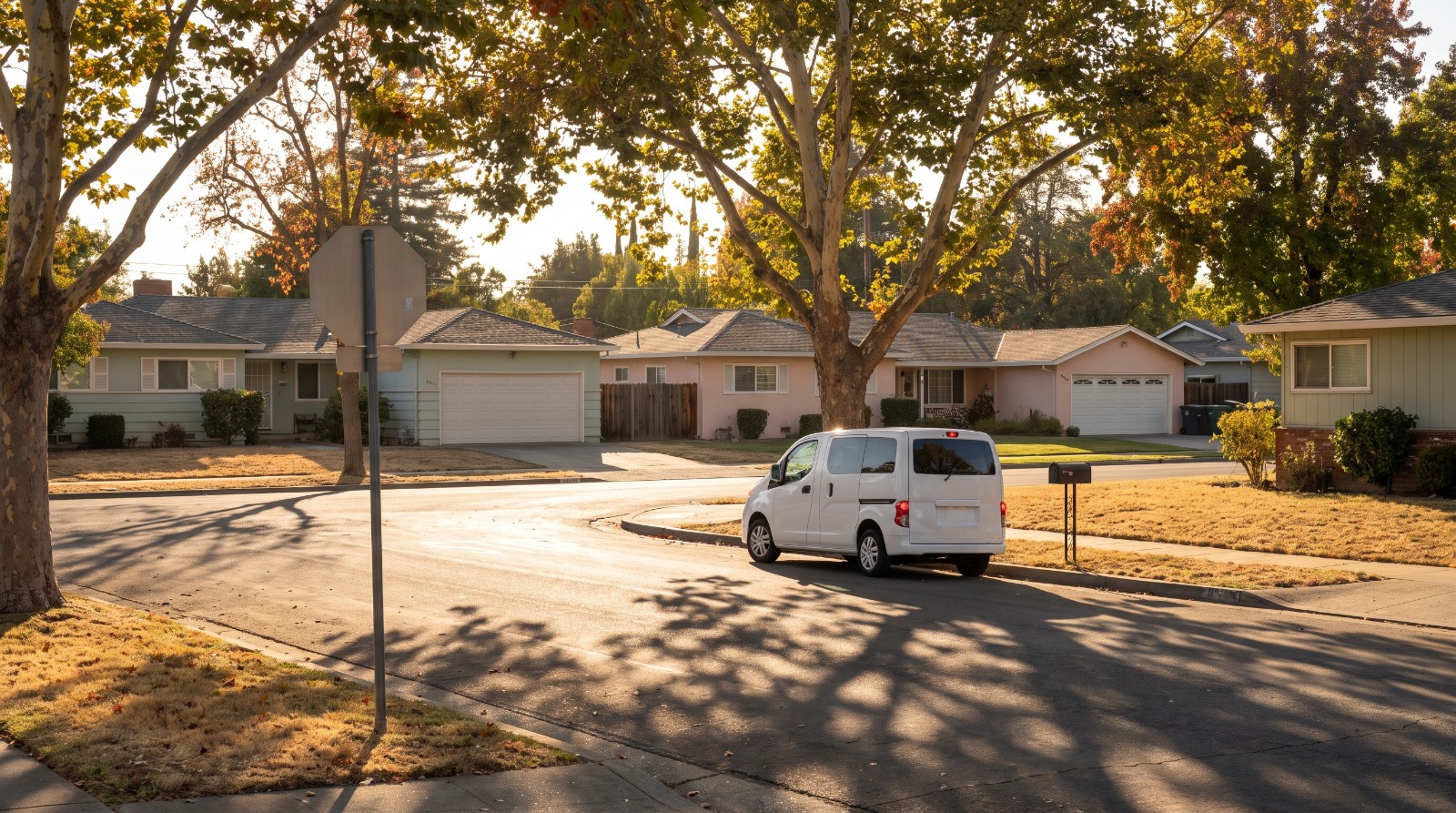
A small white shuttle van pulling up to the curb on a quiet ranch-home street corner in Sunnyvale, the kind of trip Sunnyvale Beam now covers for $3.50. Photo: Houseberry
A friend who lives off Hollenbeck Avenue in Serra asked me the question a lot of Sunnyvale households are quietly asking this month: now that the city runs a $3.50 ride to anywhere inside its borders, can she finally sell the second car?
The short answer is closer to yes than I expected, with two conditions attached. Sunnyvale Beam, the on-demand shuttle the city started on August 18 and celebrated on September 1, covers all 19.2 square miles of the city for $3.50 a ride, or $1.75 if you are 65 or older, 13 to 18, low-income, or living with a disability. It runs weekdays 7 a.m. to 9 p.m. and weekends 9 a.m. to 5 p.m. The conditions are the hours and the fleet.
Beam will not replace a car for everyone. It replaces the trips a second car exists for here: the Caltrain run, the Homestead High pickup, the Kaiser appointment, the downtown dinner. On the south side of Sunnyvale, where every rail station is two or three miles away, that is most of the second car's job.
What Sunnyvale Beam offers as of September 2026
Beam is a city program operated under contract by Via, the company behind Cupertino's Silicon Valley Hopper and Palo Alto Link. You book through the Sunnyvale Beam app or by calling 408-547-9943, 15 to 20 minutes ahead, since there are no advance reservations. The city's Beam page covers the rest: corner-to-corner pickups at virtual stops, door-to-door for riders who need it, anyone 13 and up can ride alone, and your first three rides are free.
The service area is the whole city plus two out-of-town stops added on purpose: Homestead High School, just over the Cupertino line, and Kaiser Permanente's Santa Clara medical center on Lawrence Expressway. A parent in Ortega without a second car can do the school run and a 10 a.m. appointment on the same morning without a rideshare bill.
The fleet is nine electric vehicles, six Kia Niros and three Ford E-Transit vans, per the city's environmental filing and San José Spotlight's reporting. Riders took about 800 trips in the two weeks before the ribbon cutting. Jim Van Pernis, 81, told the Spotlight: "This will help, especially with the last mile."
How Beam compares to SV Hopper and Palo Alto Link
Sunnyvale is the third nearby city to run a Via shuttle, and the other two tell you what to expect. Cupertino's Silicon Valley Hopper, expanded into north Santa Clara this July, charges the same $3.50 and gave roughly 103,000 rides in the year before that expansion, per the Silicon Valley Voice. Palo Alto Link charges $4 and is on borrowed time. Side by side:
| Service | Fare | Hours | Service area | Booking |
|---|---|---|---|---|
| Sunnyvale Beam | $3.50, $1.75 reduced, $1 per extra rider | Weekdays 7 a.m. to 9 p.m., weekends 9 a.m. to 5 p.m. | All of Sunnyvale plus Homestead High and Kaiser Santa Clara | Sunnyvale Beam app or 408-547-9943 |
| Silicon Valley Hopper (Cupertino) | $3.50, $1.75 reduced, $1 per extra rider | Weekdays 7 a.m. to 7 p.m., Saturday 9 a.m. to 5 p.m., no Sunday service | Cupertino and Santa Clara plus Sunnyvale and Mountain View Caltrain and El Camino Hospital | Silicon Valley Hopper app or 669-201-1892 |
| Palo Alto Link | $4, $2 reduced, $2 per extra rider | Weekdays 7 a.m. to 7 p.m., no weekend service | Most of Palo Alto, excluding Stanford, north of Bayshore and south of 280 | Palo Alto Link app or 650-505-5772, approved through Oct. 30, 2026 |
Beam is the only one that runs past 7 p.m. on a weekday and the only one open on Sundays, the coverage a car replacement needs. The other number to notice is $26, what the Palo Alto Daily Post reported each Link ride costs once the $1.2 million annual budget is spread across the trips. That gap is why Palo Alto's council spent the spring debating Uber and Lyft vouchers and why the city's page now lists October 30, 2026 as the end of the approved run.
The second-car math, neighborhood by neighborhood
Owning a new car cost an average of $11,577 a year in 2025, about $965 a month, according to AAA's annual driving-cost study. At $3.50 a ride, that buys roughly 3,300 Beam trips a year. A household riding twice every weekday, which is heavy use, spends about $1,750. Most second cars are a paid-off Corolla costing a few thousand a year, not $11,577, so the math works less dramatically, and it works best in the parts of Sunnyvale farthest from a train.
That is the south side. Serra, on the west side around Serra Park, ranks second on our Sunnyvale neighborhood rankings with an overall 4.4 and a 4.8 for safety, and its median sale price was about $3.03 million in August 2026. Raynor, near Lawrence Expressway and Homestead Road, ranks first at 4.5 with a perfect 5.0 for safety and a July 2026 median near $2.69 million. De Anza, the Cherry Chase Elementary area, sits at 4.3 with an August 2026 median of about $2.96 million. Ponderosa, around Ponderosa Park near Wolfe Road, comes in at 3.8 with a July 2026 median of about $2.54 million.
All four sit roughly two to three miles from the Sunnyvale or Lawrence Caltrain stations and farther from the light rail on Tasman Drive, and all four are where a $2.5 million to $3 million ranch house comes with a two-car garage. Nobody in Serra is walking to Caltrain, but a ten-minute shuttle to the downtown station is a different proposition.
The north side reads differently. Lakewood, north of 101 near Twin Creeks and Baylands Park, scores 3.6 overall and its median was around $1.49 million in August 2026, the lowest in the city. It sits near the Fair Oaks light rail stop and the Moffett Park offices Google just recommitted to, but far from Caltrain, and the city's project filing named Lakewood as one of two neighborhoods the service was designed around. The Heritage District, downtown around Murphy Avenue and the Caltrain station, already leads Sunnyvale on our amenities ranking at 4.3, and Beam matters less where you can already walk.
Against Cupertino, the price line still leads. Sunnyvale's citywide median was about $2.48 million in July 2026 on our city page, against roughly $3.28 million in Cupertino as of May 2026. Sunnyvale now has a longer-hours version for about $800,000 less on the house, and the 137 for-sale townhomes approved on Kifer Road will land a short Beam ride from Lawrence Caltrain.
The parts the launch coverage skipped
The honest downside is that a nine-vehicle fleet has a ceiling. The Hopper's annual report for November 2023 through November 2024 shows an average wait of 14.1 minutes with 13 vehicles, and peak waits of 24 minutes on Thursday afternoons. Beam has nine vehicles for a city of about 155,000 people, so the 3 p.m. to 5 p.m. school window is where you will feel it. Palo Alto's "seat unavailable" rate climbing to 15 to 20 percent this year is what a capacity crunch looks like from inside the app. A 5 p.m. Saturday cutoff is the other gap. The car still comes out for dinner.
Then there is the money. Beam costs about $1.6 million a year, and a roughly $4.2 million state Transit and Intercity Rail Capital Program grant covers about half of that for the first five years. The city has budgeted the program for 20 years, and a 20-year budget line is a plan that future councils can revisit. Councils turn over, general funds get squeezed, and Palo Alto went from a lifeline extension in June 2025 to a shutdown date a year later. Beam's real test is year six, when the full $1.6 million lands on the city budget.
Do not sell the second car on the strength of a launch press release. Ride Beam for a month and track the waits at the hours you actually travel, especially school pickup and Saturday afternoon. If it covers the Caltrain run, the school run and the Kaiser run reliably, the second car is doing a lot less work than its insurance bill suggests. If the waits stretch past 20 minutes at 3 p.m., you have learned something too.
Either way, the shuttle changes what to research when comparing Sunnyvale neighborhoods. A house in Serra or Raynor that used to require two cars might now need one and an app. When we compare neighborhoods at Houseberry, that is the kind of detail that moves a place up or down the list before the address does.
Sources
City of Sunnyvale, Sunnyvale Beam program page
Via, Sunnyvale Beam rider information
San José Spotlight, Silicon Valley cities get funding for ride-share service (Nov. 5, 2024)
CEQAnet, Sunnyvale Zero-Emission First-Mile Last-Mile Microtransit Project (SCH 2025040088)
City of Cupertino, SV Hopper program page
Cities of Cupertino and Santa Clara, SV Hopper Annual Report, Nov. 2023 to Nov. 2024
Silicon Valley Voice, SV Hopper expands to north Santa Clara (July 2026)
City of Palo Alto, Palo Alto Link program page
San José Spotlight, Palo Alto may end ride-share program amid bleak budget outlook (March 2026)
AAA, Your Driving Costs 2025 (Sept. 16, 2025)
Houseberry, Sunnyvale neighborhood rankings, Serra, Lakewood, Sunnyvale and Cupertino city pages
The Houseberry Research Team is Houseberry's reporting team: Bay Area real estate analysts, data specialists and longtime local market watchers. Every day we check the public record: building permits, city council and planning agendas, county recorder filings, state housing bills, police incident data and school results. Then we tie each story to what it means for specific neighborhoods, using Houseberry's own neighborhood data on prices, appreciation, safety, schools and amenities. Questions or corrections: Contact us.
Map of Sunnyvale Neighborhoods
Loading map...
View Full Map
Top Neighborhoods in Sunnyvale, CA


All information provided on this website including but not limited to - school ratings, safety, amenities, user opinions, and property data - is for general informational purposes only. We do not guarantee its reliability, accuracy, or completeness. Users should independently verify information and consult appropriate professionals as needed. By using this website, you agree Houseberry is not responsible for actions, decisions, or consequences arising from reliance on the information provided
houseberry.com - CA DRE# 01847391
 Bay East ©2025. CCAR ©2025. bridgeMLS ©2025. Information Deemed Reliable But Not Guaranteed. This information is being provided by the Bay East MLS, or CCAR MLS, or bridgeMLS. The listings presented here may or may not be listed by the Broker/Agent operating this website. This information is intended for the personal use of consumers and may not be used for any purpose other than to identify prospective properties consumers may be interested in purchasing. Data last updated at October 22, 2026 12:00 AM