SB 1116: Can You Split Your Lot in 2027?
SB 1116 is on the governor’s desk with a September 30 deadline. It rewrites California’s starter home law for applications filed on or after January 1, 2027. Here is what it changes, how it differs from SB 9, and which Bay Area lots would actually qualify.
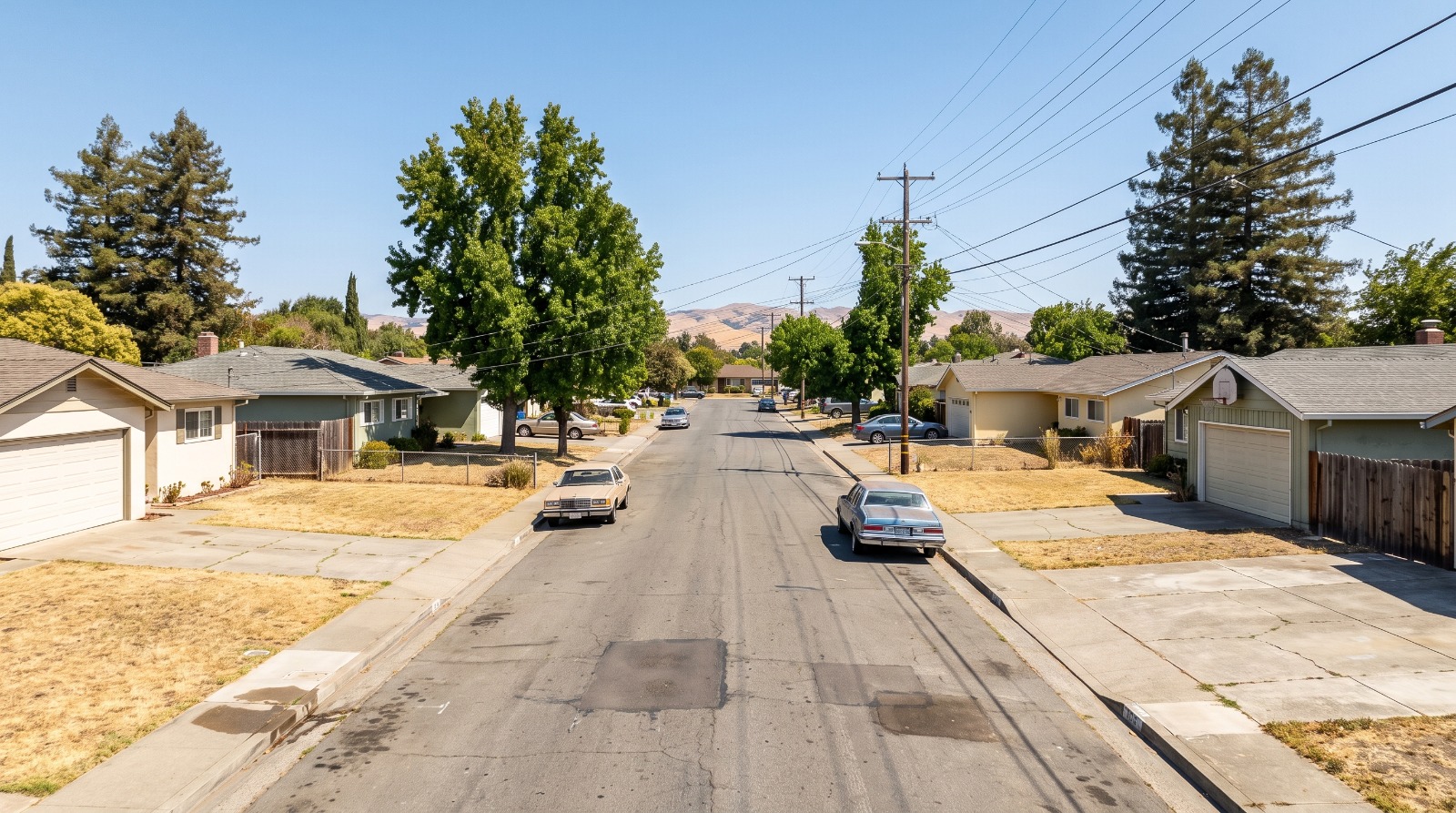
A flat street of single-story 1950s homes on wide lots in an inner Bay Area suburb, the kind of parcel California’s SB 1116 lot split rules would apply to. Photo: Houseberry
SB 1116 is sitting on Governor Newsom’s desk with a September 30 deadline, and if he signs it, California’s rules for splitting a lot into small for-sale homes change on January 1, 2027.
The short answer for a homeowner: this is probably not the law that lets you carve up your backyard. It is the law that decides what happens to the vacant parcel down the street and to the lot with the boarded-up house on it. But it is the most consequential small-lot bill of the year, it passed both houses without a single recorded no vote, and one of its provisions quietly reaches into private deed restrictions in a way nothing else on the desk does.
Here is what it actually says, checked against the bill text rather than the press releases.
What SB 1116 changes
The bill amends Government Code sections 65400, 65852.28 and 66499.41 and adds a new Civil Code section 714.9. Section 66499.41 governs the split itself. Section 65852.28 governs what you can build on the resulting lots. Most explainers blur the two, and the difference is why people come away confused.
Smaller lots, but through averaging rather than a lower floor
Existing law sets a hard minimum of 600 square feet for a new parcel on multifamily-zoned land and 1,200 square feet on single-family-zoned land. SB 1116 lets an individual parcel go as low as 480 or 960 square feet respectively, provided the average across the newly created parcels still clears 600 or 1,200.
So the floor did not drop 20 percent. The rigidity did. Before, one awkward corner or a utility easement could disqualify an entire subdivision layout. Now a designer can shave one lot and make it up on another. There is an anti-gaming clause attached: where averaging is used, no newly created residential parcel may be larger than 50 percent of the original parcel, which in practice means you cannot carve one token lot off the side and keep the rest as an estate.
Height gets measured in feet, not stories
The bill says height limits apply exclusively to the physical height of the building and may not restrict the number of floors. There is no number of feet anywhere in it. This is a measurement rule, not a threshold.
It matters more than it sounds. Cities were writing zoning as two stories maximum and using that to kill three-story townhouse stacks that fit comfortably inside the same height envelope. A 960-square-foot lot only pencils if you can build up. The story cap was, functionally, the off switch.
Setbacks between the new lots go away
A local agency may not require a front setback greater than 10 feet from the original lot line, and may not impose internal setbacks between the newly created parcels at all, except as the California Building Standards Code requires for fire and building separation.
The second half is the consequential one and almost nobody has written about it. On a 960-square-foot parcel, a conventional five-foot side yard on each side of a new interior line eats most of the buildable width. Zeroing the internal setbacks is what makes a rowhouse form legal by right instead of theoretically permitted and physically impossible.
Stairs stop counting against the size cap
Qualifying projects are capped at an average of 1,750 net habitable square feet per home, and SB 1116 redefines net habitable square feet to exclude stairs and enclosed bicycle parking, alongside the garages, carports, cellars, half-stories and unfinished attics already excluded.
A three-story townhouse has two full stair runs. Counting that footprint on every floor against the cap was a tax on building vertically, which is the only direction a small lot has. Depending on the design, this is worth two to three hundred square feet of real living space per unit. It is the least glamorous provision in the bill and possibly the one that changes the most floor plans.
Private covenants that block these projects become unenforceable
New Civil Code section 714.9 makes void and unenforceable any covenant, condition, restriction or other provision in a deed, declaration, contract or security instrument that prohibits or would physically preclude a housing development permitted under sections 65852.28 or 66499.41.
That reaches the private-law layer that survives even after a city’s zoning has been preempted. Enormous stretches of Bay Area tract housing built after 1950 carry recorded minimum-lot-size and one-dwelling-per-parcel covenants with no active association left to enforce them, and a title company that flags them anyway. Those appear to be exactly the covenants this voids. How the section interacts with a functioning homeowners association operating under Davis-Stirling is the part to read closely before relying on it, and it is the question I would put to a land use attorney rather than to a blog.
SB 9 and SB 1116 are not the same law, and they do not apply to the same land
This is the confusion worth clearing up first, because almost every search for a California lot split lands on SB 9 content.
| SB 9, live since 2022 | SB 1116, applications from January 1, 2027 | |
|---|---|---|
| Maximum new parcels | 2 | 10 |
| Maximum units | 4, two per lot | 10 |
| Minimum resulting lot | 1,200 sq ft | 480 or 960 sq ft with averaging |
| Split ratio | No lot smaller than 40 percent of the original | No new parcel larger than 50 percent of the original where averaging is used |
| Owner occupancy | Three-year affidavit required | None |
| Eligible land | Single-family zoned | Multifamily up to 5 acres, or vacant single-family up to 1.5 acres |
| Must the land be vacant | No | Yes on the single-family track |
| Internal setbacks | Four feet side and rear | Prohibited except under the building code |
| Height | Set locally | Set locally, but in feet rather than stories |
| Unit size | 800 sq ft minimum | 1,750 net habitable sq ft average maximum |
| Private CC and Rs | Not addressed | Void where they block the project |
| Further splits | Banned | Not banned |
The one-line version: SB 9 is for the homeowner who wants to split their own backyard and keep living there. SB 1116 is for the owner of a vacant or derelict parcel who wants to build up to ten for-sale homes and move on. They are not competitors. They mostly do not even touch the same parcels.
SB 9’s record is the cautionary half of this. Terner Center researchers found that in the law’s first year through November 2022, San Jose received ten urban lot split applications and approved five, San Francisco received four and approved two, and Berkeley received one and approved none. A law can be on the books for years and produce almost nothing.
The sleeper provision: vacant no longer means empty
SB 1116 redefines vacant to include a parcel whose only permanent structure is abandoned or untenantable, using the standard in Civil Code section 1941.1.
This is a real eligibility expansion and it is the item I would flag to anyone sitting on an inherited property. The single-family track added by SB 1123 in 2024 applies only to vacant land. Under the old reading, a derelict, boarded-up, uninhabitable house made a parcel not vacant and therefore ineligible, which was precisely backwards. The worse the structure, the more locked the land.
The standard borrowed here is the tenant habitability standard, the one that decides whether a landlord could legally rent a place out. No working plumbing, no heat, not weatherproof. The test for whether a lot is developable is now the same test for whether it would be illegal to rent. That is a tidy piece of drafting, and it opens up a category of parcel nobody has been counting.
The tenant protections sit separately and still apply. Qualifying projects cannot demolish rent-controlled housing, deed-restricted affordable housing, or housing occupied by tenants within the statutory lookback.
Why the first version produced almost nothing, and what Campbell did differently
The Starter Home Revitalization Act is not new. It has been rewritten three times because cities kept finding ways around it.
The lineage runs from AB 803 in 2021, through SB 684 in 2023 which took effect July 1, 2024 and allowed up to ten homes on qualifying sites, to SB 1123 in 2024 which extended it to vacant single-family land and took effect July 1, 2025. The first project under the law to break ground anywhere in California did so on March 6, 2026, in Campbell, roughly twenty months after SB 684 went live.
Campbell is also the counterexample, and it is worth dwelling on. The city publishes a live tracker of its starter home projects, and it lists thirteen of them filed between October 31, 2024 and March 2026, with five approved and six under review. Project sizes run from two to nine homes. One Silicon Valley city of about 43,000 people ran the law straight and got thirteen projects in seventeen months while the rest of the state produced almost nothing.
What the others did is documented. Reporting on the cleanup bill describes Oakland requiring conditional use permits for qualifying projects and enforcing setback and open space rules that made them undeliverable, and Hayward improperly limiting applications to exclusively multifamily-zoned sites. SB 1116 reads, section by section, like a list of the specific workarounds cities used. That is a more honest framing than saying the law failed.
Where in the Bay Area this would actually apply
Not where you would guess. The exclusions push this away from the towns with the biggest lots and toward the flat older suburbs.
Qualifying sites are capped at ten parcels and ten units, five acres on multifamily-zoned land, 1.5 acres on vacant single-family land, and must sit in urban infill locations. Prime farmland, wetlands, very high fire hazard severity zones, hazardous waste sites, earthquake fault zones, flood hazard areas and conservation lands are all excluded.
Run that filter across the region and the hillside towns mostly drop out. Atherton requires a full acre minimum on gentle slopes and five acres above a 35 percent grade under its own municipal code, which is a different universe from a 960-square-foot parcel. The Oakland and Berkeley hills, much of Danville and hillside Saratoga fall out on fire hazard. What is left is flat, older, 5,000 to 8,000 square foot inner-suburb land. For reference, San Jose’s median single-family lot has been measured at about 6,000 square feet and San Francisco’s at about 2,701.
Here is what those candidate cities cost right now, taken from each city page’s twelve-month price history with the month attached.
| City | Median price | Month |
|---|---|---|
| Concord | $824,630 | July 2026 |
| Livermore | $1.27M | July 2026 |
| Walnut Creek | $1.53M | June 2026 |
| San Jose | $1.63M | August 2026 |
| Fremont | $1.71M | June 2026 |
| Los Altos, for contrast | $4.86M | July 2026 |
Concord is the interesting line. It is flat, it is not in a fire severity zone, its lots are generous, and at $824,630 it is the only city in that set trading under a million. A law aimed at producing modest for-sale homes has to work somewhere the finished product can be priced under the regional median, and that is a short list, and San Jose and Fremont at $1.63 million and $1.71 million show how quickly that gets hard. The East Bay value ranking is where we track which neighborhoods are priced below what their scores would predict, and it overlaps with this map more than you would expect.
The January 1 cliff, and what to watch
The new rules apply only to applications a local agency receives on or after January 1, 2027. A lot split application filed in December 2026 is governed by the old rules for its entire life.
That is an unusually clean piece of timing guidance and I have not seen anyone else write it down. If you are working on a small-lot subdivision in a Bay Area city right now, the question of whether to file this quarter or wait a quarter has a real answer attached to it, and the answer depends on whether the internal setback rule and the stairs exclusion change your yield.
Between now and September 30, the only thing to watch is the signature. SB 1116 is one of eleven housing bills we tracked onto the governor’s desk this session, and the full list and where each one stands is worth a look if you are following the whole package. After that, the thing to watch is the same thing that has decided every one of these laws: whether cities write ordinances that implement it or ordinances that dilute it. Campbell showed what the first looks like. Local agencies have to submit their implementing ordinances to the state for review, and the annual progress reports will start carrying starter home application and permit counts, which means for the first time there will be a public scoreboard.
For most homeowners the practical takeaway is smaller and more useful. If you want a second home on your property and you intend to keep living there, the 2026 ADU laws are still your tool and they are already in force. If you own a vacant parcel, or one with a structure nobody could legally rent, 2027 is worth circling. And if you are just trying to understand why the Bay Area builds so little of the modest for-sale housing everyone says they want, the twenty months between a law taking effect and a single groundbreaking is most of the answer.
Sources
SB 1116 bill text and history, California Legislature
SB 1116 enrolled text, LegiScan
HousingWire, the starter home law cleanup bill
Assemblymember Boerner Horvath, Starter Home Revitalization Act of 2021 signed, August 31, 2021
City of Campbell, Starter Home Projects tracker
Allen Matkins, recent amendments to the Starter Home Revitalization Act
Terner Center for Housing Innovation, SB 9 Turns One
Atherton Municipal Code section 16.24.050, minimum lot sizes
StorageCafe, lot size and home size in the largest US cities
Houseberry, Bay Area city and neighborhood data, September 2026
All information provided on this website including but not limited to - school ratings, safety, amenities, user opinions, and property data - is for general informational purposes only. We do not guarantee its reliability, accuracy, or completeness. Users should independently verify information and consult appropriate professionals as needed. By using this website, you agree Houseberry is not responsible for actions, decisions, or consequences arising from reliance on the information provided
houseberry.com - CA DRE# 01847391
 Bay East ©2025. CCAR ©2025. bridgeMLS ©2025. Information Deemed Reliable But Not Guaranteed. This information is being provided by the Bay East MLS, or CCAR MLS, or bridgeMLS. The listings presented here may or may not be listed by the Broker/Agent operating this website. This information is intended for the personal use of consumers and may not be used for any purpose other than to identify prospective properties consumers may be interested in purchasing. Data last updated at September 9, 2026 12:00 AM