San Francisco Oversized Vehicle Rules, Explained
San Francisco’s large vehicle rule catches anything over 22 feet long or over 7 feet tall, which means a lot of ordinary work vans. Here is what the rule says, who the permit is for, what it costs, and how to park legally.
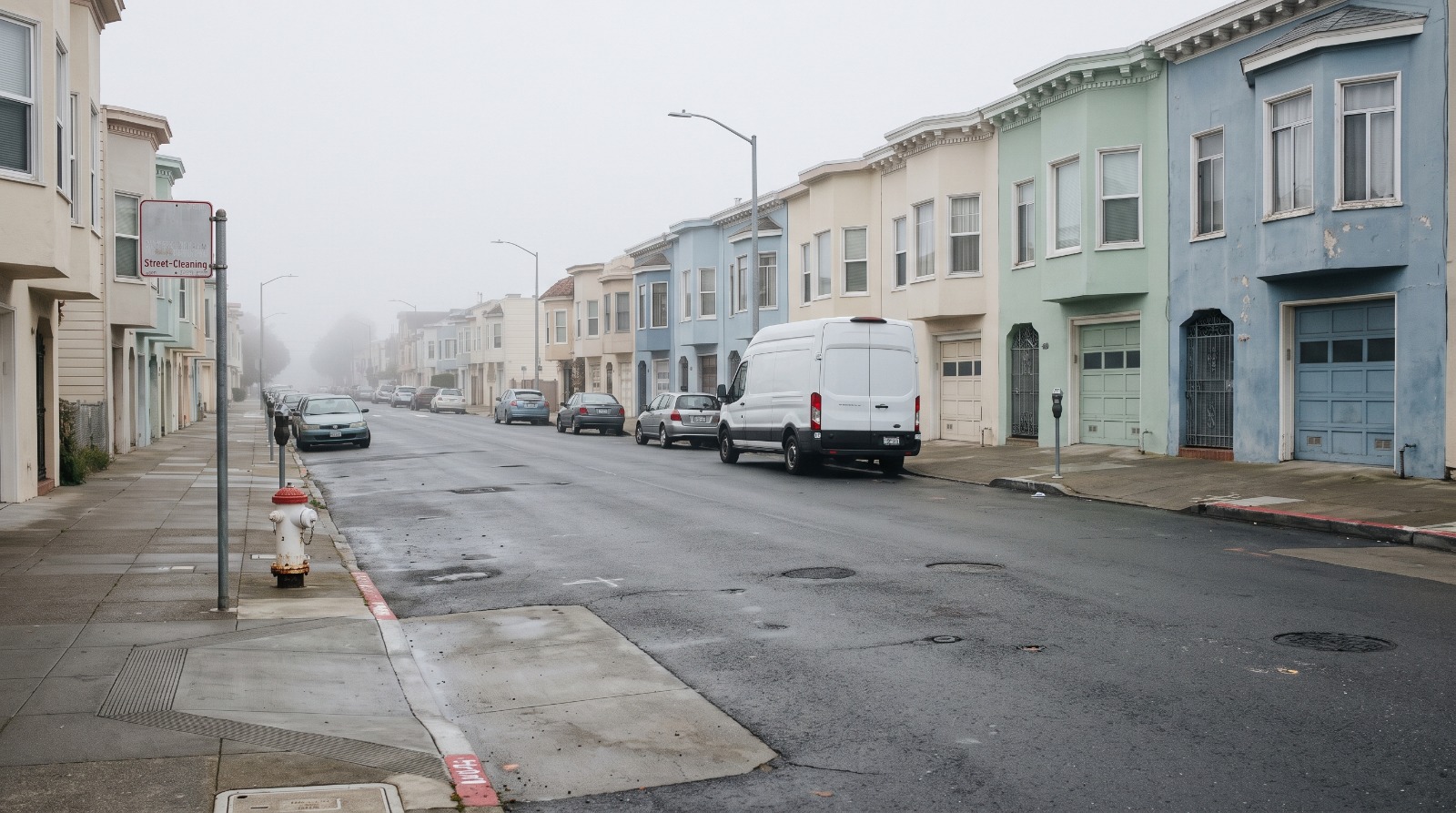
A high-roof cargo van parked at the curb on an Outer Sunset residential street in San Francisco, the kind of vehicle covered by the city’s oversized vehicle parking rule. Photo: Houseberry
The number that catches people in San Francisco’s oversized vehicle rule is not 22 feet. It is 7 feet.
The rule applies to any vehicle longer than 22 feet or taller than 7 feet, and that little word does a lot of work. A 19-foot high-roof Sprinter is nowhere near 22 feet long, and it is regulated. So is a ProMaster, a high-roof Transit, most box vans, and a great many of the work vehicles parked outside houses in the Sunset and the Excelsior every night. Since November 1, 2025, all of them have been subject to a two-hour parking limit on every street in the city, at every hour of the day.
Here is what the rule actually says, what it costs to get it wrong, and what your legal options are if you own a van, an RV or a boat on a trailer and live here.
What the rule covers, and the two versions of it
There are two large vehicle restrictions on the books in San Francisco, and they do different things.
The first is the new one. San Francisco Transportation Code section 7.2.54 defines a large vehicle as an RV, trailer, house car, mobile home, or any vehicle longer than 22 feet or taller than 7 feet, and limits it to two hours of street parking anywhere in the city. The SFMTA Board approved the change on June 17, 2025, the Board of Supervisors adopted the companion ordinance in July, and enforcement began November 1, 2025. Note that there is no width criterion in San Francisco, which is a difference from Mountain View and a common source of confusion.
The second is older and still in force. On streets where SFMTA has posted signs, large vehicles cannot park between midnight and 6 a.m. at all. That covers roughly 47 miles of street frontage across the city, according to SFMTA’s June 2025 board report. The city planned about 400 signs for the new program, 100 at entrances to the city and 300 spread through it, which means most blocks will not have a sign on them even though the two-hour limit still applies there.
That is the piece worth internalizing. The two-hour limit is citywide by default. The sign is not what makes it illegal.
When SFMTA decides which streets get the overnight posting, its own 2018 guidelines list four criteria: how many oversized vehicles concentrate at the location, whether it sits near a schoolyard, playground or community park, how scarce on-street parking already is there, and whether the area has ongoing graffiti and dumping problems. The city has not published a block-by-block map of the posted segments, so the only reliable way to know about your street is to look for the sign or ask SFMTA directly.
The permit exists, and it is almost certainly not for you
The ordinance created exactly one permit, and it is means tested.
The Large Vehicle Refuge Permit is for people who were living in a large vehicle in San Francisco on May 31, 2025, verified against the city’s own count, and who are certified by the Department of Homelessness and Supportive Housing as experiencing vehicular homelessness and engaged in services. It runs up to six months, is extendable once, is non-transferable, and it exempts the holder from the two-hour limit and nothing else. Street cleaning, the 72-hour rule, meters, colored curbs and driveway clearance all still apply.
The city counted 503 large vehicles in that May 2025 survey and had issued 322 permits by November 1, 2025, the day enforcement started.
So if you are a homeowner with a camper van, a contractor with a box truck, or a family with a boat, there is no permit application waiting for you. What there are instead are exemptions, and they are narrower than most people assume:
- Active loading and unloading is exempt, which covers the working part of a work van’s day but not the overnight
- Commercial vehicles in designated commercial loading zones are exempt during posted hours
- Vehicles on residential permit parking streets are described in SFMTA’s program materials as exempt from the two-hour large vehicle limit, which is the single most useful carve-out if your block has RPP. Confirm your specific block with SFMTA before relying on it
- A disabled placard exempts you from meters and RPP time limits, but it does not by itself exempt you from the large vehicle rule. Supervisor Myrna Melgar has publicly supported adding a disability exemption. As of today there is not one
Which leaves the practical answers most people end up at: a garage, a driveway, a private lot, a storage yard, or a street outside the city line.
What it costs when you get it wrong
The citation is $108, and the tow is the part that hurts.
SFMTA’s June 2025 board report puts the fine for a section 7.2.54 violation at $108, and the SF Standard reported the same figure this month. The 2025 amendments made large vehicle violations towable, and SFMTA’s text-before-tow courtesy warning program specifically excludes large vehicle infractions, so there is no heads-up text before the truck arrives. The city impound lot most oversized vehicles end up at is in Daly City, and release and storage fees are separate from the citation.
You have 21 days from the date of the ticket, or from the first courtesy notice, to contest it. Unpaid citations get transmitted to the DMV and will block a registration renewal.
The enforcement numbers give a sense of scale. As of early September 2026, the city had issued nearly 1,100 citations and towed more than 360 vehicles under the new rule. Over the same stretch, from November 2025 through July 2026, 28 people filed complaints saying the rule had hit them despite not living in their vehicle, most of them cargo van owners and several of them people whose van is the household’s only car.
How the neighbors handle it
Every Bay Area city with this issue has landed somewhere different, and knowing the map matters if you are deciding where to keep a vehicle.
| City | Size threshold | Restriction | Permit for ordinary owners |
|---|---|---|---|
| San Francisco | Over 22 ft long or over 7 ft tall | Two hours citywide at all hours, plus midnight to 6 a.m. on about 47 miles of posted frontage | No. The refuge permit is means tested |
| Mountain View | Over 22 ft long, over 7 ft wide, or over 7 ft tall | Banned on narrow streets, about 470 streets covering 1,081 blocks, enforced since October 1, 2022 | No general permit. Narrow exemptions only |
| Palo Alto | RVs | Council approved a 36-space permit parking pilot on August 25, 2026, expected to launch March 2027 | Pilot is tied to case management, not open enrollment |
| Berkeley | Not yet defined | Council voted 7 to 2 on July 7, 2026 directing staff to draft large vehicle rules | No rule adopted yet |
The pattern across all four is the same. Cities are regulating the vehicle rather than sorting out who is in it, which means the rules land on everyone who owns something tall.
Why this belongs on a neighborhood checklist
Off-street parking has quietly become a feature you should price, not an afterthought.
This is the sort of thing that never appears in a listing description and shapes daily life anyway. If you own a van, a truck with a shell, a camper or a trailer, a garage is now the difference between parking at home and parking in Daly City. San Francisco’s housing stock varies enormously on this. The Outer Sunset and the Richmond are full of flat-fronted homes with a garage under the living space, which is exactly the stock that solves the problem, and the Outer Sunset came in at $1.7 million in July 2026 against a citywide median of $2.2 million in August. Portola at $1.23 million in July has the same shape of housing at a lower number. Older flats in the Mission and North Beach mostly do not.
We built Houseberry around looking hard at the area before zeroing in on the address, and this is a small, concrete case of why. Two houses at the same price, three miles apart, and one of them makes your work vehicle legal to park. If you are going the other direction and getting rid of the car entirely, our piece on the San Francisco neighborhoods that work without one is the companion to this, and the full 92-neighborhood ranking is where to start comparing.
Two things I would confirm before relying on any of this
First, the boat trailer question does not have a published answer. The code lists trailers generically, and whether a tow vehicle and trailer are measured together or separately is not spelled out. A typical boat, trailer and truck combination clears 22 feet comfortably, so assume it is covered and call SFMTA if the answer matters to you.
Second, this is a young rule that is still moving. A disability exemption has support at the Board and does not exist yet, the fine is indexed annually, and Berkeley is drafting its own version right now. If you are making a decision with real money attached, check sf.gov and the SFMTA fee schedule for the current figures rather than trusting a number you read in September.
Sources
SFMTA, Board of Directors calendar item on large vehicle parking restrictions, June 17, 2025
SFMTA, Board resolution amending Transportation Code section 7.2.54
SFMTA, oversized vehicle overnight parking policy guidelines, December 18, 2018
sf.gov, Large Vehicle Refuge Permit Program
SFMTA, citations and how to contest them
The San Francisco Standard, September 8, 2026
KQED, San Francisco begins enforcement of the large vehicle rule, November 2025
El Tecolote, reporting on the permit rollout
City of Mountain View, narrow streets program
San Jose Spotlight, Palo Alto RV permit parking decision, August 2026
Street Spirit, Berkeley City Council votes to tighten RV parking rules, August 1, 2026
Houseberry, San Francisco neighborhood and city data, September 2026
All information provided on this website including but not limited to - school ratings, safety, amenities, user opinions, and property data - is for general informational purposes only. We do not guarantee its reliability, accuracy, or completeness. Users should independently verify information and consult appropriate professionals as needed. By using this website, you agree Houseberry is not responsible for actions, decisions, or consequences arising from reliance on the information provided
houseberry.com - CA DRE# 01847391
 Bay East ©2025. CCAR ©2025. bridgeMLS ©2025. Information Deemed Reliable But Not Guaranteed. This information is being provided by the Bay East MLS, or CCAR MLS, or bridgeMLS. The listings presented here may or may not be listed by the Broker/Agent operating this website. This information is intended for the personal use of consumers and may not be used for any purpose other than to identify prospective properties consumers may be interested in purchasing. Data last updated at September 9, 2026 12:00 AM