San Mateo County Affordable Housing: $24.3M, 459 Homes
San Mateo County just funded six affordable housing projects. We divided the awards by the homes and found a 7.5-to-1 spread between the cheapest project and the most expensive.

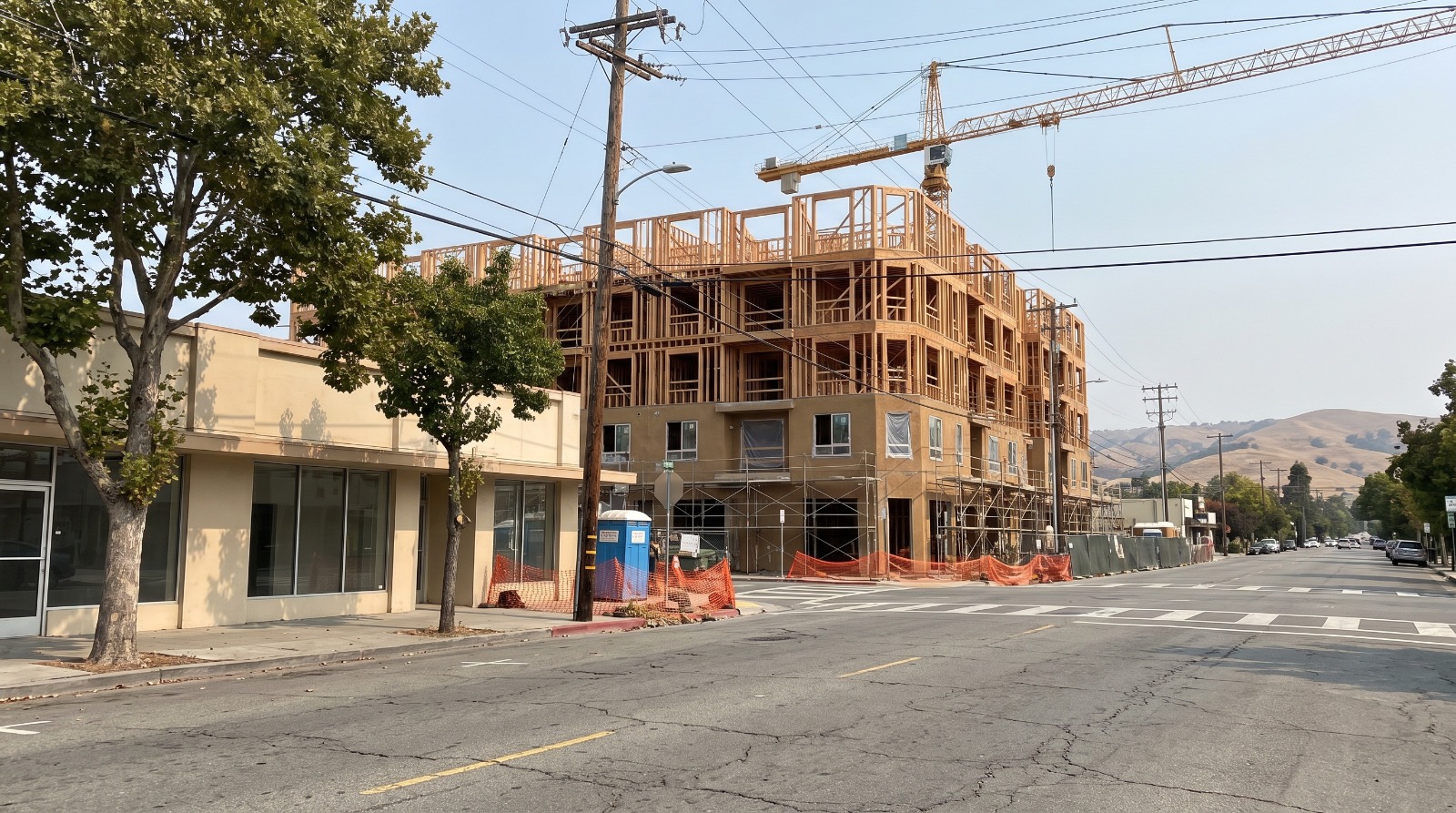
A five-story apartment building under construction on a Peninsula street, the kind of San Mateo County affordable housing project the county's Measure K fund pays into. Photo: Houseberry
San Mateo County committed $24,347,311 to affordable housing on Tuesday, August 25, 2026, spread across six projects holding 459 homes. Divide the money by the homes and the county paid $53,044 a home. Almost none of the six actually cost that. The cheapest home in the round cost the county $21,970. The most expensive cost $164,375. Same fund, same meeting, seven and a half times the price.
The county's own staff report and funding table lists the dollars and the units side by side. It does not divide them, and neither did the coverage. So we did.
The six projects, and what each home cost the county
Here is the round in full, sorted cheapest to most expensive per home. The award column is exact, from Attachment A of the staff report, not the rounded figures in the press coverage.
| Project (city) | Homes | County award | Cost per home |
|---|---|---|---|
| 3051 Edison, North Fair Oaks | 70 | $1,537,897 | $21,970 |
| 1051 Mission, South San Francisco | 158 | $3,545,414 | $22,439 |
| 626 Walnut Street, San Carlos | 95 | $3,000,000 | $31,579 |
| Rise City, Redwood City | 94 | $9,389,000 | $99,883 |
| Habitat Ladera, Portola Valley | 2 | $300,000 | $150,000 |
| 555 Kelly Avenue, Half Moon Bay | 40 | $6,575,000 | $164,375 |
| All six | 459 | $24,347,311 | $53,044 |
The $53,044 average is real arithmetic and almost useless as a guide. Four of the six projects sit nowhere near it. If you want to know what county money buys, the answer depends almost entirely on which city you are standing in and how big the project is.
Small projects and coastal land are what move the number
Two things drive the spread, and neither is waste. Scale is the first. Habitat for Humanity's Ladera project in Portola Valley is two homes. Two. Every fixed cost in a housing deal, the survey, the permits, the legal work, the utility hookups, lands on those two units, so $300,000 becomes $150,000 a home almost automatically. The 158-home project in South San Francisco spreads its fixed costs across eighty times as many households.
Land and labor are the second. 555 Kelly Avenue in Half Moon Bay is 40 homes for senior farmworkers on the coast, where there is no deep bench of subcontractors and no economies of scale to find. It drew the largest per-home award in the round and it is also the project we wrote about in July, when the city council sent it to the November ballot. The county funded it anyway.
Rise City in Redwood City is the one worth pausing on. Ninety-four homes at 1304 Middlefield Road, with 24 of them permanent supportive housing and 19 set aside for adults with intellectual and developmental disabilities, serving households from 20 to 70 percent of area median income. Redwood City had already put in roughly $8 million as a residual receipts loan, per the Redwood City Pulse. Add the county's $9,389,000 and local government alone is in for about $185,000 a home before a single state or federal dollar shows up. Deeply supportive housing costs more because it is harder. That is the trade, stated plainly.
The two cheapest projects are the two the county underfunded
This is the part that makes a simple cost-per-home ranking misleading, and it is why we are not going to hand you a league table of which city builds affordable housing most efficiently.
3051 Edison in North Fair Oaks asked for $7,810,000 and got $1,537,897, about 20 percent. 1051 Mission in South San Francisco asked for $9,386,692 and got $3,545,414, about 38 percent. Those are the two lowest per-home figures in the table, and the reason they are low is that the county declined most of the request. The other four got everything they asked for.
So a low number here is partly a measure of site efficiency and partly a measure of how much of the gap somebody else now has to close. Both projects still need the rest of the money from somewhere. Nine applicants met the county's threshold, together asking $58,929,293 for their share of 810 homes. Six got funded.
$53,044 against what a home on the Peninsula actually costs
Two comparisons put the county's contribution in scale, and they point in opposite directions.
Against the cost of building, it is a slice. The Terner Center at UC Berkeley put total development cost for affordable housing in its South and West Bay grouping at roughly $276,579 a unit in 2024 dollars, in research published in April 2025. If San Mateo County projects land anywhere near that, the county's blended $53,044 is covering something like a fifth of the stack. Housing Director Raymond Hodges told the Almanac that each Measure K dollar in the fund leverages about $16 from other sources. Those two figures do not sit comfortably together, and we would rather flag the tension than pick the flattering one.
Against the market, it is a rounding error. Our own price history has the South San Francisco median at about $1.29 million in July 2026, Redwood City at about $2.30 million, San Carlos at about $2.82 million and Portola Valley at about $4.43 million. The county's entire per-home subsidy in San Carlos, $31,579, is about one percent of what a San Carlos house trades for. That is the size of the lever the county is pulling.
Three projects cleared the bar and got nothing
The round drew 10 applications asking $70,329,293 for 810 homes. Three projects that met every threshold requirement went home empty, together holding 217 homes: Midway Village Phase 3 in Daly City, 146 homes from MidPen, asking $15,968,601. Ridge on Masonic in Belmont, 63 homes, asking $5,000,000. Laurel Landing in Menlo Park, eight Habitat homes, asking $700,000.
The staff report also shows $29,347,311 available, including $5 million in Mental Health Services Act money, against $24,347,311 committed. It does not explain what happens to the rest. If you follow county housing money, that is the question worth asking at the next meeting.
The per-home cost has roughly doubled since 2021
One round is a snapshot. Three rounds start to look like a trend, and this one is not comfortable.
In December 2021 the board approved $28.7 million toward 1,068 homes, which works out to $26,873 a home. In October 2025 it approved $41,146,469.75 toward 636 homes, or $64,696 a home. This round lands at $53,044. Call it a doubling of what a county dollar has to carry in five years, with a lot of noise around the line. Construction costs, insurance, interest rates and the shrinking pool of state and federal money all push the same direction.
Worth knowing: these awards are structured as low-interest, long-term, deferred payment loans, not grants. The money is supposed to come back eventually and go out again. Whether it does is a separate story.
What this does and does not mean
It does not mean Half Moon Bay wasted money or that North Fair Oaks got a bargain. It means the county is buying different products at different prices, and that a headline dollar figure tells you nothing about how far the money went.
For anyone comparing Peninsula cities as a place to live, the practical read is narrower than the headline suggests. Six projects and 459 homes will not change what a house costs in Redwood City or San Carlos. Since 2013 the fund has committed $368.8 million to 72 projects and 5,122 homes, of which about 3,100 are built and occupied. That is thirteen years of work against a countywide eight-year planning target of 47,687. The fund is doing something real for the people who get in. It is not the thing that moves the market.
What people ask next
Where does San Mateo County's affordable housing money come from?
This round is $24,247,311 of Measure K, the countywide half-cent sales tax, plus $100,000 in county impact fees for the unincorporated project. Of the Measure K portion, $19 million is new fiscal year 2026-27 revenue and $5,247,311 was recaptured from earlier commitments that came back unspent.
Who actually gets to live in these homes?
Across the 459 homes the county lists 24 for people who are unhoused, 76 for people with intellectual disabilities, 39 for senior farmworkers, 24 for public employees and 193 family units with two and three bedrooms. Average affordability across the projects clusters in the mid-40s to low-50s percent of area median income.
How much does it cost to build one affordable home in the Bay Area?
There is no clean San Mateo County figure in the public record, which is itself notable. The best regional benchmark is the Terner Center's roughly $276,579 per unit for the South and West Bay in 2024 dollars. Older Bay Area Council work using 2019 tax credit data put the nine-county average far higher, above $660,000 a unit, so treat any single number as a range rather than a price tag.
When will these homes actually exist?
Slowly. Rise City in Redwood City is one of the faster ones and does not start construction until early 2027. Of the 5,122 homes the fund has backed since 2013, about 1,190 are still in pre-development. One Daly City site has taken county commitments in 2019, 2020, 2021, 2022 and 2024 totaling roughly $25 million and has yet to be built.
Sources
- San Mateo County Board of Supervisors, File 26-679, Affordable Housing Fund 14.0 funding recommendations, August 25, 2026
- Attachment A, AHF 14 Funding Recommendations
- The Almanac, San Mateo County Board of Supervisors approves $24.3 million for affordable housing providers, August 26, 2026
- Redwood City Pulse, City approves millions for 2 affordable housing projects, May 12, 2026
- Terner Center for Housing Innovation, Reducing the Complexity in California's Affordable Housing Finance System, April 2025
- San Mateo County, Supervisors approve $28.7 million toward affordable housing, December 2021
- San Mateo County, County commits over $41 million to advance affordable housing projects, October 2025
- Home for All San Mateo County, RHNA 2023-2031 allocation
- Houseberry city price histories for South San Francisco, Redwood City, San Carlos and Portola Valley, read August 27, 2026
The Houseberry Research Team is Houseberry's reporting team: Bay Area real estate analysts, data specialists and longtime local market watchers. Every day we check the public record: building permits, city council and planning agendas, county recorder filings, state housing bills, police incident data and school results. Then we tie each story to what it means for specific neighborhoods, using Houseberry's own neighborhood data on prices, appreciation, safety, schools and amenities. Questions or corrections: Contact us.
All information provided on this website including but not limited to - school ratings, safety, amenities, user opinions, and property data - is for general informational purposes only. We do not guarantee its reliability, accuracy, or completeness. Users should independently verify information and consult appropriate professionals as needed. By using this website, you agree Houseberry is not responsible for actions, decisions, or consequences arising from reliance on the information provided
houseberry.com - CA DRE# 01847391
 Bay East ©2025. CCAR ©2025. bridgeMLS ©2025. Information Deemed Reliable But Not Guaranteed. This information is being provided by the Bay East MLS, or CCAR MLS, or bridgeMLS. The listings presented here may or may not be listed by the Broker/Agent operating this website. This information is intended for the personal use of consumers and may not be used for any purpose other than to identify prospective properties consumers may be interested in purchasing. Data last updated at October 22, 2026 12:00 AM