Tenant Rights After a Fire in San Francisco, Explained
Fire displacements in San Francisco hit 87 by late September 2026, already past last year. Here is what rent-controlled tenants keep after a fire, what landlords owe, what the city pays for, and where insurance fits.
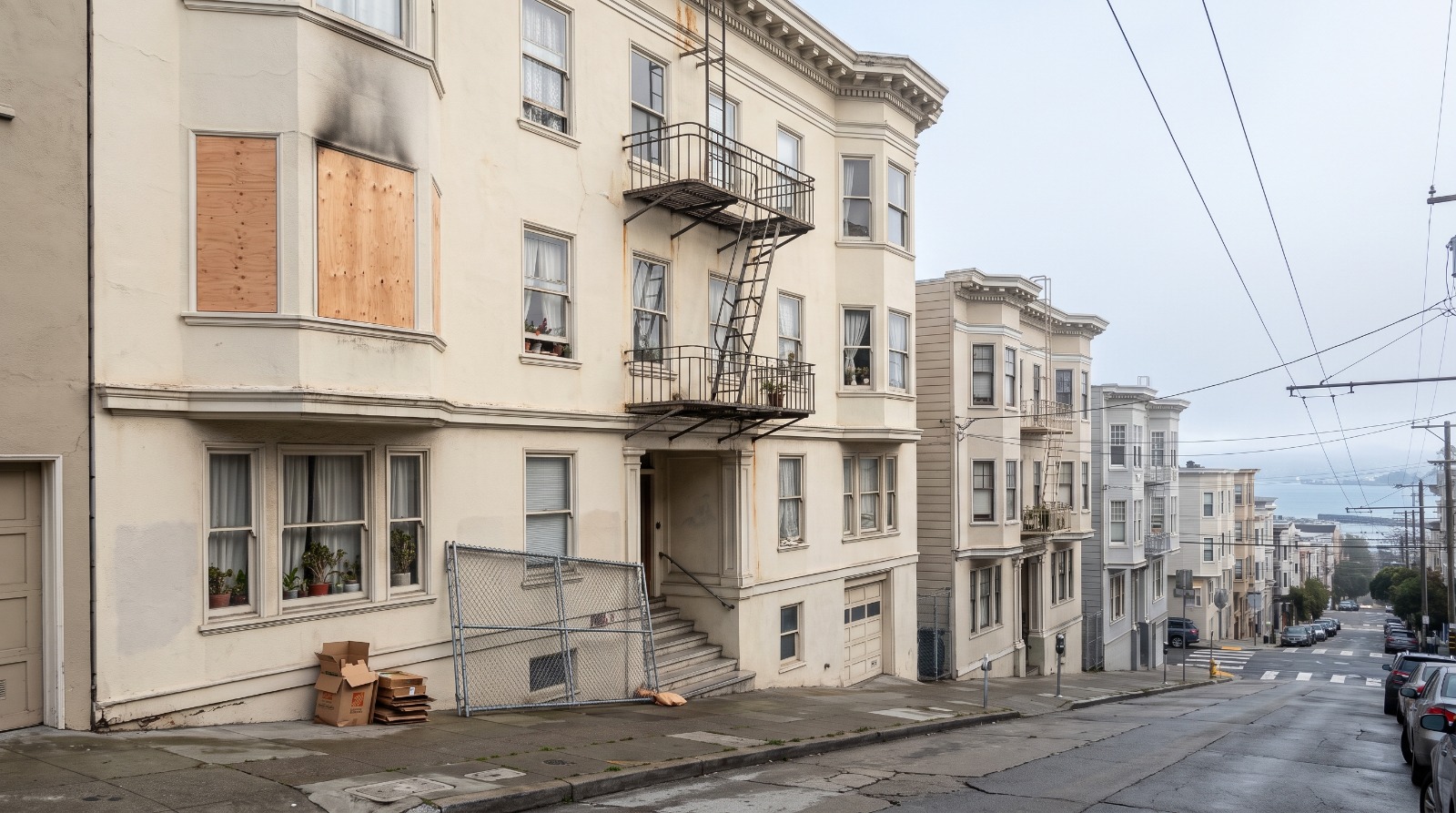
A Nob Hill apartment building with one boarded-up bay window after a fire, a reminder of tenant rights after a fire in San Francisco. Photo: Houseberry
The question parents and longtime renters keep asking me this fall is a simple one. If a fire guts my rent-controlled apartment, do I get it back?
In San Francisco, the answer is mostly yes. Once the unit is repaired, the landlord has to offer it back to you on the same terms and at the same rent. What the law does not give you is money to live somewhere else while you wait, and that gap is where people get hurt. The San Francisco Standard reported on September 28, 2026 that one Nob Hill tenant went from a $975 rent to a $2,900 replacement apartment after a fire.
Why fire displacement is suddenly a bigger San Francisco story
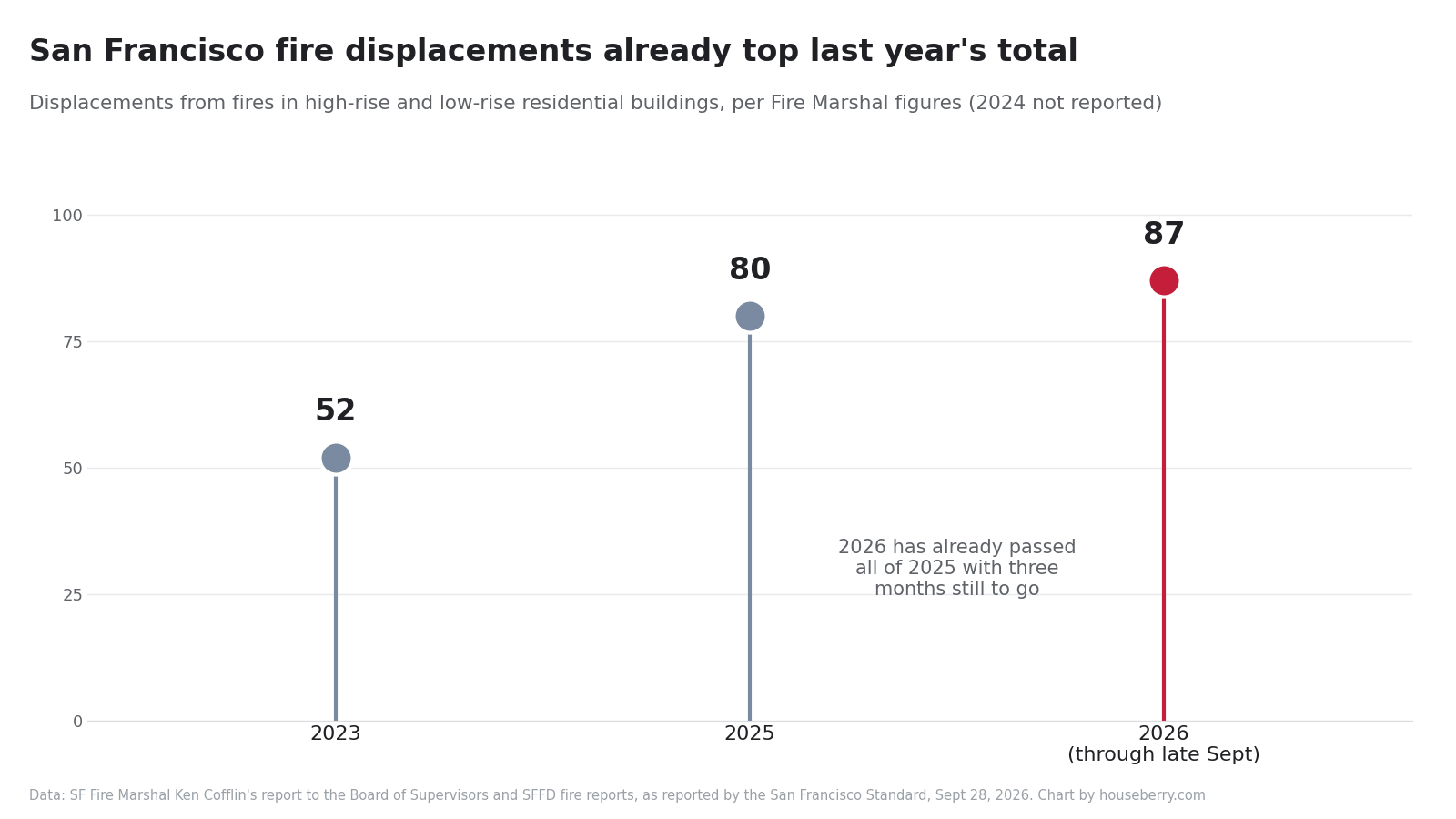
Fires in residential buildings are displacing more people than they were two years ago, and 2026 has already passed 2025 with a quarter of the year left. Fire Marshal Ken Cofflin's figures, shared with the Board of Supervisors and reported by the Standard, put 2023 at 52 displacements, which was itself a 10-year high. Last year hit 80. This year is at 87.
The buildings behind the recent headlines are older, rent-controlled ones. The Standard walked through a 24-unit building on La Playa Street in the Outer Sunset, the fog-belt neighborhood running along Ocean Beach between Golden Gate Park and Sloat Boulevard. A December fire in the Tenderloin uprooted about 142 tenants on its own.
I want to be careful here. A rising count is worth knowing about, but it is not a reason to avoid older buildings. The Outer Sunset still ranks second of 92 San Francisco neighborhoods in our citywide neighborhood ranking, with a 4.3 out of 5 safety score. What the trend changes is how seriously you should take the paperwork below.
Your right to return, step by step
Rent-controlled tenants keep their tenancy through a fire, and the landlord must bring them back once the unit is fixed. The rule is Section 12.19 of the Rent Board's Rules and Regulations, and the city's own summary lays out the clock.
Within 30 days after repairs are finished, the landlord has to offer you the same unit, under the same terms and conditions you had before. You then have 30 days to accept and 45 days from the offer to move back in. The offer has to go to the address you gave, the unit itself, or any other address the landlord knows about, and that explicitly includes email.
If the landlord re-rents your apartment to someone else instead, that is treated as a wrongful eviction under the Rent Ordinance, with exposure to actual and punitive damages. So the single most useful thing you can do on day one is put a forwarding email in writing to your landlord and keep a copy.
One real caveat. The right to return assumes there is something left to repair. When a building is demolished to the ground, whether the replacement counts as "repair" gets murky fast, as Mission Local found with the 22nd and Mission fire. Most fires never get there, but big ones can.
The relocation money gap nobody warns you about
San Francisco does not require landlords to pay relocation money when a fire they did not cause forces tenants out. City and state rules do require payments when a landlord moves tenants out for capital improvements or major rehab. A fire is treated as outside the landlord's control, so the relocation piece falls away. (If the landlord's negligence caused the fire, say a known-bad heater or dead alarms, that is a separate lawsuit with a two-year window, and worth a call to a tenant attorney.)
Here is what that gap looks like in real money. The tenant the Standard profiled paid $975 a month for her unit on Leavenworth Street in Nob Hill. Her replacement costs $2,900. Twelve months of that difference is about $23,100 out of pocket, before movers or storage.
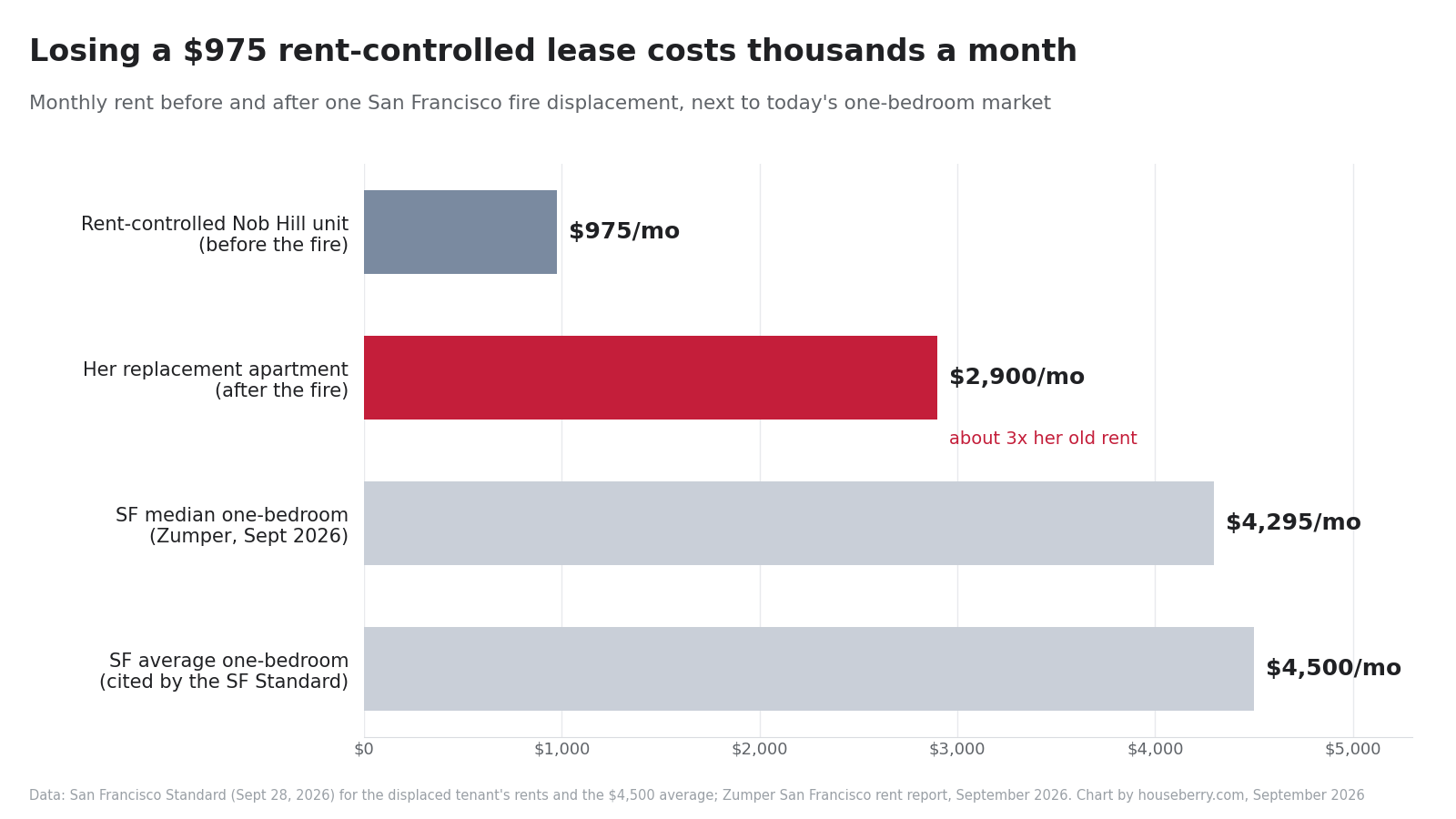
And she found something cheap by today's standards. Zumper's September 2026 report puts the San Francisco median one-bedroom at $4,295, up 21 percent in a year. The Standard cites an average closer to $4,500. For a long-tenured renter, that is the true cost of a fire: not the lost furniture, but the market you get thrown back into.
Where the city steps in
The city fills part of the relocation gap, but you have to ask, and the order matters. The Red Cross (866-272-2237) handles the first nights of shelter, food and clothing, per SFFD's fire damage page. After that, the Human Services Agency's Temporary Assistance for Displaced Persons program pays rent-controlled tenants a monthly subsidy for up to 12 months, or until the unit is ready if sooner. Non-rent-controlled tenants get a one-time move-in payment instead.
The eligibility lines are strict. You must apply within three months of displacement, have income at or below 100 percent of area median income, and have already used up any renters insurance benefit. HSA's page still lists an asset limit of $30,000 per person, but the Board of Supervisors voted in January 2026 to raise it, and Hoodline reported the new single-person cap at $130,000. Ask HSA which figure applies before you rule yourself out.
Two more tools are worth knowing. A Good Samaritan tenancy lets a landlord (yours or another) house you in a rent-controlled unit at your old rent, or up to 10 percent above it, for up to 12 months, extendable to 24, without that rent becoming the unit's new base. And if you will be out six months or longer, the Displaced Tenant Housing Preference moves you up in the city's affordable housing lotteries.
Here is how the pieces fit together.
| After the fire | Who usually covers it | Where the rule comes from |
|---|---|---|
| First nights of shelter, food, clothing | American Red Cross | SFFD and HSA fire resources |
| Hotel and extra living costs | Your renters insurance (loss of use) | Your policy |
| Rent gap while displaced (rent-controlled) | City subsidy, up to 12 months | HSA Temporary Assistance for Displaced Persons |
| Relocation payment from landlord | Not owed for a fire the landlord did not cause | SF Rent Ordinance |
| Getting your unit back at the same rent | Landlord must offer it within 30 days of repairs | Rent Board Rule 12.19 |
| Priority for affordable housing | City lottery preference if out 6+ months | Displaced Tenant Housing Preference |
Renters insurance is the piece people skip
A renters policy with loss-of-use coverage is what actually pays for the hotel and the pricier sublet in the first months. The California Department of Insurance's residential claims guide describes additional living expenses as covering temporary housing, food above your normal budget, storage, furniture rental and extra commuting, usually with an advance up front.
Keep every receipt. Insurers will ask you to account for each dollar, and HSA will ask whether your insurance is exhausted before it pays. The fire report itself comes from the SFFD Bureau of Fire Investigation (415-920-2933), and your insurer will want it.
If you own the building
Small landlords carry real obligations after a fire, and the ones that trip people up are about timing and notice rather than money. You must offer the repaired unit back within that 30-day window, at the old rent, to every address you know, including email. Doing basic research to find a displaced tenant's current contact is expected.
You are not stuck eating every cost. Repair costs your insurance does not cover can be passed through to tenants with a capital improvement petition at the Rent Board, with proper notice under Civil Code Section 827. A loss-of-rents endorsement on your landlord policy is what replaces income while units sit empty. And if you have a vacant unit, a Good Samaritan tenancy lets you keep a tenant housed without resetting that unit's base rent.
Where owners get in trouble is folding fire repairs into a larger remodel. Moving tenants out for capital improvements brings in notice rules, permits before any temporary eviction, and relocation payments, the Standard notes. Fire does not waive those when the work goes beyond fixing the damage.
I understand the temptation, and the numbers explain it. Our price history puts the Outer Sunset median at about $1.69 million in August 2026, up from about $1.47 million in September 2025, and the San Francisco citywide median at about $2.2 million. A small building with a $975 tenant is worth less to a buyer than one with a market-rate unit. That is exactly why the city made refusing a return a wrongful eviction, and why stalling rarely pays.
When waiting for your unit stops making sense
The honest downside of the right to return is that it has no deadline for the repair itself. Big restorations can stretch past a year, and the city subsidy stops at 12 months. Some tenants stay out long enough that the landlord offers a buyout instead, and landlord buyout filings are up 33 percent this year for reasons that have nothing to do with fire.
A buyout can be the right call, especially for someone who was already planning to move. But price it against the rent you would pay for the rest of your time in the city, not against this month's hotel bill. At a $3,300 monthly gap between a $975 rent and today's median one-bedroom, five years is roughly $200,000. Rent-controlled rents only rise by the Rent Board's annual allowance, and banked increases can add up, but the gap usually stays wide.
If you are the one deciding whether to hold on, whether that is in the Outer Sunset or on Nob Hill, the neighborhood still matters as much as the unit. We built Houseberry around looking at the area first, and that habit helps here too: if you end up moving, knowing which neighborhoods fit your budget and your commute before you start touring saves weeks when you have the least time to spare.
Sources
- San Francisco Standard, "Burned out: Fires are raging in rent-controlled apartments" (Sept 28, 2026)
- SF.gov, Tenant displacement due to fire or other disaster (Rent Board Rule 12.19)
- SF.gov, Good Samaritan tenancy information
- SF Human Services Agency, Emergency services for fire damage
- Hoodline, SF hikes fire aid after Tenderloin blaze (Feb 2026)
- SF.gov, Displaced Tenant Housing Preference
- San Francisco Fire Department, Help for fire damage
- Zumper, San Francisco rent research (Sept 2026)
- California Department of Insurance, Residential property claims guide
- Mission Local, Right to return after the 22nd and Mission fire
- Houseberry, Outer Sunset and San Francisco price history (Aug 2026)
Map of San Francisco Neighborhoods
Loading map...
View Full Map
Top Neighborhoods in San Francisco, CA


All information provided on this website including but not limited to - school ratings, safety, amenities, user opinions, and property data - is for general informational purposes only. We do not guarantee its reliability, accuracy, or completeness. Users should independently verify information and consult appropriate professionals as needed. By using this website, you agree Houseberry is not responsible for actions, decisions, or consequences arising from reliance on the information provided
houseberry.com - CA DRE# 01847391
 Bay East ©2025. CCAR ©2025. bridgeMLS ©2025. Information Deemed Reliable But Not Guaranteed. This information is being provided by the Bay East MLS, or CCAR MLS, or bridgeMLS. The listings presented here may or may not be listed by the Broker/Agent operating this website. This information is intended for the personal use of consumers and may not be used for any purpose other than to identify prospective properties consumers may be interested in purchasing. Data last updated at September 28, 2026 12:00 AM