AB 130 CEQA Exemption Clears Menlo Park Condo Project
Menlo Park filed a Notice of Exemption on September 18 for 15 condominiums at 800 Oak Grove Avenue, using the AB 130 infill exemption. It is the second time we have watched the statute clear a Bay Area project, and the first on a small for-sale one.
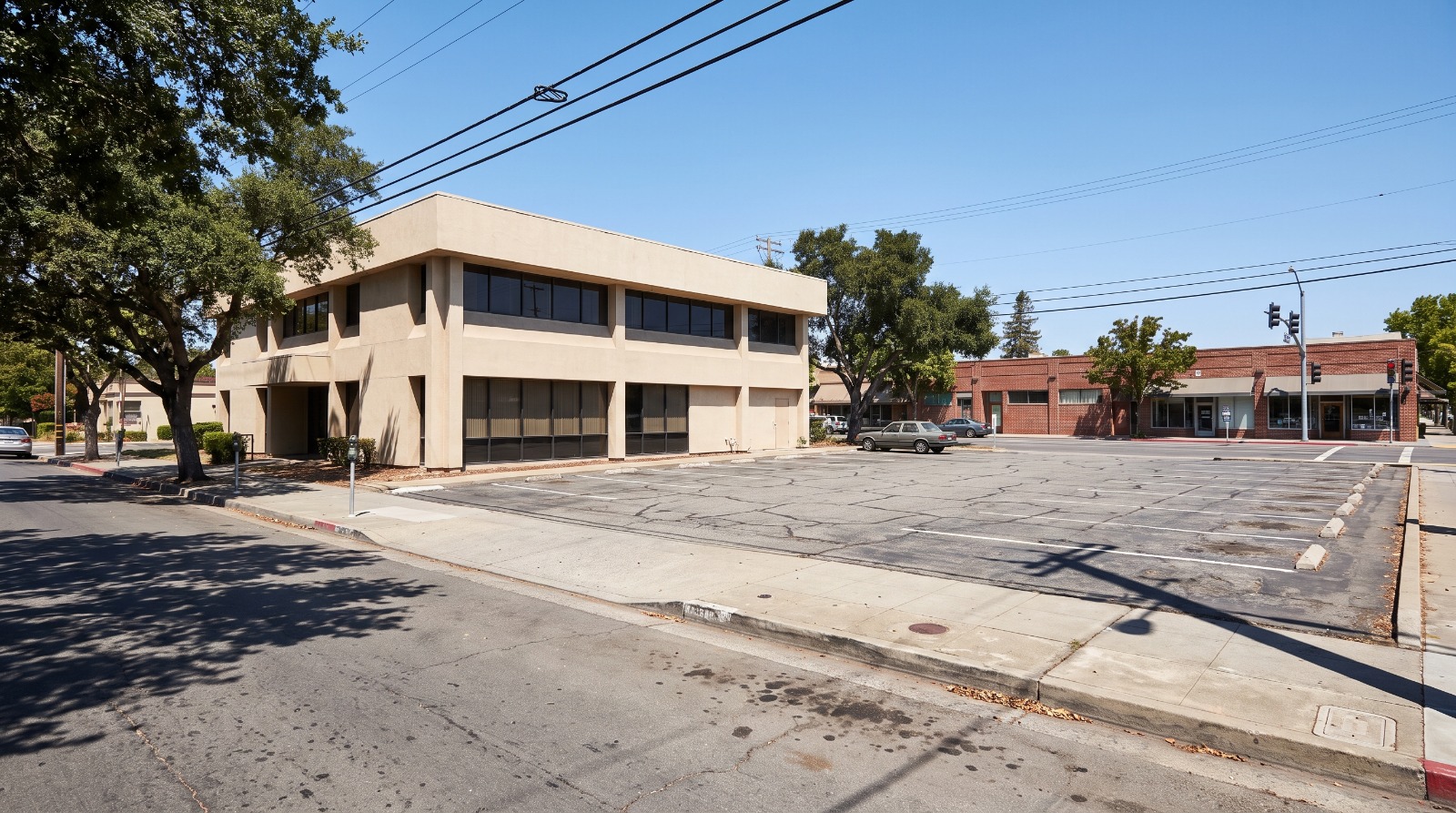
The vacant bank building and surface parking lot at Oak Grove Avenue and Crane Street in downtown Menlo Park, site of 15 approved condominiums. Photo: Houseberry
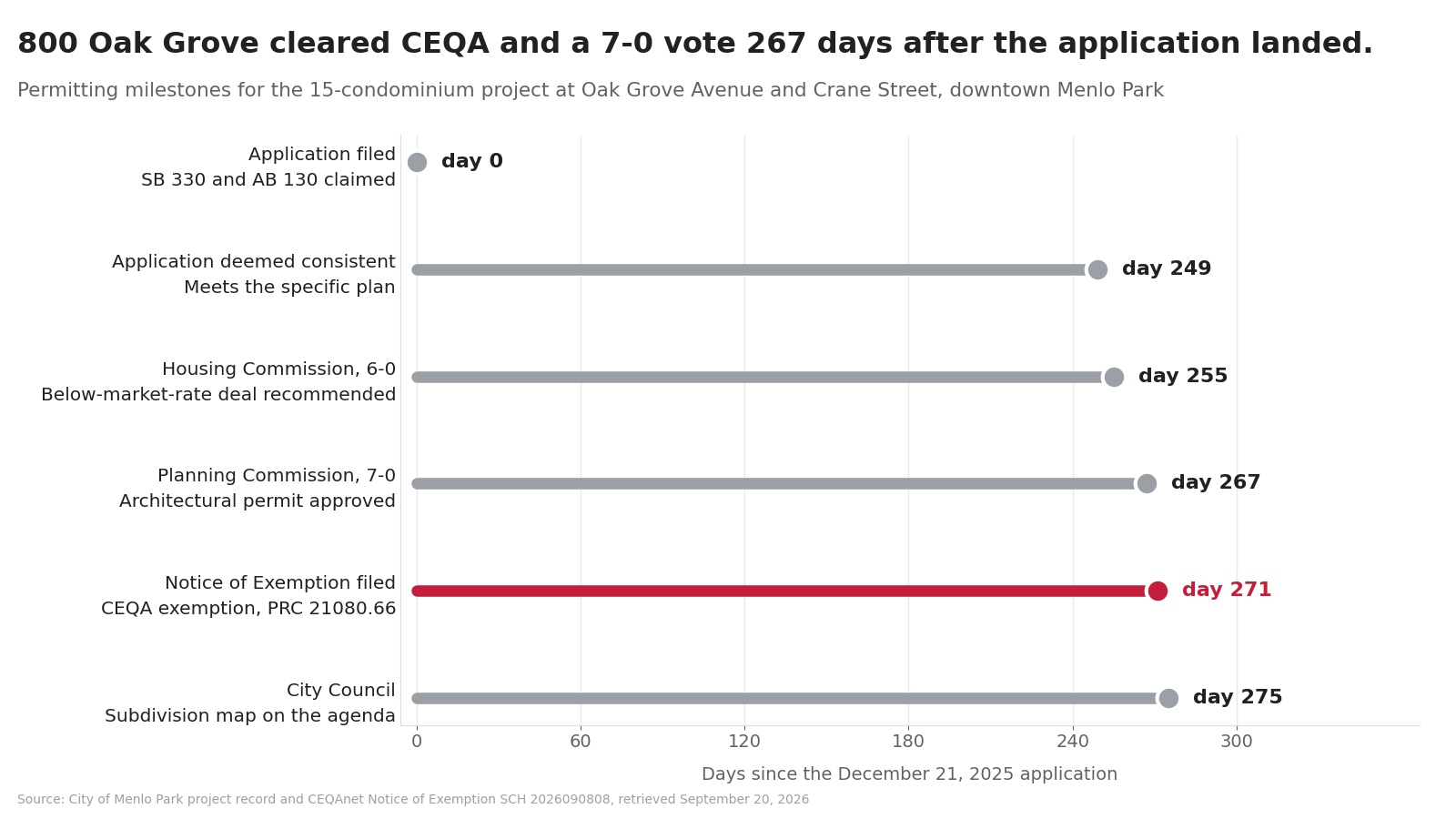
Ask a Peninsula planner what the AB 130 CEQA exemption actually does and you usually get a hypothetical. Here is a real one. On September 18, 2026, Menlo Park filed a Notice of Exemption for a six-story, 15-condominium building at 800 Oak Grove Avenue, claiming a full statutory exemption from environmental review under Public Resources Code section 21080.66. No study, no comment period on traffic counts, no mitigation package to negotiate. The application landed on December 21, 2025. The Planning Commission approved it 7-0 on September 14.
That is 267 days for a six-story building in a city that has spent decades being careful about six-story buildings.
A parking lot, 0.75 acres and no environmental document
The site is the corner lot at Oak Grove and Crane, one block off Santa Cruz Avenue and under a ten-minute walk to the Menlo Park Caltrain station. Anyone who has banked downtown knows it: a flat beige two-story Comerica branch, now vacant, next to a surface lot that has been some of the most valuable asphalt in San Mateo County for twenty years.
The lot gets the new building, about 72 feet tall. The bank gets an interior gut and a roof deck. The applicant is Rob Zirkle of Prince Street Partners, and the city project record puts the combined floor area at 61,562 square feet with 34 shared spaces on 0.75 acres.
We walked through the mechanics of section 21080.66 last month when San Jose used it on 264 apartments at 741 S. Winchester Boulevard, so the short version here: AB 130 was signed on July 1, 2025 in the state budget package, and it hands qualifying infill housing a complete statutory exemption instead of the narrower categorical ones cities had been stretching for years. Sites under 20 acres, in an urban area, consistent with zoning, over a minimum density floor, off protected and hazardous land. Meet the list and the analysis does not happen.
The statute was written for 264 apartments. It just cleared 15 condos.
That is the genuinely new thing here. Winchester was the case the CEQA reform debate was actually about: a big rental building on a dead commercial parcel, stuck since 2023. Oak Grove is 15 for-sale homes on three quarters of an acre in one of the most expensive downtowns in California. Same statute. Wildly different projects.
| 741 S. Winchester Blvd, San Jose | 800 Oak Grove Ave, Menlo Park | |
|---|---|---|
| Homes | 264 rental apartments | 15 for-sale condominiums |
| Building | 7 stories | 6 stories, about 72 feet |
| Site | 2.97 acres | 0.75 acres |
| Notice of Exemption filed | August 24, 2026 | September 18, 2026 |
| Exemption cited | PRC 21080.66 | PRC 21080.66 |
| Other state law used | Builder's remedy, Housing Accountability Act, density bonus | SB 330, Housing Accountability Act, density bonus, AB 2097 parking |
The seven-day notice on file with the city shows the real pattern. Oak Grove did not lean on one law. It stacked five: SB 330 to freeze the rules at application, the Housing Accountability Act because 72.5 percent of the floor area is residential, State Density Bonus Law for a 20 percent bonus plus a concession and waivers, AB 2097 to cut parking near transit, and AB 130 to delete environmental review at the end. Any one of those a city could have survived. Together they leave almost nothing to argue about, which is the point.
Fifteen condominiums in a $3.13 million market
Fifteen homes will not move the Menlo Park median. They add ownership product in a price band the city barely builds.
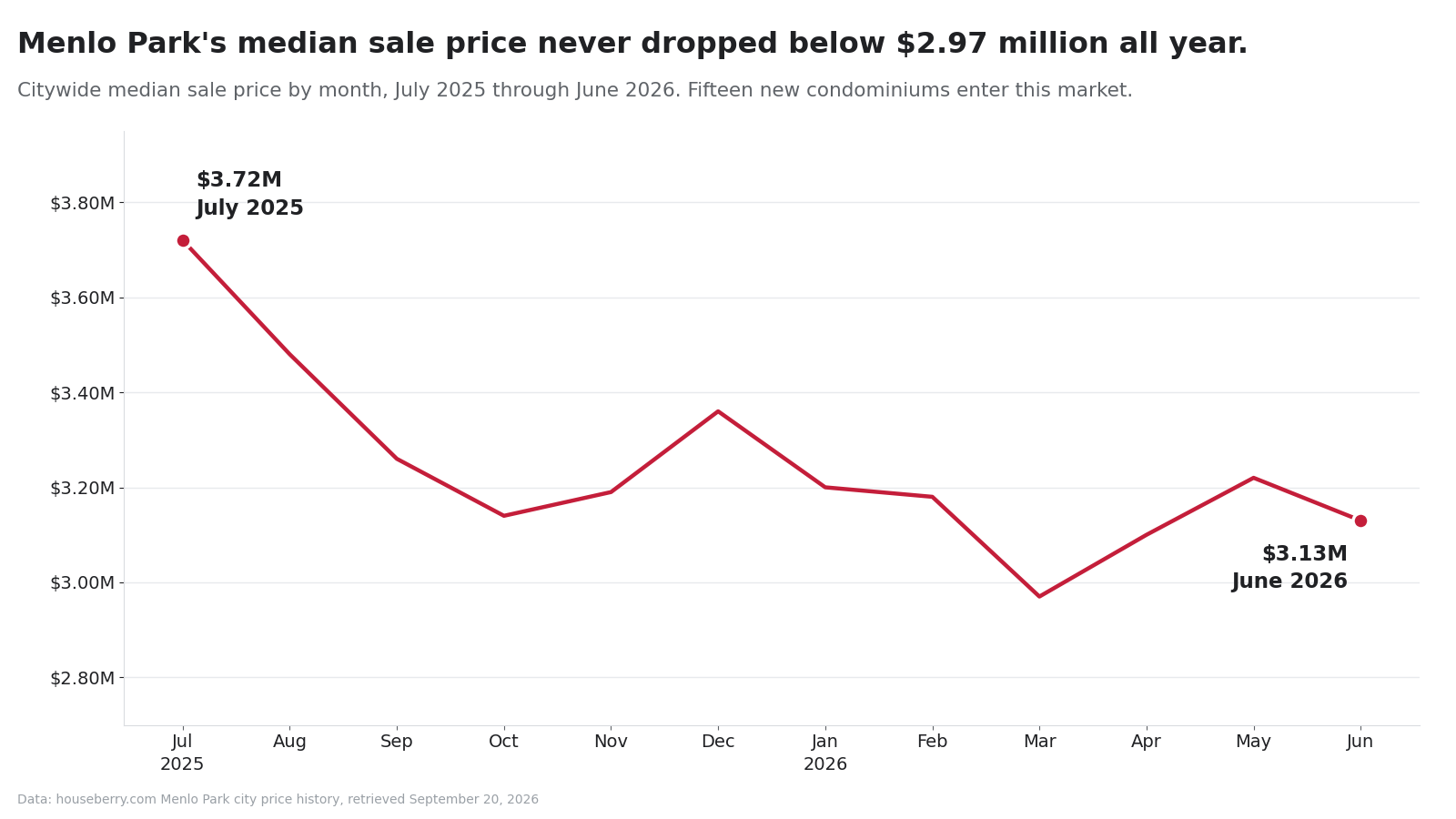
The citywide median was roughly $3.13 million in June 2026, down from about $3.72 million in July 2025, per the 12-month history on our Menlo Park city page. That is detached-house money. A two-bedroom condominium off Santa Cruz Avenue is a different product, and downtown Menlo Park has produced almost none of it in a decade.
The scores are why the location matters. Downtown Menlo Park rates 4.4 out of 5 overall, third of the 15 Menlo Park neighborhoods we cover, with a 4.7 on schools, 4.6 on amenities and a perfect 5.0 on nearby merchants. Safety sits at 3.7, the softest number on the card and an ordinary one for a walkable commercial core. Daily life here is already excellent. The entry price is the barrier.
Fifteen units do not fix that. They do put a few addresses in the best-scoring part of Menlo Park that are not a $3 million single-family house. The way we look at it, the neighborhood was never the problem on this block. The product type was.
One unit out of fifteen
Here is the part worth being honest about. The project deed-restricts exactly one home for very low income households, about 6.7 percent of base density, with an in-lieu fee covering the fraction left over. The Housing Commission recommended that package 6-0 on September 2. In a city where the median is over $3 million, one very-low-income condominium is not an affordability program, and nobody at the dais pretended otherwise. The other half of the site is not housing at all.
The faster path costs something procedurally too. Environmental review handed neighbors a document, a comment window and a hearing where parking and shade and the construction schedule got argued in public. AB 130 removes that venue along with the study. The trade is worth making, because the old process killed good projects about as often as bad ones. But it is a trade, and saying so is how you stay honest with the people who live across the street.
Tuesday night, and the filing after that
The City Council takes up the vesting tentative map on September 22, the last discretionary approval between this and a building permit. InMenlo previewed the Planning Commission hearing and the commission moved it 7-0, so the map is unlikely to be where this one dies.
The better question is the one this filing starts to answer. When San Jose used section 21080.66 in August, the fair response was that one exemption is not a trend. A month later a second Bay Area city has used the same section on a project a seventeenth the size, in a downtown with a long memory for fighting height. If the next few Peninsula applications come in this way, the real effect of AB 130 will not be that big projects got faster. It will be that small ones stopped being impossible to pencil, because a 15-unit building can now carry an entitlement cost that used to take 200 units to absorb.
That is worth watching on Santa Cruz Avenue, on El Camino, and in every downtown between here and Redwood City.
Sources
City of Menlo Park, 800 Oak Grove Avenue project page, project description, hearing dates and votes
The Almanac, "New six-story residential building proposed for downtown Menlo Park," February 3, 2026
San Francisco YIMBY, "Housing Planned for 800 Oak Grove Avenue, Menlo Park," February 2026
Houseberry, Menlo Park city and Downtown Menlo Park neighborhood data, retrieved September 20, 2026
Map of Menlo Park Neighborhoods
Loading map...
View Full Map
Top Neighborhoods in Menlo Park, CA


All information provided on this website including but not limited to - school ratings, safety, amenities, user opinions, and property data - is for general informational purposes only. We do not guarantee its reliability, accuracy, or completeness. Users should independently verify information and consult appropriate professionals as needed. By using this website, you agree Houseberry is not responsible for actions, decisions, or consequences arising from reliance on the information provided
houseberry.com - CA DRE# 01847391
 Bay East ©2025. CCAR ©2025. bridgeMLS ©2025. Information Deemed Reliable But Not Guaranteed. This information is being provided by the Bay East MLS, or CCAR MLS, or bridgeMLS. The listings presented here may or may not be listed by the Broker/Agent operating this website. This information is intended for the personal use of consumers and may not be used for any purpose other than to identify prospective properties consumers may be interested in purchasing. Data last updated at September 21, 2026 12:00 AM