Farmers Insurance California Rate Change: 1.5% vs 29.1%
Farmers' California rate change reaches about 915,000 homeowners this fall at an approved 1.5 percent. The number that matters in the Bay Area hills is the cap it lifted at the same time.
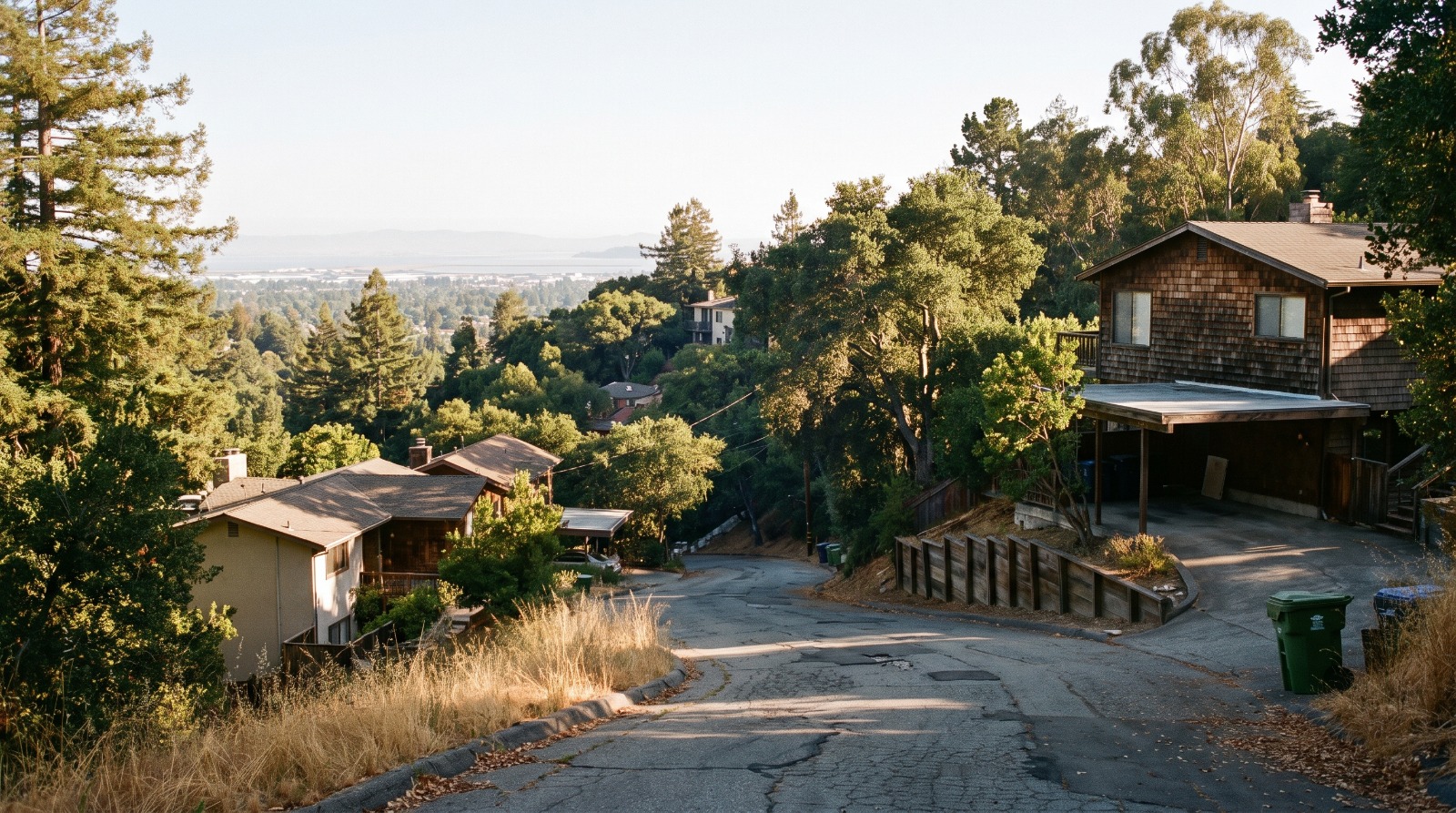
Homes on wooded Oakland hills slopes in Montclair, a Bay Area wildfire zone affected by the Farmers Insurance rate change. Photo: Houseberry
Farmers asked California for a 6.99 percent homeowners rate increase. The state approved 1.5 percent. That change reaches about 915,000 California homeowners at each policy's first renewal after September 15, 2026, which means the envelopes are landing in mailboxes right now. If you bundle home and auto with Farmers, your bill probably goes down.
The part almost nobody has written about is in the same filing. Farmers also removed the cap on how many new homeowners policies it will write in this state, and it says it is going looking for business in the places private carriers spent five years backing out of.
What 1.5 percent actually does to a hillside premium
Very little, and that is the point. Start with a high-fire-hazard Bay Area hillside home paying $2,400 a year with a 15 percent home-and-auto bundle discount already baked in. The approved 1.5 percent adds about $36.
Then the discount moves. Seven extra points of bundle discount beats 1.5 points of rate every time. Run the same policy through the new plan and it lands near $2,235, roughly $165 cheaper than it is today. For a bundled customer, this filing is a price cut wearing the word increase.
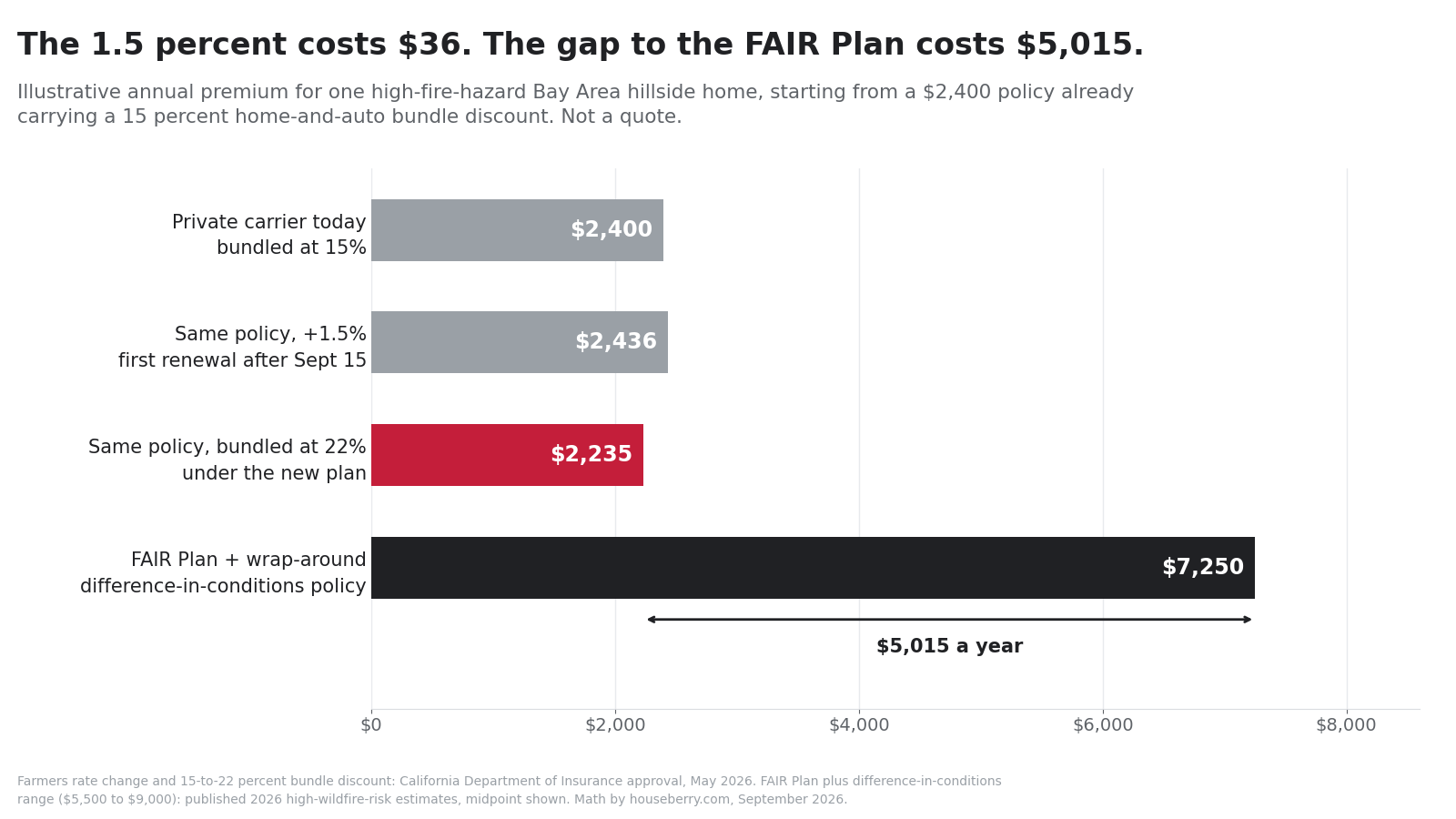
The alternative is where the money is. A California FAIR Plan policy, the state's insurer of last resort, pays for fire, smoke, lightning and in-home explosions and close to nothing else, so most owners bolt on a wrap-around difference-in-conditions policy to get liability, theft and water damage back. In high wildfire country that stack has been running roughly $5,500 to $9,000 a year. Against a private policy near $2,235, that is not a premium difference. That is a car payment.
The cap is the part that matters in Orinda and the Oakland hills
Farmers had been rationing California homeowners policies at 9,500 a month, up from 7,000 in 2023. Its November 21, 2025 announcement scrapped the limit and said the company would market directly to about 300,000 consumers in areas the state calls distressed. Fox Business confirmed the old cap figures.
Distressed is a defined term, not a mood. The Department of Insurance flags a ZIP code when FAIR Plan penetration reaches 15 percent or higher and CAL FIRE rates the area high or very high fire hazard. Larger insurers writing there commit to covering at least 85 percent of the properties in those areas.
Hold that test against a Bay Area map and the list writes itself. CAL FIRE's 2025 local responsibility area maps put very high fire hazard zones inside twelve Contra Costa cities, Orinda, Moraga and Lafayette among them. The Oakland and Berkeley hills have been in that category since well before the 1991 firestorm. None of these are cheap markets an insurer can afford to ignore.
Four Bay Area hillside markets where a returning carrier would actually matter. City medians come from our city pages. Montclair is a neighborhood median. Most recent month shown, not an annual average.
| Hillside market | Median sale price | Houseberry overall score | Very high fire hazard zone |
|---|---|---|---|
| Lafayette | $2.12M (Aug 2026) | 4.1 / 5 | Yes, 2025 CAL FIRE LRA maps |
| Orinda | $1.94M (Jul 2026) | 3.8 / 5 | Yes, 2025 CAL FIRE LRA maps |
| Moraga | $1.85M (Aug 2026) | 3.5 / 5 | Yes, 2025 CAL FIRE LRA maps |
| Montclair, Oakland | $1.56M (Aug 2026) | 3.8 / 5 | Yes, Oakland hills |
Read down that median column. Lafayette sat at about $2.12M in August 2026 across the 31 neighborhoods we rank there, and Montclair, the wooded Oakland hills neighborhood spread along Mountain Boulevard, was about $1.56M the same month. These are seven-figure homes whose owners have been quoted like uninsurable risk. A carrier that can write 20,000 policies a month instead of 9,500 has room to look at them again.
The honest caveat: removing a cap is permission, not a promise. Farmers expects several thousand new policies over two years in distressed areas. The FAIR Plan had 696,562 policies in force and $768 billion of exposure as of June 2026, up 157 percent in policy count since September 2022. Several thousand does not reverse that. It is a first trickle back up the hill, and it will show up address by address rather than town by town.
Asked versus got is the whole California story right now
The interesting comparison is not Farmers against last year. It is Farmers against everyone else who filed in 2026.
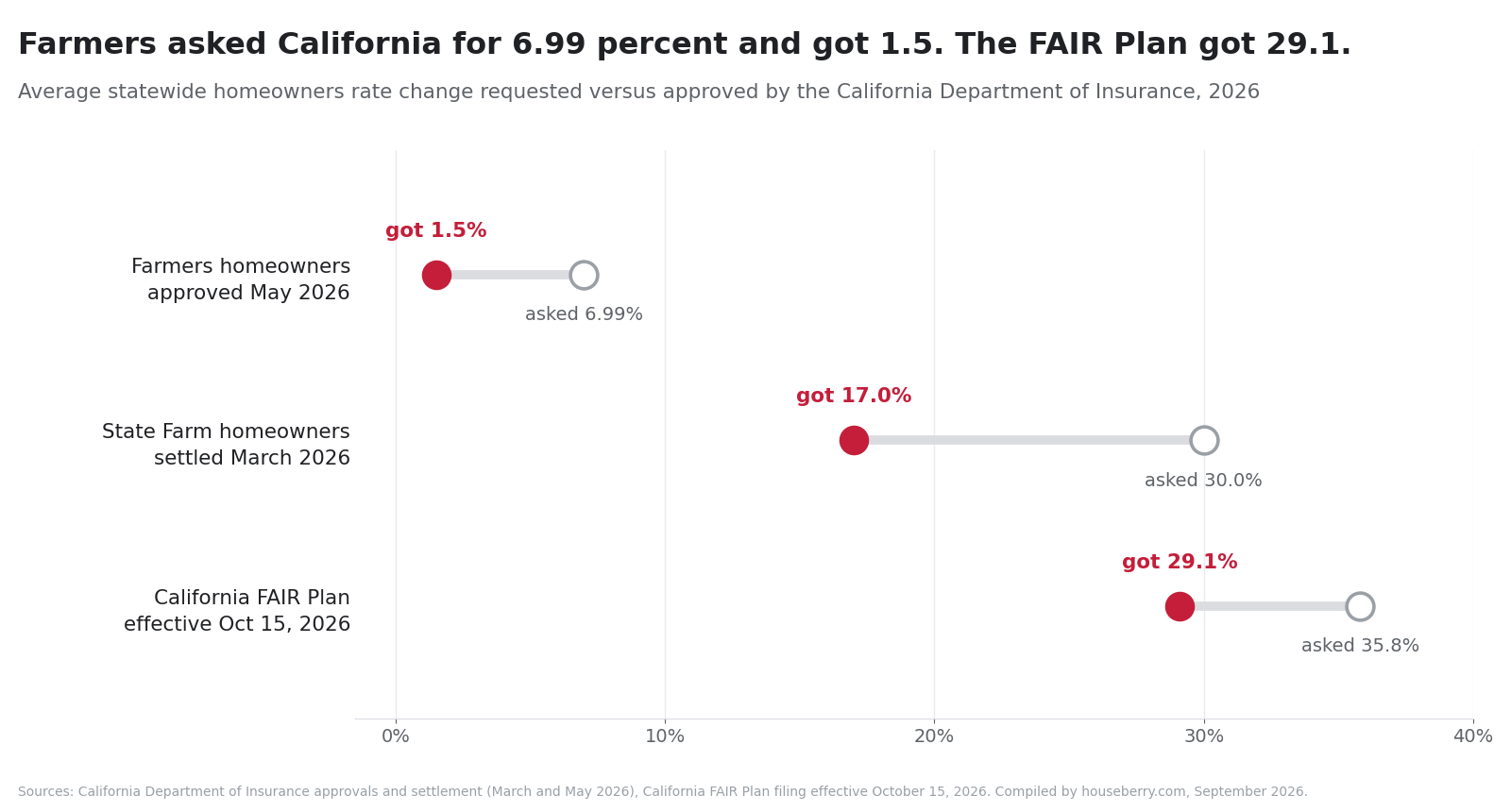
Farmers took the smallest ask and the smallest approval of the three, and it was the first filing under the state's Sustainable Insurance Strategy, the framework that lets carriers price wildfire risk with catastrophe models in exchange for writing in distressed areas. State Farm's 17 percent came out of a settlement in March 2026. The FAIR Plan asked for 35.8 percent and was approved for 29.1 effective October 15.
Two envelopes are arriving a month apart with opposite messages. A Farmers renewal after September 15 moves about 1.5 percent. A FAIR Plan renewal after October 15 moves about 29.1 percent, and KQED reports that owners in genuinely high-risk areas could see premiums roughly double while some urban Bay Area policyholders see reductions. The spread between staying private and falling back on the FAIR Plan just got wider, in one season, by design.
What I would do with that envelope
Three practical moves, none of which take an afternoon.
Check the bundle line, not the headline. If your Farmers declarations page still shows a 15 percent home-and-auto discount, ask when the 22 percent applies to you. That single line is worth more than the rate change.
If you are on the FAIR Plan, get requoted before October 15. Carriers re-entering distressed ZIP codes do not send letters announcing it. Farmers began pushing new-business marketing into those areas in early 2026, and an independent broker will know which addresses are being quoted again.
If you are shopping a hillside home, quote the address before you write the offer. Two houses half a mile apart in the Berkeley hills can carry very different answers, and the answer that matters is whether a private carrier will write it at all.
We built Houseberry around comparing the area before the address, and insurability has quietly become one of those area-level facts, sitting next to schools and safety rather than next to closing costs. It is now the fastest-moving one. When we wrote in June that the insurance problem was spreading past the hills, the direction of travel was carriers leaving. This is the first filing in a while pointed the other way, and it is worth watching whether it reaches the hillside blocks inside the 258 East Bay neighborhoods we rank or stops at the flats. Ask your agent in the spring, not next September.
Sources
- Farmers Insurance newsroom: Farmers to remove cap on writing new homeowners policies in California (November 21, 2025)
- Carrier Management: Farmers in California, HO rates up 1.5%, bundlers get 22% discount (May 12, 2026)
- Newsweek: Nearly 1 million Californians face home insurance change in coming months
- Fox Business: Insurance giant lifts cap on California homeowners policies
- California Department of Insurance: FAQ on insurer commitments for wildfire distressed areas
- KQED: California FAIR Plan announces 29.1% rate hike for homeowners this fall
- California FAIR Plan: Key statistics and data (June 2026)
- Local News Matters: State says 12 cities in Contra Costa County have very high fire hazard severity areas
- Real Cost Report: California FAIR Plan costs vs. private market 2026
- Houseberry: Lafayette, Orinda, Moraga city pages and the Montclair, Oakland neighborhood page
Map of East Bay Neighborhoods
Loading map...
View Full Map
Top Neighborhoods in East Bay, CA


All information provided on this website including but not limited to - school ratings, safety, amenities, user opinions, and property data - is for general informational purposes only. We do not guarantee its reliability, accuracy, or completeness. Users should independently verify information and consult appropriate professionals as needed. By using this website, you agree Houseberry is not responsible for actions, decisions, or consequences arising from reliance on the information provided
houseberry.com - CA DRE# 01847391
 Bay East ©2025. CCAR ©2025. bridgeMLS ©2025. Information Deemed Reliable But Not Guaranteed. This information is being provided by the Bay East MLS, or CCAR MLS, or bridgeMLS. The listings presented here may or may not be listed by the Broker/Agent operating this website. This information is intended for the personal use of consumers and may not be used for any purpose other than to identify prospective properties consumers may be interested in purchasing. Data last updated at September 21, 2026 12:00 AM