The Marina Park flyers are fake. Here's the real Safeway plan
Flyers on Marina doorsteps pitch a car-free Marina Boulevard and 900-plus homes, credited to groups that never signed on. We checked every claim against the city's file for the Marina Safeway.

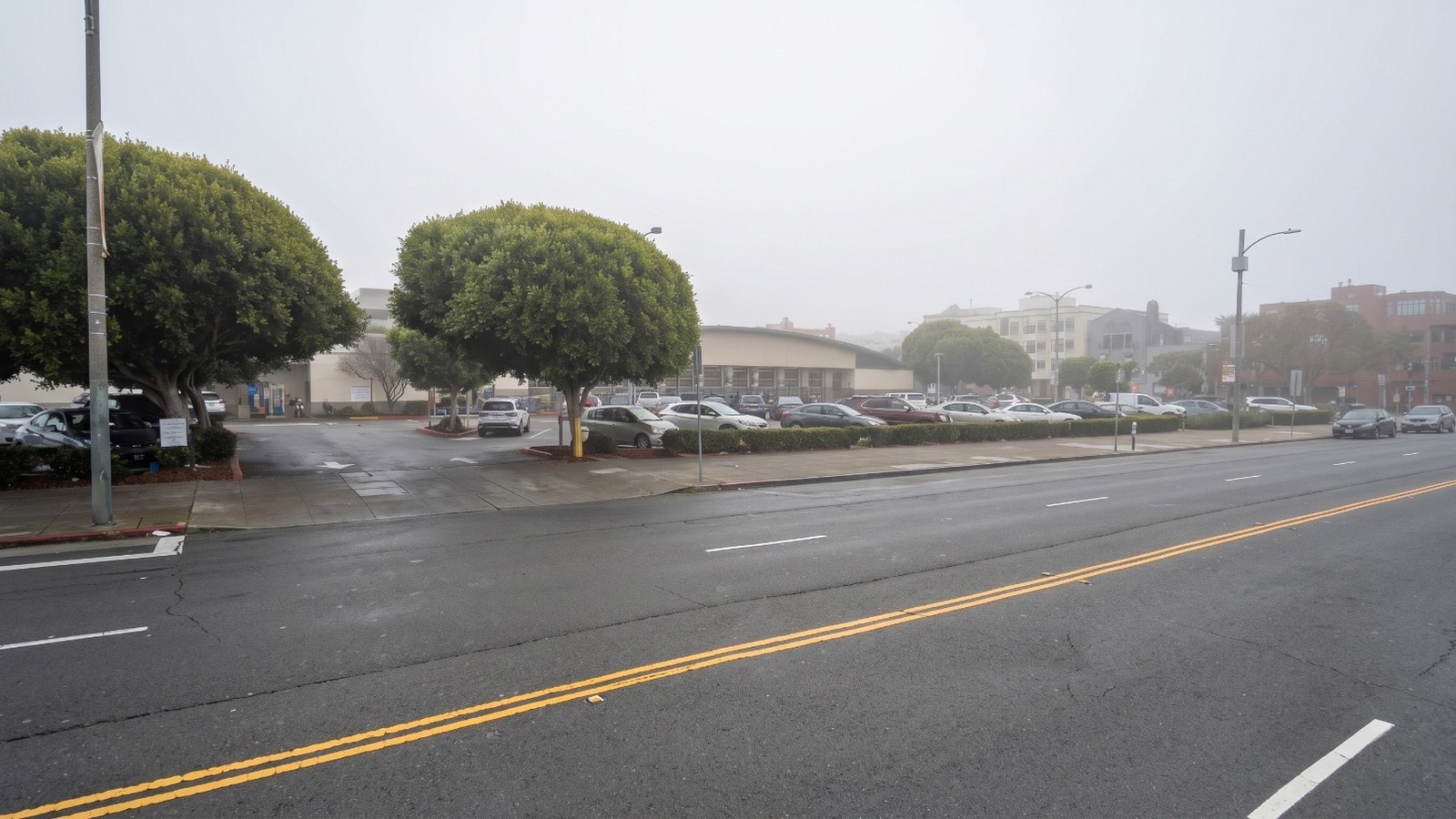
AI-rendered view of Marina Boulevard and the Marina Safeway lot at 15 Marina Boulevard, San Francisco, in fog Photo: Houseberry
The flyer shows families walking hand in hand along a waterfront with no cars on it, the Golden Gate Bridge behind them. Close all four lanes to private vehicles, it argues, and the neighborhood could make way for more than 900 homes. The idea, the flyer adds, is "inspired by Sunset Dunes."
Nobody has proposed that plan.
Copies have been landing on doorsteps and windshields across the Marina since early October. The real plan for the Safeway block, on file with San Francisco Planning as record 2025-011405PRJ, is 848 apartments and a new grocery store. It does not close a single lane of Marina Boulevard. It adds parking.
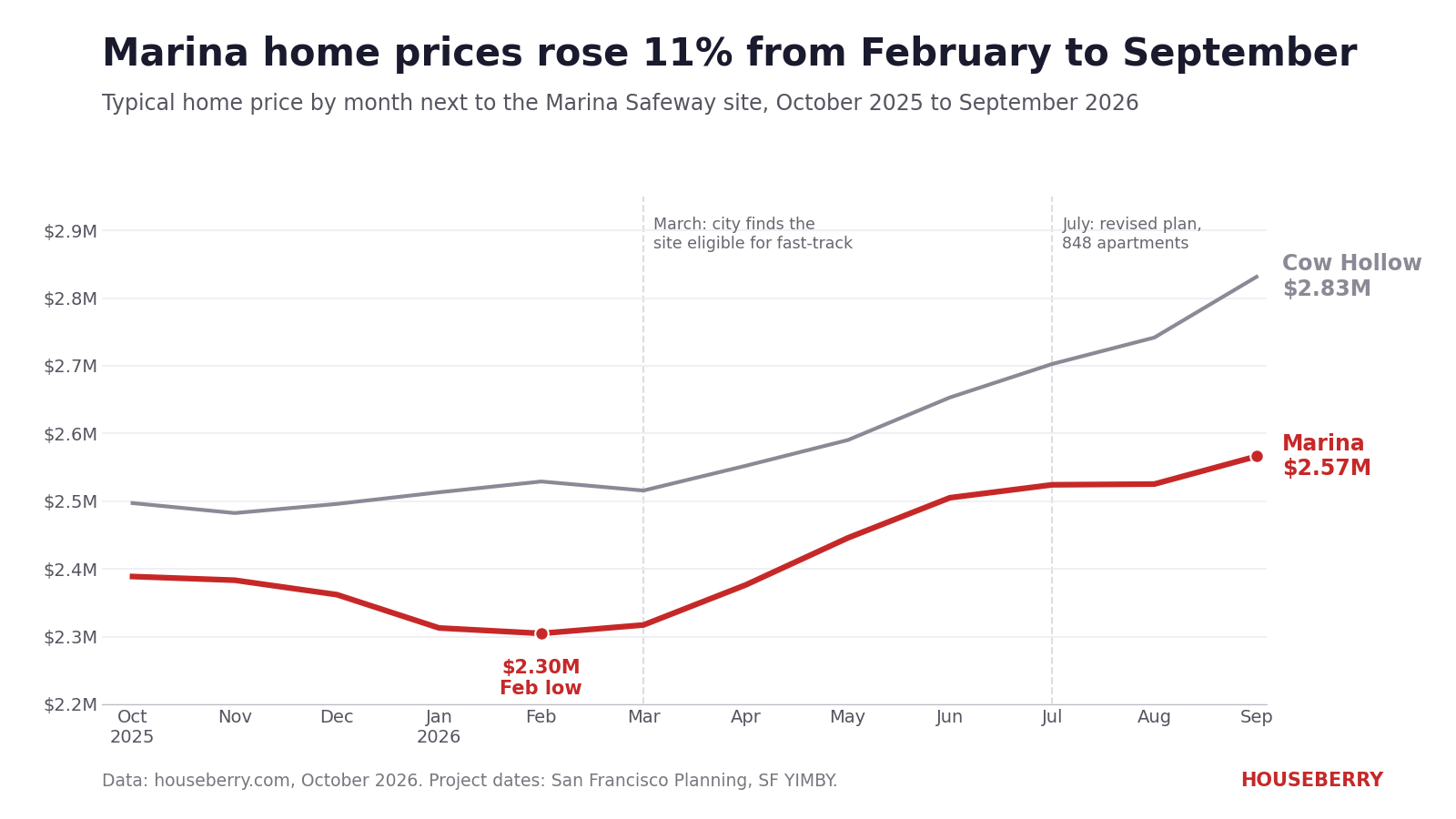
That gap matters right now. The city's decision on the real project is due this fall, in a neighborhood where the typical home sold for about $2.57 million in September 2026, according to Houseberry's Marina data. Residents are forming views on the biggest housing project in the Marina's history, and some of them are forming those views from a leaflet nobody will put a name to. We have followed this block since July. Here is the flyer checked against the file.
The flyer against the file
The San Francisco Standard first reported the flyers on October 15 and checked with the groups named on them. We set each claim beside the city's project record, the July revision first detailed by SF YIMBY and what those groups said.
| The flyer says | What the record shows |
|---|---|
| Paid for by Friends of Marina Park | The San Francisco Ethics Commission has no committee or filer by that name, the Standard found |
| Backed by the SF Bicycle Coalition, Sunset Dunes Park and the No on G campaign | The Bicycle Coalition says it never endorsed the idea or approved use of its logo. Friends of Sunset Dunes says its logo was used without permission |
| Close all four lanes of Marina Boulevard | The Safeway application covers the grocery block. Nothing in it touches the boulevard's lanes |
| More than 900 new homes | 848 apartments, 86 of them affordable |
| A car-free waterfront | 349 parking spaces, up from 159 in today's lot |
| More open space | The filing describes homes, a store and a garage. Marina Green is already across the boulevard |
Not one row lines up. The flyer also never says how closing a road would make room for homes. Taking cars off Marina Boulevard does not create a building lot, and the flyer does not name one.
What is actually planned at 15 Marina Boulevard
Align Real Estate, working for Safeway's parent company Albertsons, filed in December 2025 and revised the plan on July 14. The current version is two towers on a shared base, 22 and 18 stories, topping out near 258 feet. Inside are 254 studios, 268 one-bedrooms, 212 two-bedrooms and 114 three-bedrooms. Eighty-six are set aside for households earning about half the area median income. A 67,180-square-foot Safeway comes back at the bottom, so the neighborhood keeps its grocery store.
The site is a full 2.6-acre block bounded by Marina Boulevard, Laguna, North Point and Buchanan. Today it holds a one-story store and a lot that the city's record counts at 159 spaces.
Is it approved? Not yet. The city found the block eligible in mid-March for AB 2011, the 2022 state law that lets housing on commercial land skip public hearings if it meets objective standards. Planners cleared the next step in August. The city's record still reads "Under Review," and KQED reported the final decision was expected in October.
Opponents are in court. In September the YesAND Foundation, Neighborhoods United SF and several Marina residents sued the city, PG&E and Align in federal court, arguing the site does not qualify for the fast track and that contamination from a former gas works and steam plant was never properly assessed, as KQED reported. We covered the contamination fight in August and the AB 2011 question in July. Mayor Daniel Lurie and Supervisor Stephen Sherrill have both opposed the project, KQED reported. State Senator Scott Wiener supports it.
The flyer borrows the Sunset Dunes playbook
The flyer borrows the city's best-known car-free fight on purpose. Proposition K turned the Upper Great Highway into Sunset Dunes in November 2024 with 55 percent of the citywide vote. Prop G on this November's ballot would put cars back on it on weekdays. JFK Drive in Golden Gate Park went to the voters too, in 2022. In San Francisco, taking a road away from cars has meant a citywide vote. Nothing of the kind has been filed for Marina Boulevard.
Who made the flyers is still unknown. The Standard said they appear to be AI-generated. Lori Brooke, who founded Neighborhoods United SF, one of the groups suing, told the Standard she first saw the flyer on Nextdoor and that neither she nor anyone she knows made it. Align said it had never seen it before.
We think the real plan is tamer than the fake one.
It changes one block, keeps the boulevard, keeps the grocery store and adds parking. The objections worth having are in the file: a 22-story tower in a neighborhood of three- and four-story buildings, and what sits under the parking lot. Erin Roach of the Marina Community Association told KQED the building would be "roughly six times taller than anything around it." That is a real argument, made under a real name.
What the Marina already has, and what 848 apartments would add
The park on the flyer mostly exists. Marina Green and the harbor sit across the boulevard from the store, with Crissy Field farther west and Fort Mason next door to the east. On Houseberry's San Francisco amenities ranking, the Marina scores 4.2 out of 5, tied for fourth among the city's 92 neighborhoods. Its score for nearby merchants is a perfect 5.0.
A car-free promenade here would also be a foggy one. Houseberry's climate data ranks the Marina 77th of 92 San Francisco neighborhoods for sunshine.
Prices have not flinched at the tower fight. The Marina's typical home price bottomed at about $2.30 million in February 2026 and climbed to about $2.57 million by September, a rise of 11 percent across the same months the project moved through the city's fast track. Next door, Cow Hollow rose 13 percent over the full year to about $2.83 million. Citywide demand explains more of that than one grocery store block does. The chart shows a calm market, and it cannot tell you what the towers will do to prices.
The honest trade-off is parking and scale. Even at 349 spaces, the garage works out to 0.41 spaces per apartment, so some new neighbors with cars will hunt for curb space on Beach and North Point streets. Construction on a 2.6-acre block will take years. In return the Marina gets 848 homes on a lot that now stores cars a block from the bay.
That is the choice actually in front of the city this fall. Anyone weighing it can skip the leaflet: the file is public, and so is how the Marina compares with Cow Hollow and the other 90 neighborhoods on our San Francisco neighborhood ranking.
Sources
- San Francisco Standard: Mystery flyers push fake car-free 'Marina Park' plan, October 15, 2026
- San Francisco Planning project record 2025-011405PRJ, 11 and 15 Marina Blvd
- SF YIMBY: Reduced floor count, more units for Safeway Marina redevelopment, July 2026
- KQED: San Francisco housing group files lawsuit opposing Marina Safeway project, September 2026
- Houseberry neighborhood data for the Marina, October 2026
The Houseberry Research Team is Houseberry's reporting team: Bay Area real estate analysts, data specialists and longtime local market watchers. Every day we check the public record: building permits, city council and planning agendas, county recorder filings, state housing bills, police incident data and school results. Then we tie each story to what it means for specific neighborhoods, using Houseberry's own neighborhood data on prices, appreciation, safety, schools and amenities. Questions or corrections: Contact us.
Map of San Francisco Neighborhoods
Loading map...
View Full Map
Top Neighborhoods in San Francisco, CA


All information provided on this website including but not limited to - school ratings, safety, amenities, user opinions, and property data - is for general informational purposes only. We do not guarantee its reliability, accuracy, or completeness. Users should independently verify information and consult appropriate professionals as needed. By using this website, you agree Houseberry is not responsible for actions, decisions, or consequences arising from reliance on the information provided
houseberry.com - CA DRE# 01847391
 Bay East ©2025. CCAR ©2025. bridgeMLS ©2025. Information Deemed Reliable But Not Guaranteed. This information is being provided by the Bay East MLS, or CCAR MLS, or bridgeMLS. The listings presented here may or may not be listed by the Broker/Agent operating this website. This information is intended for the personal use of consumers and may not be used for any purpose other than to identify prospective properties consumers may be interested in purchasing. Data last updated at October 18, 2026 12:00 AM