Cupertino's east-side park lot just got $1.4 million pricier
Cupertino is buying the vacant school-district lot on Finch Avenue for a park, and the price rose from $10.4 million to $11.8 million with no explanation. Here's what the city gets and what it costs.

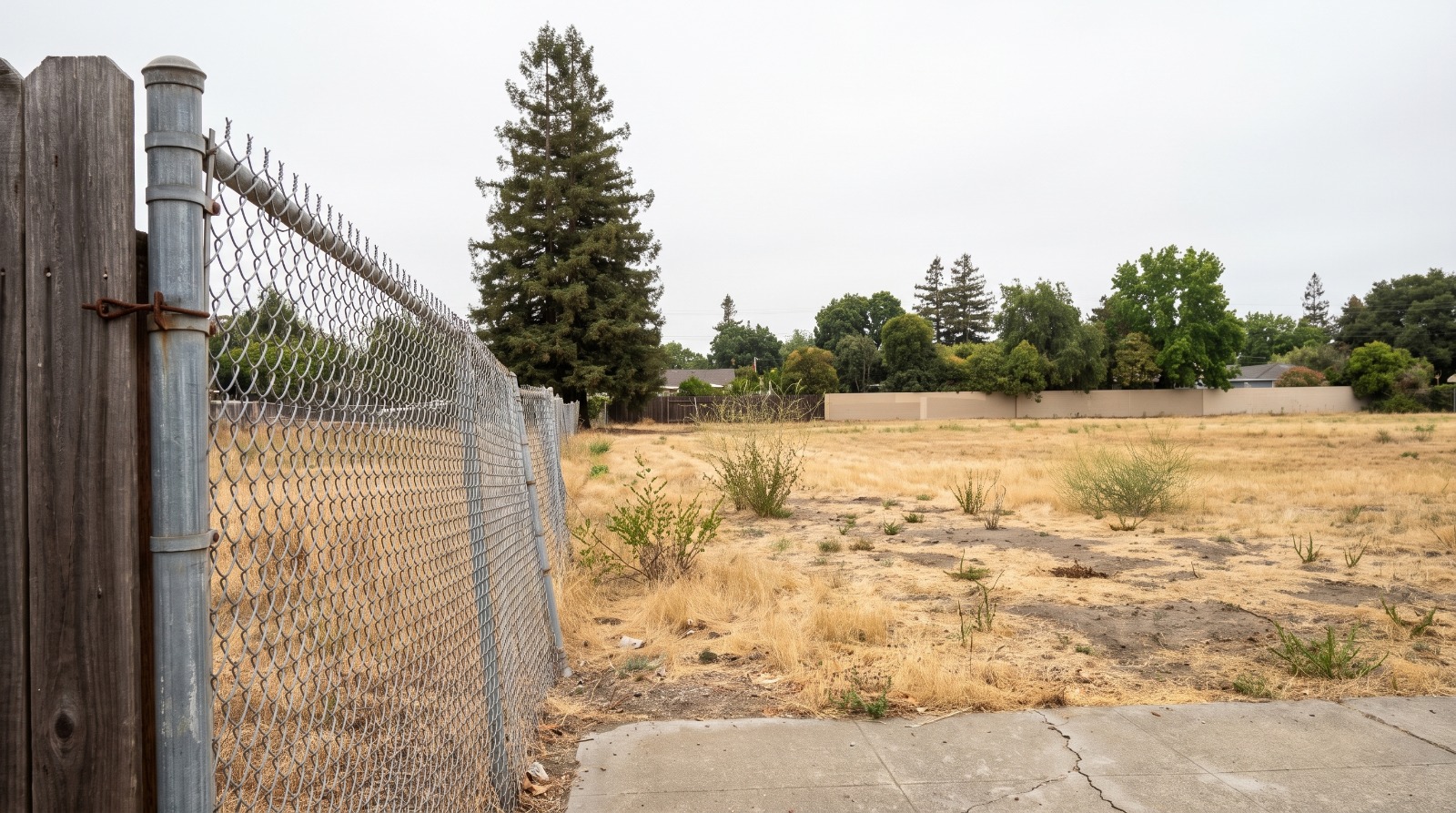
AI-rendered view of the fenced vacant lot at the end of Finch Avenue in Cupertino's Rancho Rinconada, with dry grass and a tall redwood Photo: Houseberry
At the south end of Finch Avenue, where it dead-ends into Phil Lane, there is a fenced field of dry grass with one enormous redwood in it. J.D. Sedgwick Elementary sits next door. The Cupertino Union School District has owned the lot since late 2016 and has never built on it.
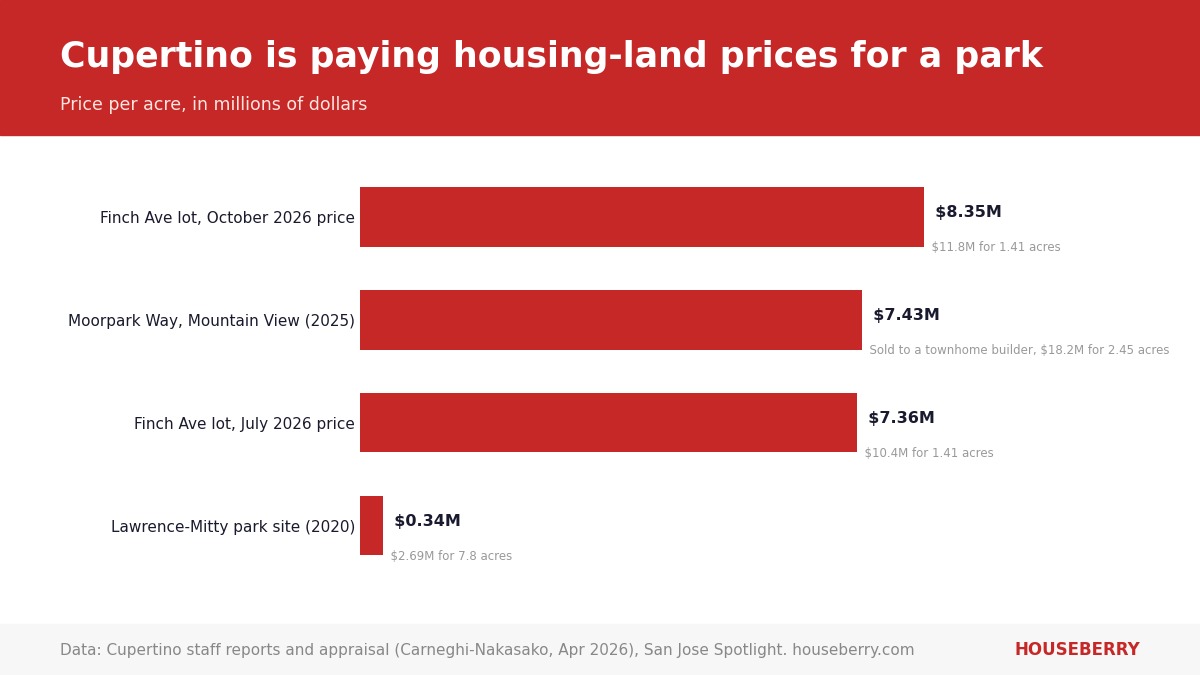
Cupertino is about to buy it for a park, and the price went up. On July 7 the City Council approved the purchase at $10.4 million. The agreement on the council's Tuesday, October 6 agenda sets a "negotiated purchase price" of $11.8 million. That is $1.4 million more, a 13.5 percent jump, for the same 1.4 acres, and the staff report does not say why.
The lot sits in Rancho Rinconada, inside what Houseberry scores as Eastside Cupertino. There, the typical home was worth about $2.54 million in early October 2026, down 2.0 percent from a year earlier, according to Houseberry data. That is about $500,000 under Southside, the city's southern neighborhood.
What Cupertino is buying
The parcel is vacant, zoned for single-family homes and fenced. The district bought it in 2016 to expand Sedgwick, then changed course. Before anyone could use it, the old farmland had to be cleaned up: in October 2018 crews hauled out 257 tons of soil tainted with pesticides and lead, and the state Department of Toxic Substances Control certified the cleanup on May 3, 2019. A new site assessment in February 2026 found nothing further.
The deal is not a plain sale. At the district's request it is an exchange agreement under the state Education Code. The district gets $11.8 million in cash or replacement property of equal value that it picks. If it has not found a property by closing, the city's cash waits in a holding escrow until the district buys one or takes the money. The draft agreement sets a $50,000 deposit, 60 days for the city's due diligence and a closing 30 days after that.
Where the extra $1.4 million came from
Nobody has said, at least not in a public document. The July price lined up with the appraisal almost exactly. The appraiser, Carneghi-Nakasako & Associates, valued the land as of April 2, 2026 at $940,000 per lot for 11 homes, and checked it against comparable land sales at about $170 a square foot, which came to $10.47 million.
October's report calls $11.8 million "negotiated." It cites no new appraisal. Council met in closed session on the price on September 15 and is scheduled to do so again before the open vote on October 6.
The same report sets one other number beside the price. The district told the city it "does not see a need" for school resource officers, the sheriff's deputies assigned to campuses, and will not ask Cupertino to pay for one. Dropping one from the sheriff's contract would save the city about $336,731 a year. Staff describe that as separate from the purchase price. At that rate it would cover the $1.4 million increase in a little over four years.
The east side and its parks
Cupertino's General Plan asks for 3 acres of parkland per 1,000 residents. The city has about 3.6 counting land shared with the school districts, and 2.98 without it, according to its parks element. The city's 2017 parks master plan named the area around Sedgwick and Lawson Middle School as a gap, a part of town where residents lean on school fields for open space.
Houseberry's numbers tell a gentler story about Eastside. Its public spaces score is 4.0 out of 5, helped by the Rancho Rinconada recreation center's pool and courts and by Creekside Park, and its overall score is 3.9, third of five in Houseberry's Cupertino ranking. Its school score of 4.6 is the lowest of Cupertino's five neighborhoods. In most Bay Area cities it would be the highest.
So the lot would add a park to a part of town that already has some. It would not fix a desert.
We'd buy it. We'd also want the receipt.
We think Cupertino should close this deal. Park fees can only be spent on parks, the fund has the money, and a 1.4-acre lot beside an elementary school, with a redwood already on it, does not come up twice. The city has looked at buying this exact parcel since at least November 2020.
But the trade deserves to be said out loud. The district's own appraisal priced this as land for 11 homes in a city that is short on them, and Cupertino is paying more than that housing value to keep homes off it. Here is the purchase next to the other numbers around it. The 2020 park purchase is from San Jose Spotlight, and the federal request is from Rep. Ro Khanna's March 2026 disclosure.
| Item | Amount | Source |
|---|---|---|
| Finch Avenue lot, October price | $11.8 million | October 6 staff report |
| Finch Avenue lot, July price | $10.4 million | July 7 staff report |
| Park fee from the 35 Coach House townhomes on De Anza | $1.62 million | October 6 staff report |
| Lawrence-Mitty park site, 7.8 acres, bought in 2020 | $2.69 million | San Jose Spotlight |
| Rep. Ro Khanna's federal funding request for Finch | $5 million (outcome unknown) | Khanna disclosure, March 2026 |
The district has reasons to want top dollar. It adopted a budget in July with a $6.3 million structural deficit and a general fund falling from $33.4 million to $24.7 million, the Los Altos Town Crier reported. A public school district selling to a city is a sale between two public treasuries. Residents fund both. They should be able to see why the number moved.
If the vote goes through, the next step is a park design process, and that is where Rancho Rinconada neighbors get a say. In the meantime, compare how Cupertino's five neighborhoods score on public spaces and price, because a new park a block away is the kind of thing buyers notice in the price of the house next door.
Sources
The Houseberry Research Team is Houseberry's reporting team: Bay Area real estate analysts, data specialists and longtime local market watchers. Every day we check the public record: building permits, city council and planning agendas, county recorder filings, state housing bills, police incident data and school results. Then we tie each story to what it means for specific neighborhoods, using Houseberry's own neighborhood data on prices, appreciation, safety, schools and amenities. Questions or corrections: Contact us.
Map of Cupertino Neighborhoods
Loading map...
View Full Map
Top Neighborhoods in Cupertino, CA



All information provided on this website including but not limited to - school ratings, safety, amenities, user opinions, and property data - is for general informational purposes only. We do not guarantee its reliability, accuracy, or completeness. Users should independently verify information and consult appropriate professionals as needed. By using this website, you agree Houseberry is not responsible for actions, decisions, or consequences arising from reliance on the information provided
houseberry.com - CA DRE# 01847391
 Bay East ©2025. CCAR ©2025. bridgeMLS ©2025. Information Deemed Reliable But Not Guaranteed. This information is being provided by the Bay East MLS, or CCAR MLS, or bridgeMLS. The listings presented here may or may not be listed by the Broker/Agent operating this website. This information is intended for the personal use of consumers and may not be used for any purpose other than to identify prospective properties consumers may be interested in purchasing. Data last updated at October 6, 2026 12:00 AM