Amoeba Berkeley Apartments: What 68 Units Mean for Southside
Amoeba Music's owners want eight stories and 68 apartments above the Telegraph Avenue store. Here is what Southside scores today, what the project adds to the corridor, and how to read it if you are renting or buying nearby.
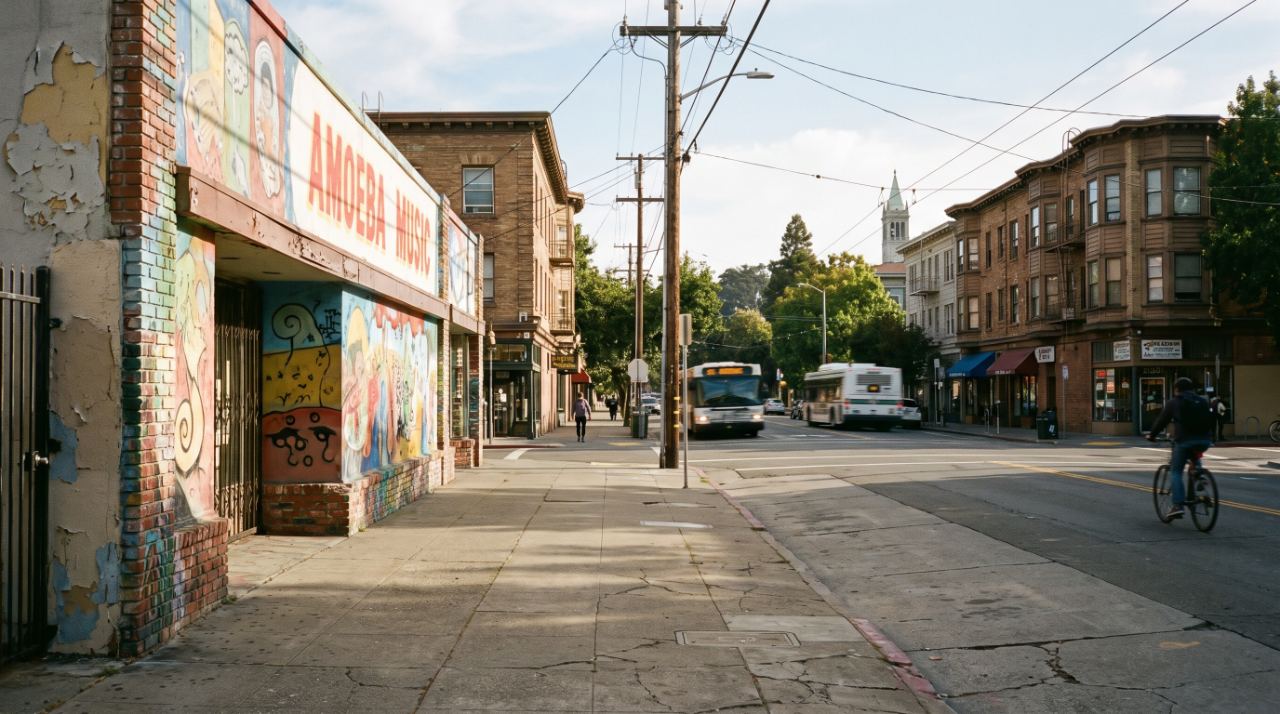
Amoeba Music block on Telegraph Avenue in Southside Berkeley, looking toward campus, where 68 apartments are proposed Photo: Houseberry
Stand outside Amoeba Music on a Thursday afternoon and count. Telegraph Avenue between Haste and Dwight in Southside Berkeley moves more people on foot in an hour than most Bay Area main streets see in a day, and almost none of them live above the shops they walk past. The Amoeba Berkeley apartments are meant to close that gap: 68 apartments and roughly 300 bedrooms in eight stories on top of the record store, with the store coming back to the ground floor and the 1976 mural staying put.
The plan went to Berkeley's Zoning Adjustments Board on September 10. Here is what it is, what Southside scores today on our data, and how to think about it if you rent or are shopping nearby.
What is being built above Amoeba
It is a student and young-renter building that keeps the store. Amoeba co-owners David Prinz and Marc Weinstein, working with Rhoades Planning Group and architect Studio KDA, filed for a use permit in February 2026 for an 84,100-square-foot mixed-use building with about 7,200 square feet of commercial space on the ground floor, per SF YIMBY's September 10 preview. That ground floor is where Amoeba lands after construction.
The unit mix is the tell. Forty-three of the 68 apartments are five-bedrooms, and the building works out to about 300 beds, which is how you build for a campus that admits more freshmen than it can house every August. Seven units are deed-restricted for very-low-income households. The design keeps the single-story Telegraph facade and steps the upper floors back, per SF YIMBY's first look at the renderings, and Mark Rhoades told the Daily Cal the team is taking "a very cautious approach with that mural." Good. Berkeley does not forgive people who scratch that wall.
One honest caveat: the store closes during construction. The Daily Cal reported a rough start around April 2028 and a finish before the 2029 school year, with no decision yet on a temporary location. If Amoeba is part of your Telegraph routine, budget for a year or more without it.
What happened at the zoning board
The project was on the September 10 consent calendar with a staff recommendation to approve, which is about as smooth a landing as a Berkeley project gets. Item 6.B on the Zoning Adjustments Board agenda asked the board to approve Use Permit #ZP2026-0015: renovate 2455 Telegraph, demolish the small structure at 2506 Haste Street, and build eight stories with 68 units.
As of September 14 I have not seen a published account of the vote, so I am not going to tell you it passed. Consent items pass in a block unless someone pulls one, and ZAB decisions get a short window for an appeal to the City Council before the permit is final. The same agenda carried a 74-unit building at 2955 Shattuck, and in July the board took up a 32-unit project at 2614 Telegraph. Telegraph is not waiting for Amoeba.
How the 2023 Southside upzoning made this possible
Eight stories on Telegraph was not legal a few years ago, and that is the whole reason the project exists. In November 2023 the City Council passed the Southside zoning package, which pushed the maximum height in the Telegraph Commercial and Residential Southside Mixed-Use districts to 85 feet, set a minimum density of 200 units per acre along Telegraph itself, and dropped lot-coverage and maximum-density caps, as SF YIMBY summarized before the vote. The city estimated the changes would allow about 2,650 more homes in Southside.
The Daily Cal's coverage of the November 21 special meeting quoted then-Councilmember Rigel Robinson saying the city and university had "failed to build the housing necessary for the growth of the campus community for years." Amoeba's 85 feet is exactly the new limit. No density bonus gymnastics, no waivers to argue over. That is what a good upzoning looks like two years on: an owner on the block since the 1990s builds on top of the business instead of selling to someone who would have torn it down.
Down the street, the university's People's Park building holds 148 apartments for more than 1,100 students, per UC Berkeley's project updates. Southside is adding beds by the thousand, the only thing that has ever pulled student rents down.
Is Southside Berkeley safe? What our score says
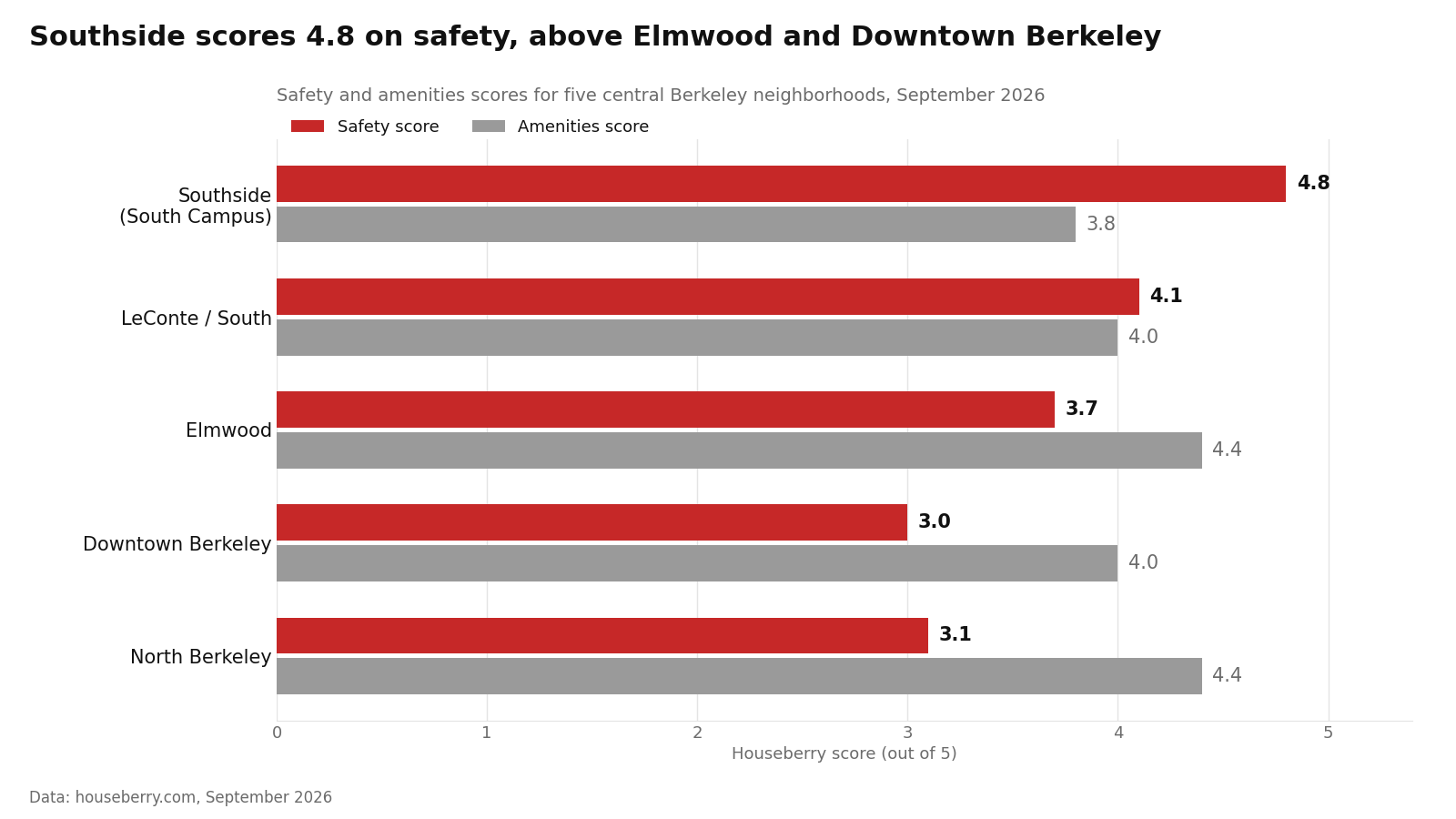
People ask this more than any other question about the neighborhood, so here is the plain answer. Southside, the area between Bancroft Way and Dwight Way from Shattuck to Piedmont, shows up on our site as South Campus, Berkeley, and it scores 4.8 out of 5 on safety in September 2026. That puts it in the top five of the 18 Berkeley neighborhoods we rank for safety, ahead of Elmwood at 3.7, Downtown Berkeley at 3.0, and North Berkeley at 3.1.
That surprises people. Southside is loud, and every parent has read a Nixle alert about Telegraph at 2 a.m. But our safety score is built from incident counts normalized by population, and Southside's population is enormous for its footprint. A block full of students walking home at all hours puts a lot of eyes on the street, the opposite of the empty-sidewalk problem that drags West Berkeley and South Berkeley down to 2.1.
A 4.8 is not a promise. It means the everyday risk per resident is low compared with the rest of the city, and that what people mostly experience here is bike theft, package theft, and noise. Adding 300 residents above a store that closes at 10 p.m. makes the block busier at the hours it is quietest now, and here that helps.
Where Southside falls short, and what 68 units change
The weak spot in Southside's scorecard is amenities, and this project only partly fixes it. South Campus scores 3.8 out of 5 on amenities in September 2026, below Elmwood at 4.4, LeConte / South at 4.0, and Downtown at 4.0. Our nearby-merchants score for South Campus is a perfect 5.0, so the issue is not restaurants. The gap is everything else: groceries, a real park, curb appeal (a 3.0), and storefronts that stay open when school is out.
That is the trade-off nobody at the hearing will say out loud. A building where 43 of 68 units are five-bedrooms is a dorm with a nicer lobby. It empties out in June, and the businesses under it will live on a school-year calendar, same as now. If you were hoping for the kind of mixed building that fills Southside with year-round neighbors, this is not that, and Berkeley Bowl is still a walk down to Oregon Street.
What it does change is real, though. Southside has almost no ownership market. Niche puts the neighborhood at 99 percent renters, and our South Campus page shows a median of about $1.63M in August 2026 that has not moved all year because almost nothing trades, against a Berkeley citywide median of about $1.73M that month. Every 300 beds added on Telegraph is 300 fewer students bidding on a converted flat in LeConte or a room in Elmwood. That is how a student building helps a family three blocks away.
How to actually think about this if you live nearby
If you rent in Southside, more beds are your friend, full stop. Rents here track how many students the university admits minus how many beds exist within a ten-minute walk, and the second number is finally rising. Expect a couple of loud construction years starting around 2028 and a busier block after.
If you are buying in LeConte, Elmwood, or the blocks between Dwight and Ashby, the question is not whether eight-story buildings show up on Telegraph. The zoning guarantees they will. The question is whether Telegraph becomes a corridor where people live and stay past graduation. Amoeba nudges that outcome by keeping a 30-year business on the ground floor instead of another vape shop, and it is the rare project where the "neighborhood character" argument and the housing argument land on the same side.
Our advice is the same for any corridor in transition: look at the block, not the rendering. Walk Telegraph at 9 a.m. and again at 9 p.m., check the Berkeley neighborhood rankings to see how South Campus compares on the factors you personally weigh, and treat one building, even a well-loved one, as a data point rather than a verdict.
Sources
- SF YIMBY, Meeting Tonight for Amoeba Apartments in Southside, Berkeley (Sept. 10, 2026)
- City of Berkeley, Zoning Adjustments Board agenda, Sept. 10, 2026, Item 6.B
- Hoodline, Amoeba Apartments Plan Reviewed by Berkeley Zoning Board (Sept. 11, 2026)
- SF YIMBY, Plans Revealed for Housing on Top of Amoeba Music (Sept. 3, 2025)
- SF YIMBY, Zoning Permits Filed for Amoeba Apartments (Feb. 18, 2026)
- The Daily Californian, Amoeba Music to build apartments above store, preserving mural (Sept. 5, 2025)
- The Daily Californian, City Council passes Southside upzoning plan (Nov. 23, 2023)
- SF YIMBY, Meeting Tonight for Berkeley Southside Rezoning (Nov. 14, 2023)
- SF YIMBY, Meeting Scheduled Tomorrow for 2614 Telegraph Avenue (July 8, 2026)
- UC Berkeley, People's Park Housing news and updates
- Niche, Southside, Berkeley, CA
- Houseberry, Best Neighborhoods in Berkeley, CA (2026)
- Houseberry, Safest Neighborhoods in Berkeley, CA (2026)
- Houseberry, South Campus, Berkeley neighborhood page
Map of Berkeley Neighborhoods
Loading map...
View Full Map
Top Neighborhoods in Berkeley, CA


All information provided on this website including but not limited to - school ratings, safety, amenities, user opinions, and property data - is for general informational purposes only. We do not guarantee its reliability, accuracy, or completeness. Users should independently verify information and consult appropriate professionals as needed. By using this website, you agree Houseberry is not responsible for actions, decisions, or consequences arising from reliance on the information provided
houseberry.com - CA DRE# 01847391
 Bay East ©2025. CCAR ©2025. bridgeMLS ©2025. Information Deemed Reliable But Not Guaranteed. This information is being provided by the Bay East MLS, or CCAR MLS, or bridgeMLS. The listings presented here may or may not be listed by the Broker/Agent operating this website. This information is intended for the personal use of consumers and may not be used for any purpose other than to identify prospective properties consumers may be interested in purchasing. Data last updated at September 14, 2026 12:00 AM