2300 Stockton Default Tests SF Office-to-Housing Push
The Fisherman's Wharf office building slated for 70 homes got a notice of default on the Academy of Art's own seller loan. Here is what the foreclosure clock looks like, why this parcel was in the city's 2016 settlement with the Academy, and where San Francisco's conversion incentives stop.
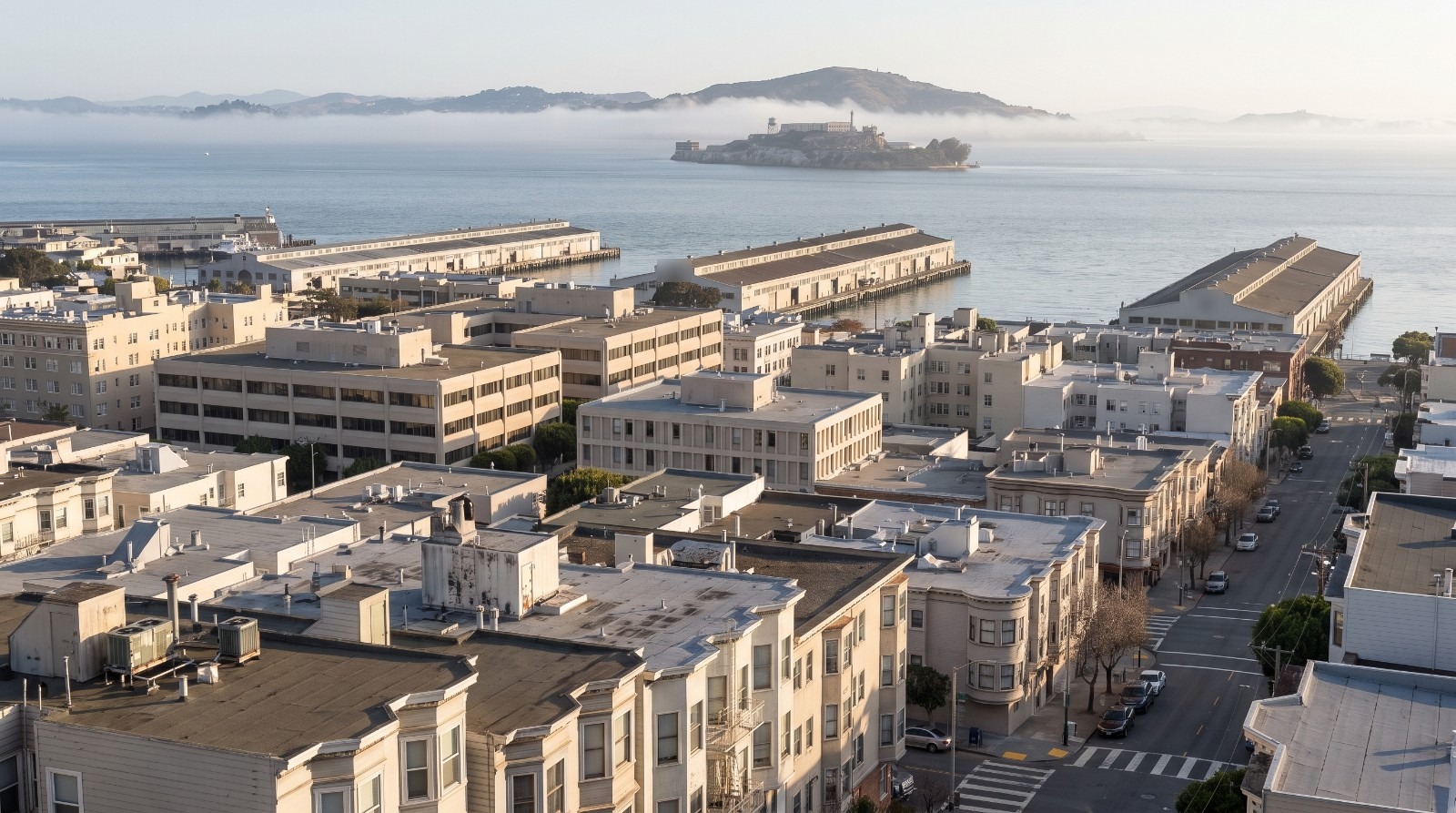
Low-rise office blocks of San Francisco's North Waterfront below Russian Hill, where the 2300 Stockton office-to-housing conversion is planned. Photo: Houseberry
The lender on the troubled Fisherman's Wharf office conversion is the school that sold it. Stockton Development LLC, the entity tied to restaurateur and investor Tony Garnicki that bought 2300 Stockton Street from the Academy of Art University in May, has been served a notice of default on a $3.4 million seller-financed loan, according to The Real Deal, citing the San Francisco Business Times and county recorder filings. The balance had grown to about $3.6 million by the time of the notice.
The short answer on what it means: nothing is lost yet. A default notice starts a statutory clock of at least three months and 20 days before any foreclosure sale, and Garnicki says he is refinancing. But this building is one of only four office-to-housing conversions San Francisco has seen filed in 2026, and the only one outside downtown. So it is worth reading the paperwork closely.
What a notice of default actually starts
A notice of default is a recorded warning with a legal timer on it, not a foreclosure. Most California commercial loans are secured by a deed of trust, which lets the lender foreclose without going to court. The recorded notice is the first public step.
The clock, as the statute sets it:
- Notice of default recorded. Reported this month from filings with the San Francisco Assessor-Recorder.
- Three months, minimum. Civil Code 2924 bars a notice of sale until at least three months after the default is recorded.
- Twenty more days. The sale date itself can be no earlier than three months and 20 days after the default notice, which lands in early 2027 at the soonest.
- Cure window. Civil Code 2924c lets a borrower reinstate up to five business days before the sale.
Here is the wrinkle most coverage skips. This loan has already matured, per Garnicki's comments to the Business Times. On a matured note, the whole balance is due, so “reinstating” is really a payoff. Garnicki said the company is in refinancing talks with the seller and aims to pay the debt off in the coming weeks. If that happens, expect a rescission or reconveyance to show up in the same recorder's index.
I would also bet on patience from the lender. The Academy is trying to sell its buildings, not take them back. Foreclosing on a vacant office it just unloaded would put it right back where it started, holding a building it does not want.
The Stockton Street parcel the Academy promised to give up
2300 Stockton is a three-story, 1970 office building on the block between Beach and North Point Streets, half a block from Pier 39. The county's 2025 tax roll lists it as Block 0018, Lot 004, with 43,366 square feet of building on a 37,812-square-foot lot (0.87 acres) zoned C-2, under the address 2340 Stockton. The Academy used it for administrative and academic space.
That address shows up in one of the more colorful chapters of San Francisco land-use history. In December 2016, then-City Attorney Dennis Herrera announced a settlement valued at $60 million with the Academy, which by then controlled about 40 properties. The city said at least 33 had zoning, permit or code violations, and that 160 rent-controlled and affordable units had been turned into student housing. Among the terms: the Academy had to withdraw its requests to legalize use at a set of outlying properties, and 2340 Stockton Street is named on that list.
In other words, the city told the Academy a decade ago this building did not fit its campus. Now it is on track to become housing. That is a better ending than most land-use fights get.
The sale is part of a broader exit. In October 2025 the school put 11 properties totaling about 375,000 square feet on the market for roughly $130 million. It has since sold the church at 2151 Van Ness Avenue for $4.7 million and 2300 Stockton, which went for $18.3 million, about 12 percent over its $16.4 million ask. Undergraduate enrollment is around 4,200, SFist reported, with many students taking classes remotely.
The math on an $18.3 million conversion
The price looked strong in May. It looks thinner with a default attached. The county's 2025 roll assessed the parcel at about $11.9 million, $7.47 million for land and $4.43 million for the building. The sale cleared that by 54 percent.
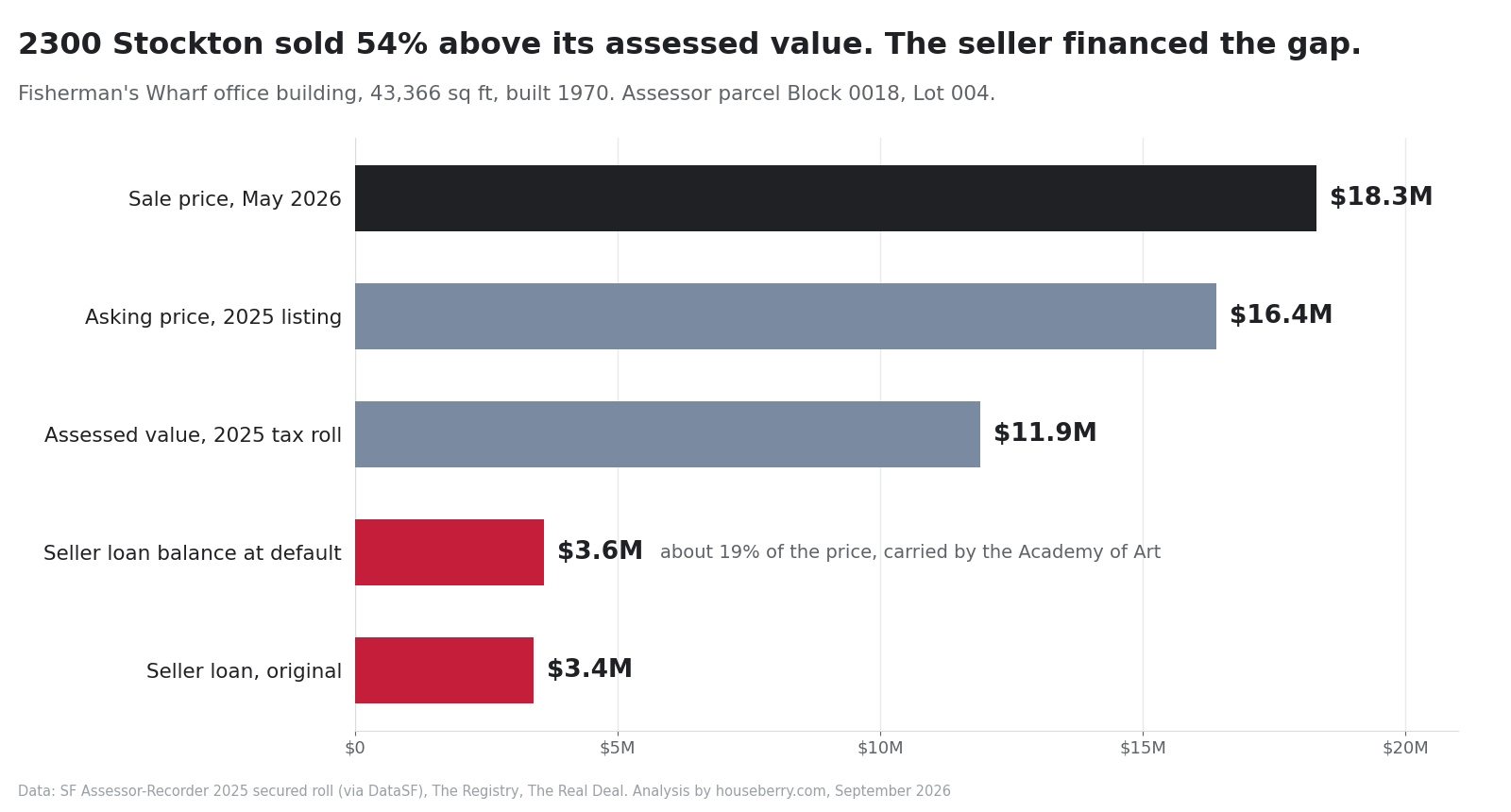
A few numbers worth sitting with:
- About $422 per square foot for the existing building, before a dollar of construction.
- About $261,000 per planned home for the building alone, across 70 units.
- Roughly $75,000 to $80,000 a year in added property tax once the parcel is reassessed at the sale price, our estimate at San Francisco's roughly 1.2 percent rate, on a building earning no rent while it is vacant.
For context, the developers of 150 Hayes told Axios that conversions can deliver apartments for $500,000 to $600,000 a unit, against roughly $1 million for new construction. At 2300 Stockton, nearly half of that budget is spent at closing. The plan to add two floors, taking floor area from about 62,300 to 90,160 square feet by the filing's own count per the preliminary filing, is what makes the unit count work, and new floors are construction, not remodel.
Where San Francisco's conversion incentives stop
San Francisco's conversion toolkit mostly covers downtown, and 2300 Stockton sits at the edge of it. Here is how the pieces line up for this site.
The Downtown Adaptive Reuse Program applies in C-3 districts and in C-2 districts east of Franklin and 13th Streets and north of Townsend. The parcel is C-2 and well east of Franklin, so on paper it qualifies for the program's code relief and the March 2025 inclusionary and impact fee waivers. We have not seen a project file confirming which path the developer is using.
Proposition C, passed in March 2024 with 52.8 percent of the vote, waives the transfer tax on the first sale after a commercial-to-residential conversion. It is capped at 5 million square feet and requires approval before January 1, 2030.
The biggest incentive is the Downtown Revitalization Financing District, signed this February. It hands back new property tax growth for up to 30 years, worth 10 to 20 percent of development costs by the Chronicle's accounting. It covers the Financial District, Union Square, SoMa and the Market Street corridor. The Wharf is not in it.
That gap matters. The one incentive that puts real cash into the capital stack stops short of this project. Meanwhile the Family Zoning Plan, the upzoning whose new height limits took effect January 31, 2026, supplies the extra height that makes the two added floors legal. The city has given this site permission. It has not given it money.
Four filings, 322 homes, zero finished
San Francisco's office-to-housing pipeline is real but tiny. The Chronicle reported in February that the city had no completed office conversions in four years, despite about 30 million square feet of vacant office space. This is what has been filed since.
| Project | Area | Planned homes | Status, Sept 2026 |
|---|---|---|---|
| 901 Market St | Market Street at Fifth | 136 | Filed July 2026 |
| 150 Hayes St | Civic Center | 104 | Filed 2026 |
| 2300 Stockton St | Fisherman's Wharf | 70 | Preliminary plans Dec 2025, notice of default Sept 2026 |
| 575 Sutter St | Union Square | 12 | Filed July 2026 |
Add it up and you get 322 homes in four buildings. The city estimates about 50 downtown buildings are good candidates, worth roughly 4,400 homes, per the mayor's office. The SF Standard points to an earlier conversion, Emerald Fund's 418 apartments at 100 Van Ness as the model, and notes the Humboldt Building conversion died last year when financing fell through.
We covered two of the others when they filed, the 136 homes planned at 901 Market and the 12-unit conversion at 575 Sutter near Union Square. 2300 Stockton is the first of the new wave to hit a financing wall in public. One default does not sink a program. But the Humboldt Building shows how quickly a stalled conversion can become a dead one.
Why the Wharf needs residents more than downtown does
Fisherman's Wharf is a district built for visitors, and 70 households would change its math more than 136 would on Market Street. Ripley's Believe It or Not, open on Jefferson Street since 1967, will close before the end of 2026. The Port's Fisherman's Wharf Forward plan is building a public plaza on Taylor Street at the old Alioto's site and an overlook on Al Scoma Way. Those help tourists. Year-round neighbors are what fill a grocery aisle on a foggy Tuesday in February.
The neighborhoods uphill are solid, not flashy. On our San Francisco rankings, Russian Hill, the cable car slopes west of Columbus Avenue, scores 3.6 out of 5 and ranks 44th of 92, with a 4.3 safety score. North Beach, the Washington Square and Columbus Avenue core just south of the site, scores 3.5 and ranks 48th. Telegraph Hill, around Coit Tower to the east, scores 3.6 with a 4.2 for amenities. The North Waterfront trails at 3.3, 60th of 92.
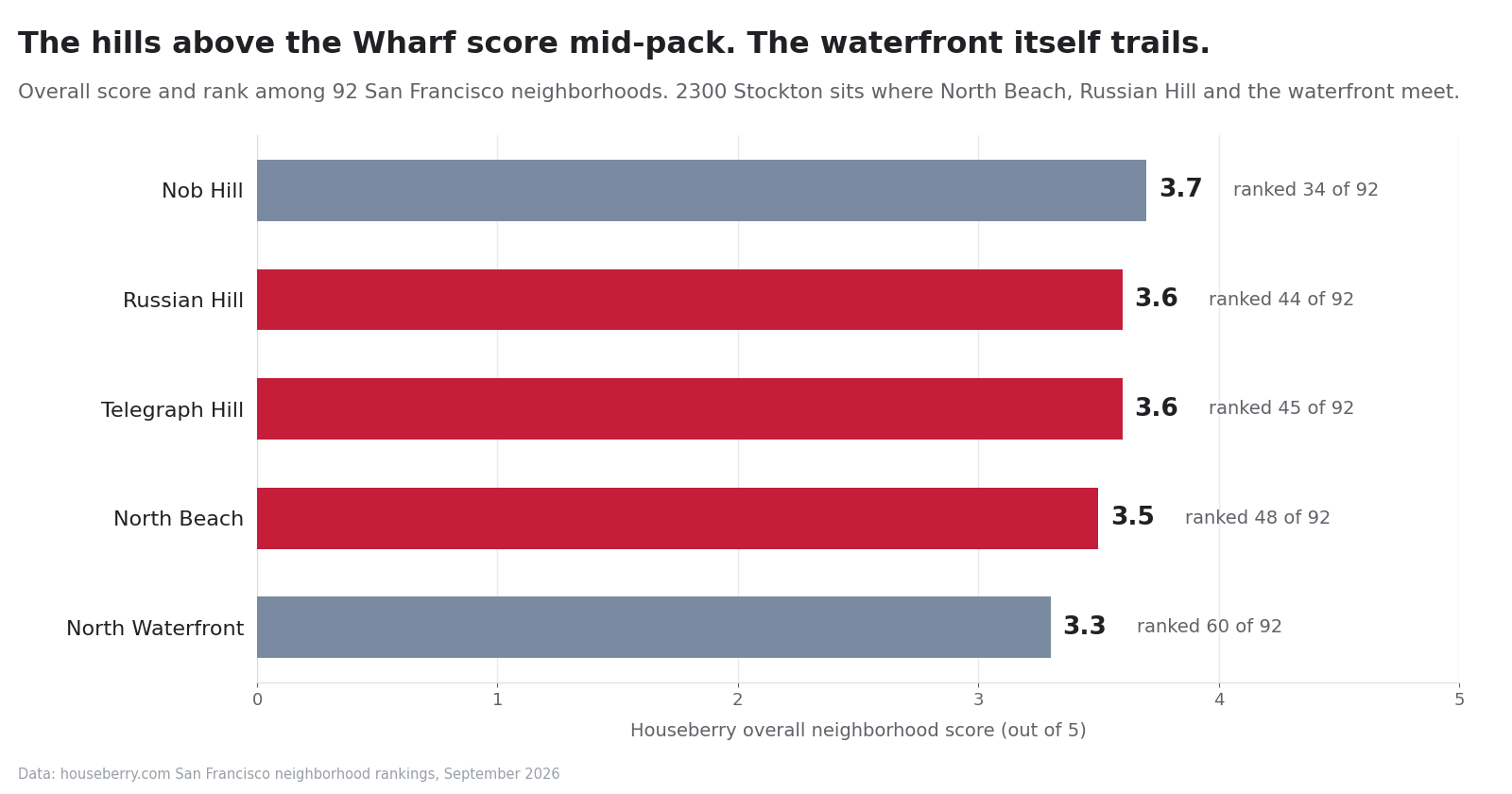
On price, Russian Hill's median was about $1.84 million in August 2026 on our price history, below the $2.2 million San Francisco citywide median. New rentals a few blocks down the hill would give people another way into that part of town without competing for a Russian Hill flat.
The honest downside: a Wharf apartment is a harder product than a Union Square one. Streets are crowded with visitors in summer and quiet in winter, daily retail is thin, and the nearest cable car turnaround at Taylor and Bay is a tourist line first. If rents here come in soft, the $261,000-a-home basis gets harder to carry. That is a real risk to the project, not a reason to skip it.
The next filings that decide 2300 Stockton
Three documents will tell us where this goes, and all of them are public. First, a rescission or reconveyance at the recorder would mean the seller loan was paid or restructured. Second, a formal project application at Planning would show whether the developer is using the adaptive reuse program and its fee waivers. Third, if neither shows up, a notice of trustee's sale could be recorded no earlier than about three months after the default notice.
My hope is the boring outcome. The Academy extends the note, the refinance closes, and 70 homes get built a few blocks from the Powell-Mason turnaround. We will update this post when any of those filings land. And if you are weighing the blocks between North Beach and the water in the meantime, our San Francisco neighborhood rankings are a good place to start comparing them.
Sources
The Real Deal, “Tony Garnicki affiliate hit with default notice for Fisherman’s Wharf offices,” September 23, 2026 (citing the San Francisco Business Times)
The Real Deal, “Academy of Art University continues SF real estate slimdown with $18M trade,” May 12, 2026
The Real Deal, Academy of Art $130 million portfolio listing, October 22, 2025, and 2151 Van Ness church sale, April 28, 2026
The Registry, Academy of Art sells 2300 Stockton for $18.3 million, May 2026
SF YIMBY, “Office-to-Housing Conversion Proposed For 2300 Stockton Street,” December 2025
San Francisco City Attorney, “Herrera secures landmark settlement valued at $60 million from Academy of Art University,” December 19, 2016
SFist, Academy of Art portfolio sale, October 21, 2025
San Francisco Assessor-Recorder, 2025 secured property tax roll, Block 0018 Lot 004, via DataSF
California Civil Code sections 2924 and 2924c
SF Planning, Downtown Adaptive Reuse Program
Ballotpedia, San Francisco Proposition C (March 2024)
SF.gov, Mayor Lurie signs Downtown Revitalization Financing District legislation, February 2026
Planetizen summarizing the San Francisco Chronicle, “Zero office conversions in four years,” February 2026
SF Standard, 150 Hayes office conversion, August 10, 2026
Axios San Francisco, office conversion incentives, July 13, 2026
CBS News Bay Area, Ripley’s Believe It or Not closure, September 2026
Port of San Francisco, Fisherman’s Wharf Forward concepts, September 3, 2025
Houseberry, San Francisco neighborhood rankings, neighborhood pages and city price history, retrieved September 23, 2026
Map of San Francisco Neighborhoods
Loading map...
View Full Map
Top Neighborhoods in San Francisco, CA


All information provided on this website including but not limited to - school ratings, safety, amenities, user opinions, and property data - is for general informational purposes only. We do not guarantee its reliability, accuracy, or completeness. Users should independently verify information and consult appropriate professionals as needed. By using this website, you agree Houseberry is not responsible for actions, decisions, or consequences arising from reliance on the information provided
houseberry.com - CA DRE# 01847391
 Bay East ©2025. CCAR ©2025. bridgeMLS ©2025. Information Deemed Reliable But Not Guaranteed. This information is being provided by the Bay East MLS, or CCAR MLS, or bridgeMLS. The listings presented here may or may not be listed by the Broker/Agent operating this website. This information is intended for the personal use of consumers and may not be used for any purpose other than to identify prospective properties consumers may be interested in purchasing. Data last updated at September 25, 2026 12:00 AM